> ## Documentation Index
> Fetch the complete documentation index at: https://solana.com/llms.txt
> Use this file to discover all available pages before exploring further.
> ## Agent Instructions
> This page is part of the Solana developer documentation at https://solana.com/developers/docs. Append `.md` to any docs URL, or send `Accept: text/markdown`, to get the page as Markdown.
> Index of all pages: https://solana.com/llms.txt. Per-section indexes such as https://solana.com/developers/docs/payments/llms.txt are smaller; prefer them when working on one task.
> Coding agents: install the official Solana skill for current APIs and conventions with `npx skills add https://github.com/solana-foundation/solana-dev-skill` (also served at https://solana.com/SKILL.md).
> Code in the cookbook and task pages comes from tested example files. Prefer it over writing API calls from memory.
# Program-derived addresses (PDAs)
> Program-derived addresses (PDAs) are deterministic addresses derived from seeds and a program ID. They have no private key; only that program can sign for them.
## In short
A PDA is an address derived from a program plus some seeds. It has no private key, so only that program can sign for it, which makes it handy for storing app state at predictable addresses.
You've used this in: [Trade settlement Step 1](/developers/docs/defi/settle-trade/try-it)
A program-derived address (PDA) is a 32-byte address derived from a program ID
and a set of seeds. It's guaranteed to be off the Ed25519 curve, so no private
key exists for it. Only the program that derived it can "sign" for it, through
[`invoke_signed`](/developers/docs/core/cpi) in a cross-program invocation (CPI).
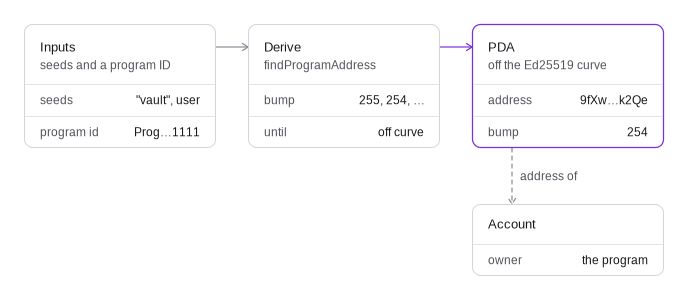
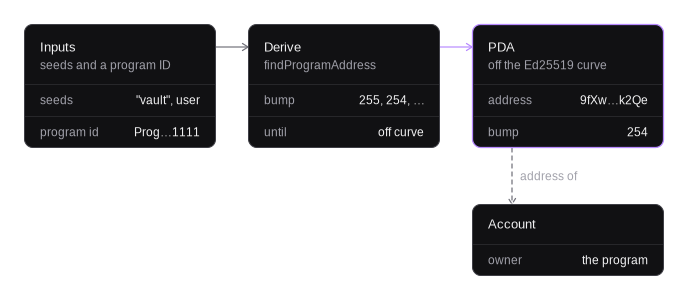
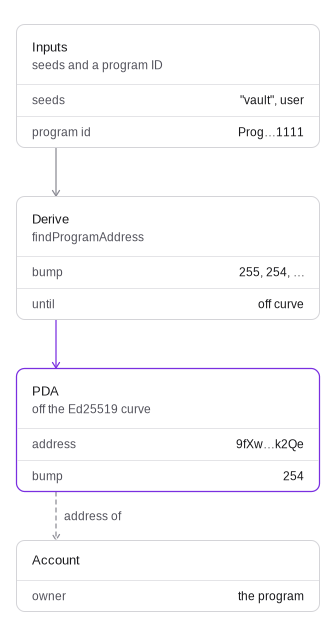
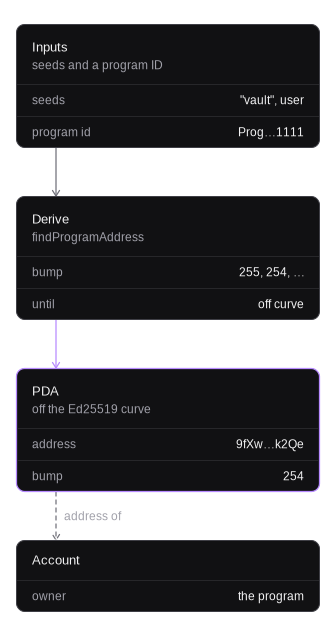 The derivation algorithm and canonical bump, with examples for different
seed types.
Creating accounts at PDAs and signing for them, with Anchor patterns.
## Key facts
- **Deterministic**: The same seeds and program ID always produce the same
address.
- **Off-curve**: If the hash lands on the Ed25519 curve, derivation fails and
the next bump seed is tried.
- Derive or verify every PDA inside the program. Don't trust an address
because the caller passed it in the right position.
- Use the canonical bump, stored at creation. Never take a bump from
instruction data.
- Use fixed-length seeds or separators so two seed sets can't produce the
same address.
- Put the user, pool, or mint in the seeds of any PDA that signs for funds.
See [PDA Derivation](/developers/docs/core/pda/pda-derivation) for each rule in
detail.
## When to use PDAs
- **Program signing**: Only the owning program can sign via `invoke_signed`,
enabling programs to act as autonomous authorities.
- **User-scoped state**: Derive per-user accounts from user pubkey seeds (e.g.,
`["user", user_pubkey]`).
- **No keypair management**: No private key to store or lose.
## Limits
| Limit | Value | Source |
| -------------------------------------- | -------------------------------- | ---------------------------------------------------------------------------------------------------------------------------- |
| Max seeds | 16, including the bump (15 of your own) | [`MAX_SEEDS`](https://github.com/anza-xyz/solana-sdk/blob/clock%40v2.2.3/pubkey/src/lib.rs#L47) |
| Max seed length | 32 bytes maximum per seed | [`MAX_SEED_LEN`](https://github.com/anza-xyz/solana-sdk/blob/clock%40v2.2.3/pubkey/src/lib.rs#L45) |
| Bump range | 0-255 (1 byte) | Appended as the final seed element |
| `create_program_address` cost | 1,500 CUs | [`create_program_address_units`](https://github.com/anza-xyz/agave/blob/v3.1.8/program-runtime/src/execution_budget.rs#L200) |
| `find_program_address` worst-case cost | 1,500 entry + 1,500 x iterations | 1,500 on entry + 1,500 per failed bump |
| Max PDA signers per CPI | 16 | [`MAX_SIGNERS`](https://github.com/anza-xyz/agave/blob/v3.1.8/program-runtime/src/cpi.rs#L62) |