> ## Documentation Index
> Fetch the complete documentation index at: https://solana.com/llms.txt
> Use this file to discover all available pages before exploring further.
> ## Agent Instructions
> This page is part of the Solana developer documentation at https://solana.com/developers/docs. Append `.md` to any docs URL, or send `Accept: text/markdown`, to get the page as Markdown.
> Index of all pages: https://solana.com/llms.txt. Per-section indexes such as https://solana.com/developers/docs/payments/llms.txt are smaller; prefer them when working on one task.
> Coding agents: install the official Solana skill for current APIs and conventions with `npx skills add https://github.com/solana-foundation/solana-dev-skill` (also served at https://solana.com/SKILL.md).
> Code in the cookbook and task pages comes from tested example files. Prefer it over writing API calls from memory.
# Private payments
> Compare Confidential Balances, Solana Privacy Rings, and Private Channels: what each keeps private, who can audit it, and which tokens it supports.
A standard Solana payment is public: once it is confirmed, anyone can look up
the amount, the sender, and recipient accounts, and their balances. Three
solutions keep parts of a payment private. They differ in what they hide, who
can audit it, and which tokens they work with.
**Decide what has to stay private**
"Private" means something different in each solution. Before you choose,
decide which parts of a payment must be hidden (the amount, balances, the
sender and recipient, or business data such as memos) and who still needs to
see them, such as an auditor or the issuer.
## Compare the three solutions
Confidential Balances and the Default Ring of Solana Privacy Rings are available
on mainnet; Custom Rings are in security audit. Private Channels is coming, but
is not yet ready for production.
| Solution | Amount and balances | Sender and recipient | Audit access | Tokens | Availability |
| --------------------- | ---------------------------------------- | ------------------------------------------------------ | ---------------------------------------------------------------------- | ------------------------------------------------------------------ | ---------------------------------------------------- |
| Confidential Balances | Encrypted | Public | Optional auditor key on the mint decrypts transfer amounts | Token-2022 mints that enabled the extension when they were created | Available on mainnet |
| Solana Privacy Rings | Asset and amount private | Public in the Default Ring, private in anonymous Rings | Custom Rings can give an auditor visibility; the Default Ring has none | SOL, SPL tokens, and Token-2022 tokens | Default Ring on mainnet; Custom Rings in audit |
| Private Channels | Hidden from outside observers | Hidden from outside observers | The institution controls who participates, what rules apply and how data is accessed | SPL tokens the channel admin allows | Coming soon: audited; on devnet |
For trades rather than payments, see
[Confidential settlement](/developers/docs/defi/confidential-settlement).
## Confidential Balances
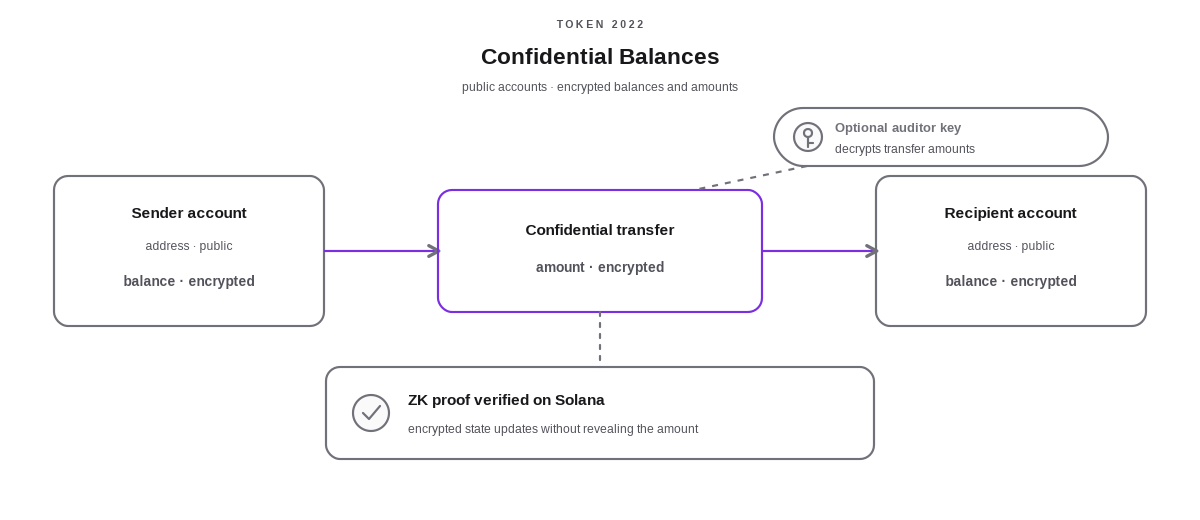
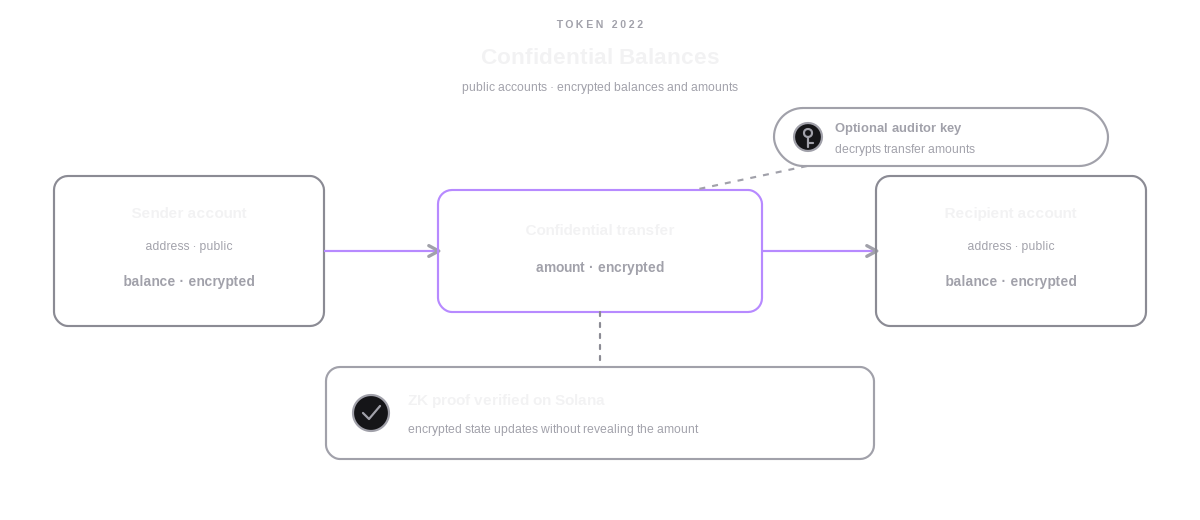
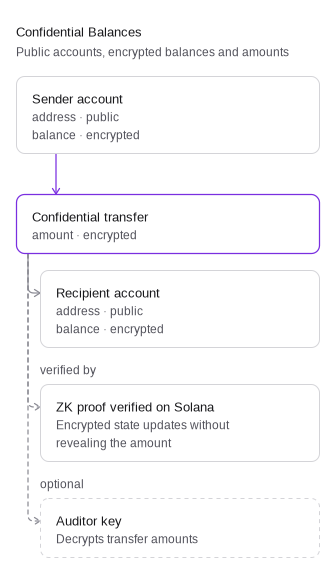
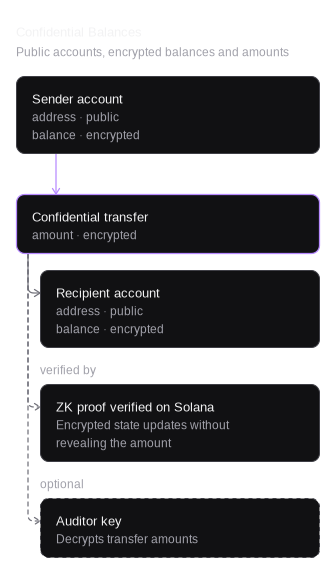 Confidential Balances is a Token-2022 extension that encrypts token balances and
transfer amounts. Payments still move between ordinary, public token accounts.
- **Private in a payment:** the transfer amount and the encrypted balances of
both accounts.
- **Public in a payment:** the mint, the token accounts, their owners, and the
fact that the sender paid the recipient. This is confidentiality from public
observers, not anonymity. Memos and other instruction data are not encrypted.
- **Moving in and out:** deposits from an account's public balance into its
confidential balance, and withdrawals back out, carry their amounts in the
clear.
- **Audit model:** the mint can set an optional auditor ElGamal key. The holder
of the auditor secret key can decrypt every transfer amount for that mint, but
not an account's full balance, and the key gives no authority to move tokens.
- **Sending and receiving:** both accounts must be configured for confidential
transfers. The sender's client generates zero-knowledge proofs, which the ZK
ElGamal Proof Program verifies on Solana, and the recipient applies its
pending balance before it can spend what it received.
### Which tokens support it
The extension must be set up when the mint is created and cannot be added to an
existing mint. A token on the original SPL Token program has no extensions, so
it cannot use Confidential Balances.
Major stablecoin mints on mainnet at the time of writing (October 2026):
| Stablecoin | Mint | Token program | Confidential Balances |
| ---------- | ---------------------------------------------- | ------------- | ------------------------------------------------------ |
| USDC | `EPjFWdd5AufqSSqeM2qN1xzybapC8G4wEGGkZwyTDt1v` | SPL Token | Not supported |
| USDT | `Es9vMFrzaCERmJfrF4H2FYD4KCoNkY11McCe8BenwNYB` | SPL Token | Not supported |
| PYUSD | `2b1kV6DkPAnxd5ixfnxCpjxmKwqjjaYmCZfHsFu24GXo` | Token-2022 | Extension enabled, manual approval, no auditor key set |
| USDG | `2u1tszSeqZ3qBWF3uNGPFc8TzMk2tdiwknnRMWGWjGWH` | Token-2022 | Extension enabled, manual approval, no auditor key set |
The PYUSD and USDG mints also carry the permanent delegate extension and the
transfer fee extension, with the fee set to 0%.
With manual approval, an account can make confidential transfers only after the
mint's Confidential Balances authority approves it, so whether you can pay in
PYUSD or USDG confidentially depends on the issuer approving your accounts.
### Set up confidential payments
If you issue the token your payments use:
1. **Enable it when you create the mint.** Add the Confidential Balances
extension at creation; it can't be added later. See
[create a confidential mint](/developers/docs/tokens/extensions/confidential-transfer/issuer-guide#create-a-confidential-mint),
or the
[Enable confidentiality (optional)](/developers/docs/assets/issue-asset/local#enable-confidentiality-optional)
step of the Issue an asset tutorial.
2. **Approve accounts.** With a manual approve policy, approve each account
after your own checks, such as KYC, before it can pay confidentially. See
[approve accounts](/developers/docs/tokens/extensions/confidential-transfer/issuer-guide#approve-accounts-manual-policy).
3. **Set an auditor key.** Give an auditor, such as your compliance team or a
regulator, the ability to decrypt transfer amounts. See
[configure an auditor](/developers/docs/tokens/extensions/confidential-transfer/issuer-guide#configure-an-auditor).
4. **Support it in your payment flow.** Configure the payer's and recipient's
token accounts, apply pending balances when payments arrive, and show both
public and confidential balances. See the
[integration guide](/developers/docs/tokens/extensions/confidential-transfer/integration-guide).
[Learn how Confidential Balances works](/developers/docs/tokens/extensions/confidential-transfer).
## Solana Privacy Rings
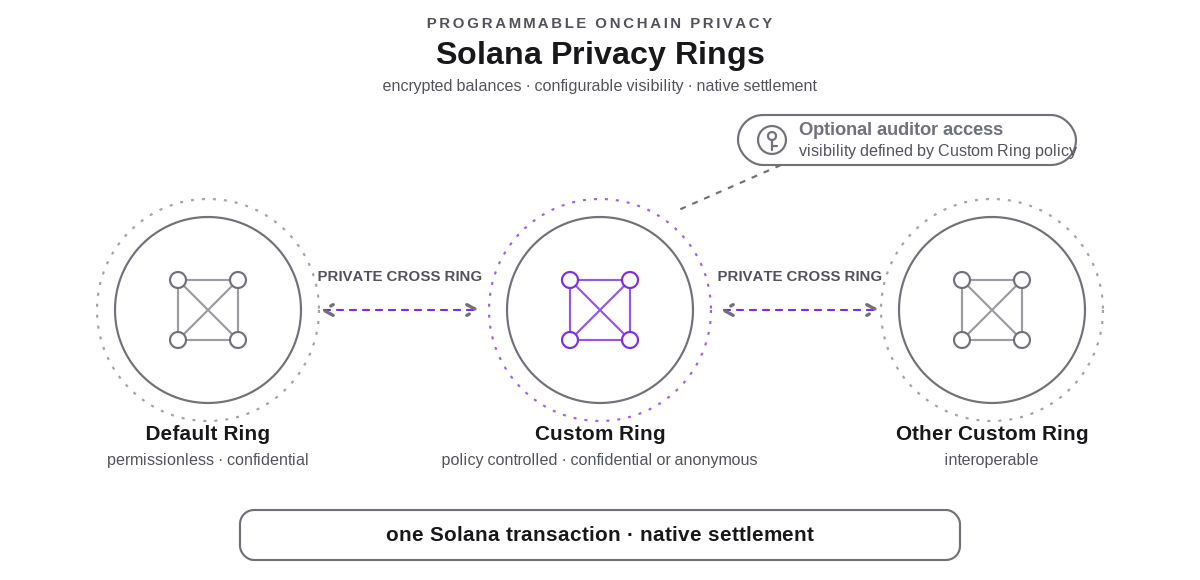
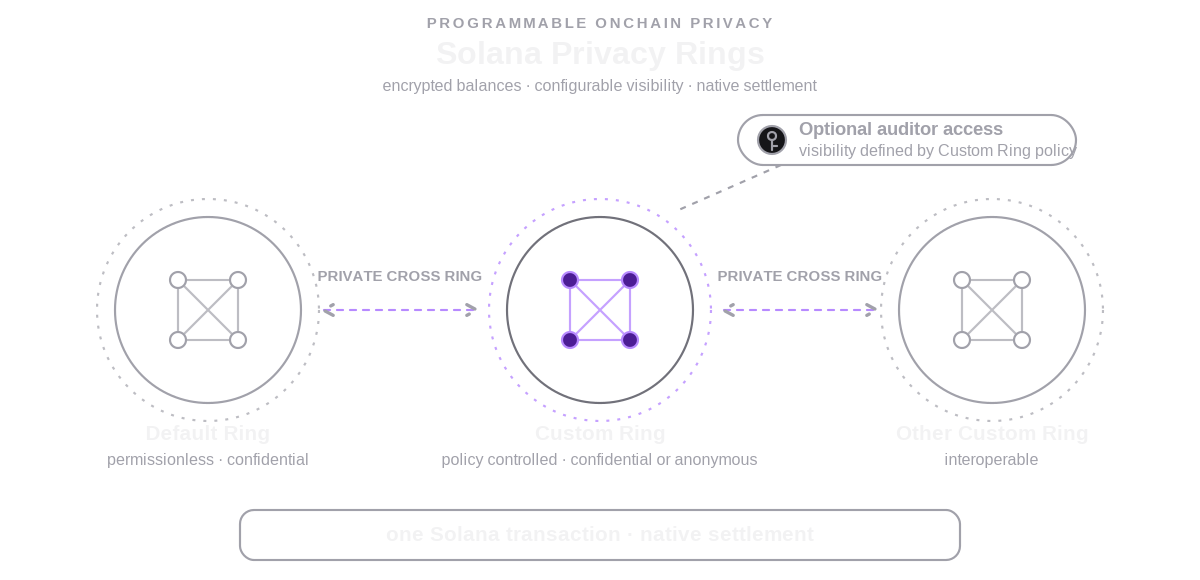
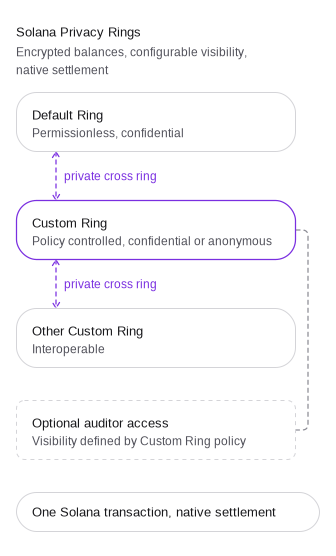
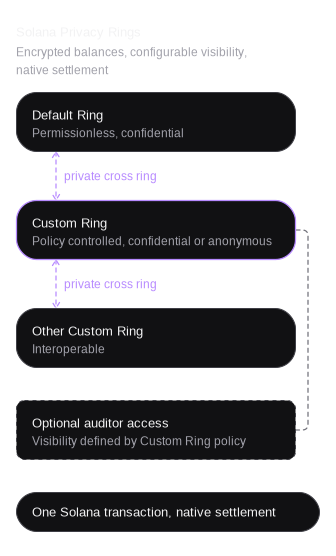 Solana Privacy Rings, documented by Helius as **Solana Rings**, provide
encrypted onchain balances and private transfers. Helius launched the
permissionless Default Ring on Solana mainnet on November 10, 2026. Custom Rings
are in security audit and not yet on mainnet; Helius targets a mainnet release
in Q4 2026. According to Helius's documentation:
- **Default Ring:** permissionless and confidential. The asset and amount of a
payment are private, and the sender and recipient are public.
- **Custom Rings:** Solana programs with configurable policy, compliance
controls, and auditor visibility. A Custom Ring can be confidential (asset
and amount private) or anonymous (asset, amount, sender, and recipient
hidden).
- **Programmable privacy:** private escrow in Solana programs, for swaps,
staking, yield, and other uses.
- **Native execution:** private transfers execute on Solana itself, with no
sequencer or sidechain. Balances are self-custodial, each private transfer
settles in one Solana transaction, and transfers can move between Rings
under the source Ring's policy.
Certora, OtterSec, and zkSecurity audited the core programs and ZK circuits, and
Helius expects formal verification of the Default Ring to finish by the end of
2026. Helius's [security page](https://www.helius.dev/docs/privacy/security)
has the published audit reports and the trusted setup records.
[Read the Solana Privacy Rings documentation](https://www.helius.dev/docs/privacy/)
or [try the Helius demo](https://helius.dev/privacy/demo), which runs on devnet.
## Private Channels
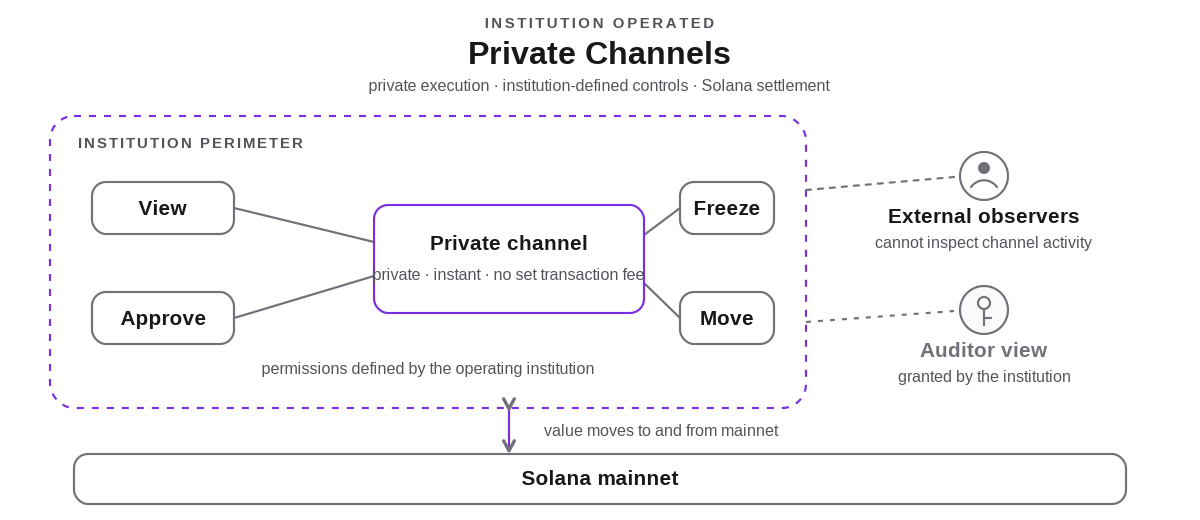
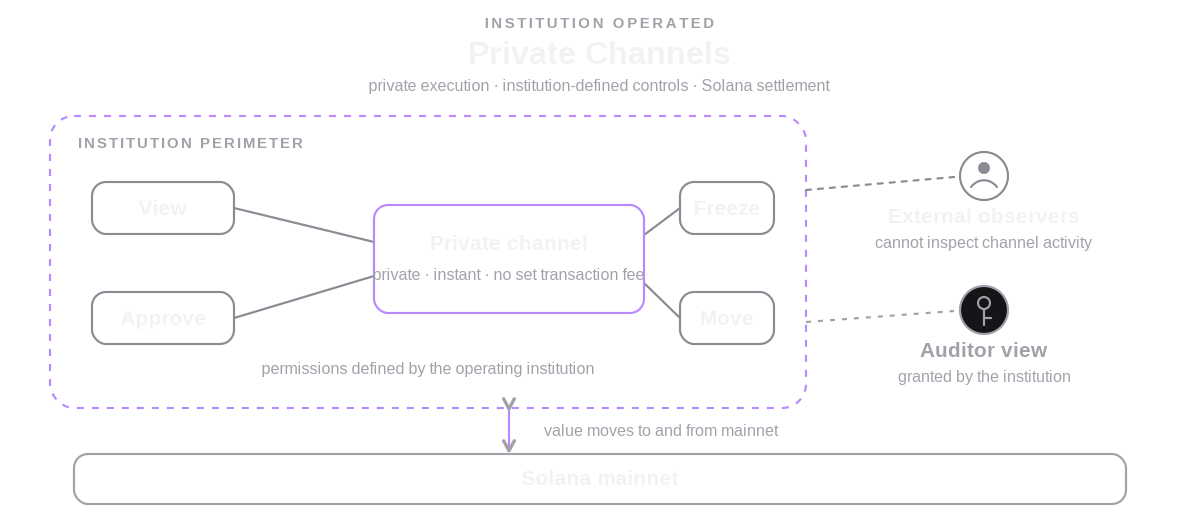
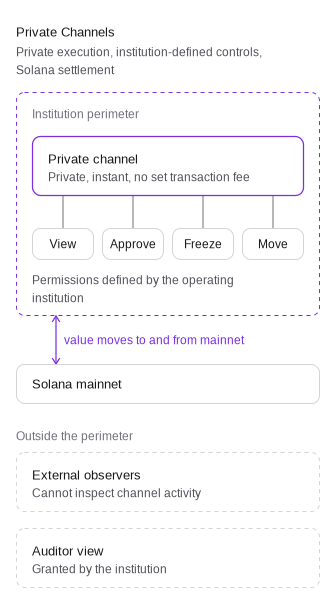
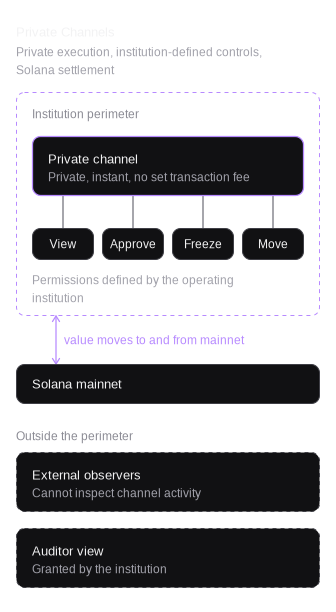 Coming soon. Private Channels is private payment infrastructure that an
institution runs: users deposit tokens into an escrow program on mainnet, pay
each other inside the channel, and withdraw back to mainnet. Payments inside the
channel are not recorded on mainnet, so outside observers can't see them. The
institution controls who participates, what rules apply, and how data is
accessed. OtterSec and Cantina have audited it, but the Private Channels docs
target the devnet program, which predates many of the audit fixes. Have the
commit you deploy reviewed before you use it with real funds.
[Explore Private Channels](/developers/docs/tools/private-channels) or
[view the product page](https://launch.solana.com/products/private-channels).