> ## Documentation Index
> Fetch the complete documentation index at: https://solana.com/llms.txt
> Use this file to discover all available pages before exploring further.
> ## Agent Instructions
> This page is part of the Solana developer documentation at https://solana.com/developers/docs. Append `.md` to any docs URL, or send `Accept: text/markdown`, to get the page as Markdown.
> Index of all pages: https://solana.com/llms.txt. Per-section indexes such as https://solana.com/developers/docs/payments/llms.txt are smaller; prefer them when working on one task.
> Coding agents: install the official Solana skill for current APIs and conventions with `npx skills add https://github.com/solana-foundation/solana-dev-skill` (also served at https://solana.com/SKILL.md).
> Code in the cookbook and task pages comes from tested example files. Prefer it over writing API calls from memory.
# Cross-program invocation
> Cross-program invocation (CPI): how Solana programs call other programs with invoke and invoke_signed, and how PDAs sign.
## In short
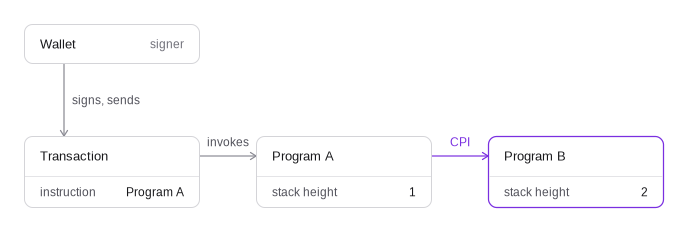
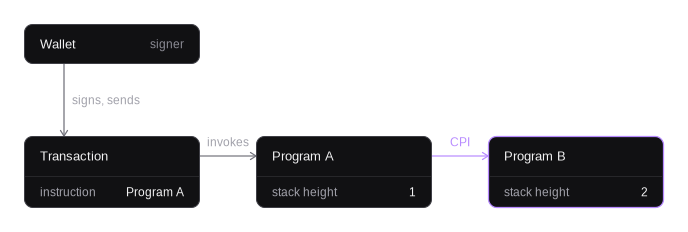
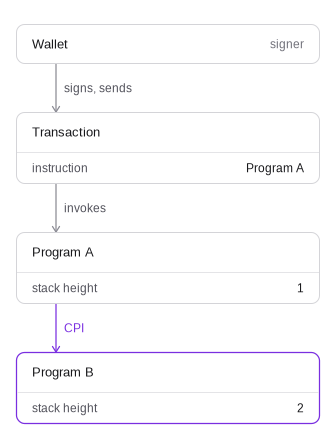
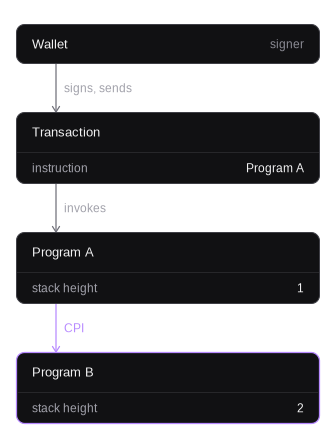
A cross-program call (CPI) is one program calling another inside the same transaction, the way your program would call the Token program to move tokens.
You've used this in: [Trade settlement Step 2](/developers/docs/defi/settle-trade/browser)
A cross-program invocation (CPI) is one [program](/developers/docs/core/programs)
calling an [instruction](/developers/docs/core/instructions) on another while it runs.
Any program can call any other program's instructions.
 `invoke` and Anchor's CpiContext, with SOL transfer examples.
`invoke_signed` with signer seeds, in Anchor and native Rust.
The 11-step execution flow, privilege rules, and reentrancy.
CPI costs, account data synchronization, and return data.
## Key facts
- **Privilege extension**: Account privileges (signer, writable) extend from
caller to callee. A callee cannot escalate privileges
beyond what the caller passed.
- **Shared compute budget**: A callee's CU consumption reduces the caller's
remaining budget.
- **Reentrancy**: Direct self-recursion is allowed (A->A->A). Indirect
reentrancy is not (A->B->A returns `ReentrancyNotAllowed`).
The program you CPI into is an account the caller passes in. If your
program invokes whatever account sits in the `token_program` position, an
attacker can pass their own program. It receives every account and
privilege you forward, can return success without doing the work, and can
use your users' signatures. Check the program ID before invoking:
```rust title="Native Rust"
if token_program.key != &spl_token::ID {
return Err(ProgramError::IncorrectProgramId);
}
```
In Anchor, `Program<'info, Token>` checks the ID for one program, and
`Interface<'info, TokenInterface>` accepts either the Token Program or the
Token Extensions Program. Instruction builders such as
`system_instruction::transfer` hard-code the program ID, which is safe as
long as you don't overwrite it.
Signer and writable privileges pass from caller to callee for the duration
of the CPI. Passing a user's signer account into a program you don't
control gives that program the user's signature for anything it does
during the call, including CPIs of its own. Forward signer accounts only
to programs you trust, and only the accounts that instruction needs.
## Limits
| Limit | Value | Source |
| -------------------------------- | --------------------------------------------------------------------- | --------------------------------------------------------------------------------------------------------------------------------------------------------------------------------------------------------------------------------------------------------------- |
| Max instruction stack depth | 5 (9 with [SIMD-0268](https://solana.com/upgrades/cpi-nesting-depth)) | [`MAX_INSTRUCTION_STACK_DEPTH`](https://github.com/anza-xyz/agave/blob/v3.1.8/program-runtime/src/execution_budget.rs#L8), [`MAX_INSTRUCTION_STACK_DEPTH_SIMD_0268`](https://github.com/anza-xyz/agave/blob/v3.1.8/program-runtime/src/execution_budget.rs#L10) |
| CPI invocation cost | 946 CUs (1,000 before SIMD-0339) | [`DEFAULT_INVOCATION_COST`](https://github.com/anza-xyz/agave/blob/v3.1.8/program-runtime/src/execution_budget.rs#L21), [`INVOKE_UNITS_COST_SIMD_0339`](https://github.com/anza-xyz/agave/blob/v3.1.8/program-runtime/src/execution_budget.rs#L23) |
| Max PDA signers per CPI | 16 | [`MAX_SIGNERS`](https://github.com/anza-xyz/agave/blob/v3.1.8/program-runtime/src/cpi.rs#L62) |
| Max CPI instruction data | 10 KiB (10,240 bytes) | [`MAX_INSTRUCTION_DATA_LEN`](https://github.com/anza-xyz/agave/blob/v3.1.8/transaction-context/src/lib.rs#L33) |
| Max return data | 1,024 bytes | [`MAX_RETURN_DATA`](https://github.com/anza-xyz/solana-sdk/blob/clock%40v2.2.3/cpi/src/lib.rs#L329) |
| Max CPI account infos | 255 (128 before SIMD-0339) | [`MAX_CPI_ACCOUNT_INFOS`](https://github.com/anza-xyz/agave/blob/v3.1.8/program-runtime/src/cpi.rs#L122), [`MAX_CPI_ACCOUNT_INFOS_SIMD_0339`](https://github.com/anza-xyz/agave/blob/v3.1.8/program-runtime/src/cpi.rs#L124) |
| CPI serialization cost | 1 CU per 250 bytes | [`cpi_bytes_per_unit`](https://github.com/anza-xyz/agave/blob/v3.1.8/program-runtime/src/execution_budget.rs#L205) |
| Max account data realloc per CPI | 10,240 bytes (10 KiB) | [`MAX_PERMITTED_DATA_INCREASE`](https://github.com/anza-xyz/solana-sdk/blob/clock%40v2.2.3/account-info/src/lib.rs#L17) |
## `invoke` vs `invoke_signed`
| Function | Use case | PDA signing |
| --------------- | ---------------------------------------------------------------------------- | --------------------- |
| `invoke` | CPIs where all required signers have already signed the original transaction | No |
| `invoke_signed` | CPIs where the calling program needs to sign on behalf of a PDA it owns | Yes, via signer seeds |
`invoke` is `invoke_signed` with an empty signer seeds array. Both use the same
syscall
([`sol_invoke_signed_rust`](https://github.com/anza-xyz/agave/blob/v3.1.8/syscalls/src/cpi.rs#L11-L33))
and runtime path
([`cpi_common`](https://github.com/anza-xyz/agave/blob/v3.1.8/program-runtime/src/cpi.rs#L802-L925)).
When seeds are provided, the runtime derives the PDA addresses and adds them to
the valid signers before checking privileges.