> ## Documentation Index
> Fetch the complete documentation index at: https://solana.com/llms.txt
> Use this file to discover all available pages before exploring further.
> ## Agent Instructions
> This page is part of the Solana developer documentation at https://solana.com/developers/docs. Append `.md` to any docs URL, or send `Accept: text/markdown`, to get the page as Markdown.
> Index of all pages: https://solana.com/llms.txt. Per-section indexes such as https://solana.com/developers/docs/payments/llms.txt are smaller; prefer them when working on one task.
> Coding agents: install the official Solana skill for current APIs and conventions with `npx skills add https://github.com/solana-foundation/solana-dev-skill` (also served at https://solana.com/SKILL.md).
> Code in the cookbook and task pages comes from tested example files. Prefer it over writing API calls from memory.
# PDA Derivation
> How Solana PDAs are derived using SHA-256 with seeds, bump values, and a program ID. Derivation algorithm, canonical bump search, compute costs, and SDK examples in TypeScript and Rust.
**Summary**
PDAs are derived by hashing seeds + program ID + bump via SHA-256 until the
result is off the Ed25519 curve. The canonical bump is the first value that
produces an off-curve address. Max 16 seeds including the bump (15 of your
own), Max 32 bytes per seed.
## Background
Solana
[`Keypair`](https://github.com/anza-xyz/solana-sdk/blob/clock%40v2.2.3/keypair/src/lib.rs#L26)
values are points on the [Ed25519 curve](https://ed25519.cr.yp.to/). A keypair
consists of a public key (used as the account address) and a secret key (used to
produce signatures). Anyone with the secret key can sign transactions for that
address.
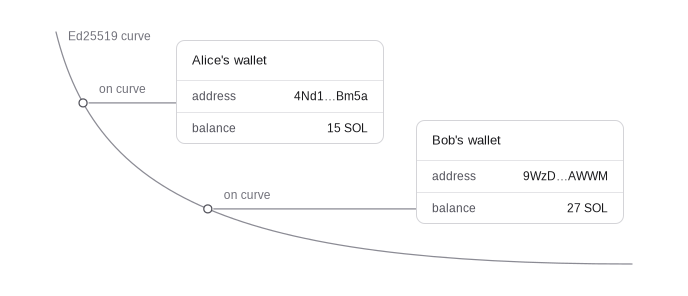
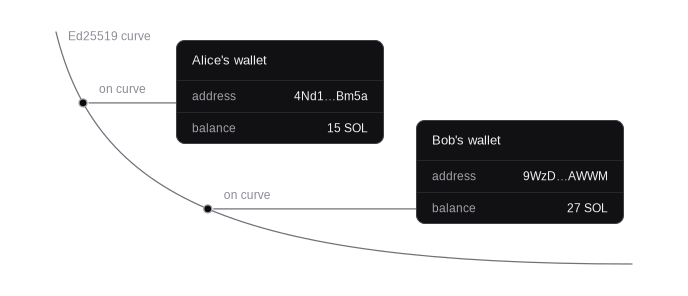
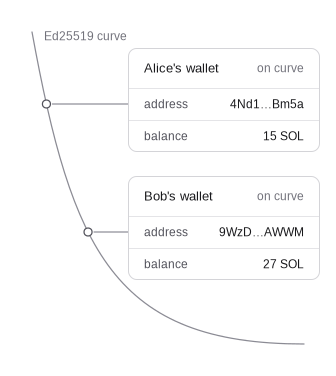
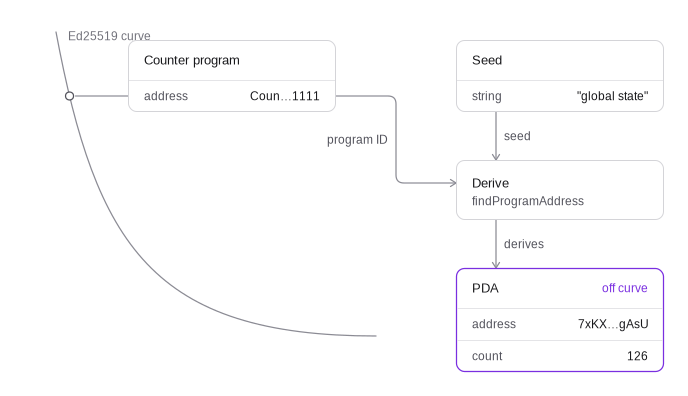
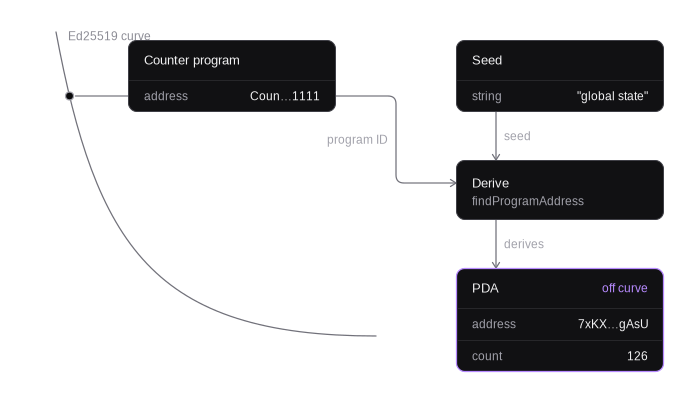
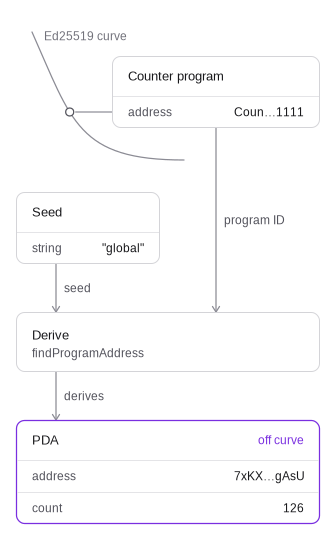
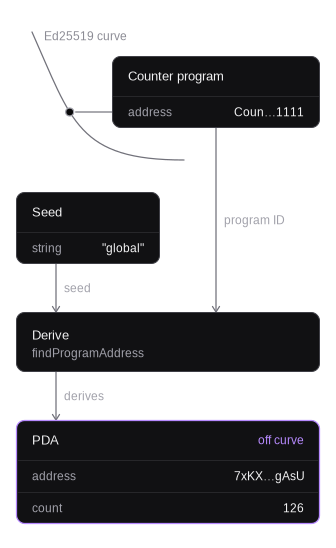
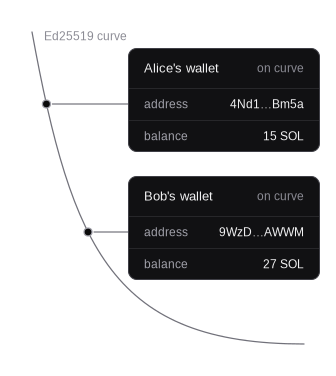 A PDA is intentionally derived to fall _off_ the Ed25519 curve. Because it is
not a valid curve point, no secret key exists, and no external party can produce
a signature. Only the deriving program can authorize operations on the PDA
through `invoke_signed`.
 ### PDA vs keypair accounts
| Property | Keypair account | PDA account |
| --------------------- | --------------------------------------------- | ------------------------------------- |
| Address type | On Ed25519 curve | Off Ed25519 curve |
| Has private key | Yes | No |
| Can sign transactions | Yes (with private key) | No |
| Can sign during CPI | No (unless signature included in transaction) | Yes (via `invoke_signed`) |
| Derivation | Generate Ed25519 keypair | Deterministic from seeds + program ID |
| Typical use | User wallets, Program ID | Program-owned data accounts |
## Optional Seeds
The optional seeds are user-defined byte strings that serve as inputs to the PDA
derivation. They create unique, deterministic addresses scoped to a program. For
example, using `["user", user_pubkey]` as seeds derives a different PDA for each
user.
Seeds must follow these constraints:
- Maximum 16 seeds per derivation (`MAX_SEEDS`), including the bump seed, so
`find_program_address` takes at most 15 seeds of your own
- Maximum 32 bytes per seed (`MAX_SEED_LEN`)
## Bump Seed
The bump seed is a single byte (u8) appended to the optional seeds during
derivation.
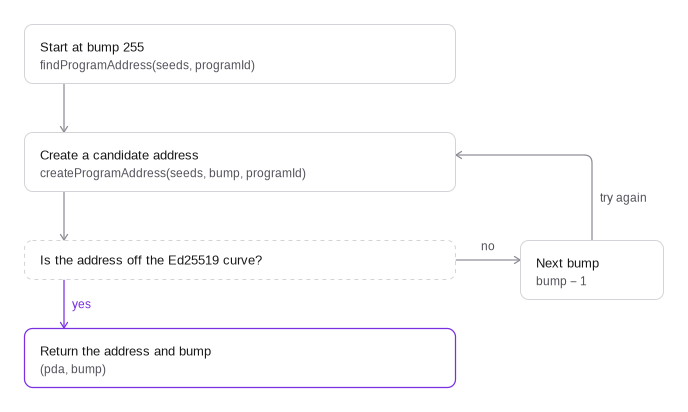
[`find_program_address`](https://github.com/anza-xyz/solana-sdk/blob/clock%40v2.2.3/pubkey/src/lib.rs#L800)
searches from 255 down to 1, calling `create_program_address` with each
value until the result falls off the Ed25519 curve. The first value that
succeeds is the **canonical bump**.
Programs should always use the canonical bump to ensure a unique, deterministic
mapping from seeds to address.
Most seed sets have several valid bumps, and each one derives a different
address. If your program accepts a bump from the caller, an attacker can
pass a non-canonical bump and get your program to accept a second account
for the same seeds.
Find the canonical bump with `find_program_address` when the account is
created, store it in the account, and verify against the stored value
afterwards. In Anchor, `seeds = [...], bump` finds the canonical bump on
`init`, and `bump = account.bump` checks the stored one on later
instructions. Don't take the bump from instruction data.
 ## Derivation Algorithm
The PDA derivation is implemented in the SDK's
[`create_program_address`](https://github.com/anza-xyz/solana-sdk/blob/clock%40v2.2.3/pubkey/src/lib.rs#L911)
function. The algorithm works as follows:
1. Validate that the number of seeds does not exceed `MAX_SEEDS` (16) and no
individual seed exceeds `MAX_SEED_LEN` (32 bytes). If either check fails,
return `PubkeyError::MaxSeedLengthExceeded`.
2. SHA-256 hash all seeds, the program ID, and the string
`"ProgramDerivedAddress"` together to produce a 32-byte result.
3. Check if the result is a valid point on the Ed25519 curve.
4. If the result IS on the curve, return `PubkeyError::InvalidSeeds` (the
address would have a corresponding private key, which violates the PDA
security property).
5. If the result is NOT on the curve, return it as the PDA.
## Compute Unit Costs
The
[onchain syscall](https://github.com/anza-xyz/agave/blob/v3.1.8/syscalls/src/lib.rs#L798-L834)
for `create_program_address` charges
[1,500 CUs](https://github.com/anza-xyz/agave/blob/v3.1.8/program-runtime/src/execution_budget.rs#L200)
per call.
The
[`try_find_program_address` syscall](https://github.com/anza-xyz/agave/blob/v3.1.8/syscalls/src/lib.rs#L836-L886)
charges 1,500 CUs on entry (before the loop), then an additional 1,500 CUs for
each failed bump attempt within the loop.
## Common Seed Patterns
Seeds are application-specific. Common patterns include:
| Pattern | Seeds | Use case |
| -------------------- | ------------------------------------------------- | ---------------------------------- |
| Global singleton | `["global"]` | Single program-wide config account |
| Per-user account | `["user", user_pubkey]` | One account per user per program |
| Per-user-per-entity | `["vault", user_pubkey, mint_pubkey]` | Token vaults, per-user-per-token |
| Counter / sequential | `["order", user_pubkey, &order_id.to_le_bytes()]` | Sequential records per user |
Seeds are concatenated before hashing, so `["ab", "cd"]` and `["abcd"]`
produce the same PDA. Use fixed-length seeds or a separator to avoid
collisions. For example, `["ab", "-", "cd"]` is unambiguous. Fixed-length
values such as public keys and `to_le_bytes()` integers are not affected.
A PDA that signs for funds should include the user, pool, or mint it
controls in its seeds. When one global PDA (`["authority"]`) is the
authority over every user's token account, a single missing check that lets
a caller choose the destination or the account to sign for can drain all of
them. Per-entity seeds such as `["vault", user_pubkey, mint_pubkey]` limit
what one signature can reach.
## Examples: Derive a PDA
Deriving a PDA computes an address only. It does not create an onchain account
at that address. The account must be explicitly created through a separate
instruction (typically `create_account` via CPI).
The Solana SDKs provide functions for PDA derivation. Each function takes:
- **Program ID**: The address of the program used to derive the PDA. This
program can sign on behalf of the PDA.
- **Optional seeds**: Predefined inputs such as strings, numbers, or other
account addresses.
| SDK | Function |
| -------------------------------------- | --------------------------------------------------------------------------------------------------------------------------------- |
| `@solana/kit` (TypeScript) | [`getProgramDerivedAddress`](https://github.com/anza-xyz/kit/blob/v2.1.0/packages/addresses/src/program-derived-address.ts#L157) |
| `@solana/web3.js` v3 (TypeScript) | [`PublicKey.findProgramAddress`](https://github.com/solana-foundation/solana-web3.js/blob/main/packages/web3.js/src/publickey.ts) |
| `@solana/web3.js` (legacy, TypeScript) | [`findProgramAddressSync`](https://github.com/solana-foundation/solana-web3.js/blob/v1.98.0/src/publickey.ts#L212) |
| `solana_sdk` (Rust) | [`find_program_address`](https://github.com/anza-xyz/solana-sdk/blob/clock%40v2.2.3/pubkey/src/lib.rs#L800) |
The examples below derive a PDA using the Solana SDKs. Click **▷ Run** to
execute the code.
### Derive a PDA with a string seed
The example below derives a PDA using a program ID and an optional string seed.
The Rust tabs on this page use the 2.x Solana crates. Install the
dependencies with (tested with Rust 1.89 and 1.98):
```bash
cargo add anyhow solana-sdk@2
cargo add tokio --features full
```
```ts Kit focus={4}
import { Address, getProgramDerivedAddress } from "@solana/kit";
const programAddress = "11111111111111111111111111111111" as Address;
const seeds = ["helloWorld"];
const [pda, bump] = await getProgramDerivedAddress({
programAddress,
seeds
});
console.log(`PDA: ${pda}`);
console.log(`Bump: ${bump}`);
```
```ts title="Web3.js v3" focus={4}
import { PublicKey } from "@solana/web3.js";
const programAddress = new PublicKey("11111111111111111111111111111111");
const seeds = [Buffer.from("helloWorld")];
const [pda, bump] = await PublicKey.findProgramAddress(seeds, programAddress);
console.log(`PDA: ${pda}`);
console.log(`Bump: ${bump}`);
```
```rs Rust focus={7}
use solana_sdk::pubkey::Pubkey;
use std::str::FromStr;
#[tokio::main]
async fn main() -> anyhow::Result<()> {
let program_address = Pubkey::from_str("11111111111111111111111111111111")?;
let seeds: &[&[u8]] = &[b"helloWorld"];
let (pda, bump) = Pubkey::find_program_address(seeds, &program_address);
println!("PDA: {}", pda);
println!("Bump: {}", bump);
Ok(())
}
```
**`@solana/web3.js` 1.x is no longer actively maintained**
It receives critical fixes only. Use [Kit](/developers/docs/clients/official/javascript#solana-kit) for new code. To migrate existing code, follow the [Kit upgrade guide](https://www.solanakit.com/docs/upgrade-guide), or the [web3.js v3 migration guide](https://github.com/solana-foundation/solana-web3.js/blob/main/docs/web3js-v1-to-v3-migration.md) to keep the class-based API.
To run this code, install 1.x with `npm install @solana/web3.js@1`. A plain `npm install @solana/web3.js` installs v3, which this code doesn't run on.
```ts title="Web3.js (legacy)" focus={4}
import { PublicKey } from "@solana/web3.js";
const programAddress = new PublicKey("11111111111111111111111111111111");
const seeds = [Buffer.from("helloWorld")];
const [pda, bump] = PublicKey.findProgramAddressSync(seeds, programAddress);
console.log(`PDA: ${pda}`);
console.log(`Bump: ${bump}`);
```
### Derive a PDA with an address seed
The example below derives a PDA using a program ID and an optional address seed.
```ts Kit focus={8-11}
import {
Address,
getAddressEncoder,
getProgramDerivedAddress
} from "@solana/kit";
const programAddress = "11111111111111111111111111111111" as Address;
const addressEncoder = getAddressEncoder();
const optionalSeedAddress = addressEncoder.encode(
"B9Lf9z5BfNPT4d5KMeaBFx8x1G4CULZYR1jA2kmxRDka" as Address
);
const seeds = [optionalSeedAddress];
const [pda, bump] = await getProgramDerivedAddress({
programAddress,
seeds
});
console.log(`PDA: ${pda}`);
console.log(`Bump: ${bump}`);
```
```ts title="Web3.js v3" focus={5-7}
import { PublicKey } from "@solana/web3.js";
const programAddress = new PublicKey("11111111111111111111111111111111");
const optionalSeedAddress = new PublicKey(
"B9Lf9z5BfNPT4d5KMeaBFx8x1G4CULZYR1jA2kmxRDka"
);
const seeds = [optionalSeedAddress.toBytes()];
const [pda, bump] = await PublicKey.findProgramAddress(seeds, programAddress);
console.log(`PDA: ${pda}`);
console.log(`Bump: ${bump}`);
```
```rs Rust focus={7}
use solana_sdk::pubkey::Pubkey;
use std::str::FromStr;
#[tokio::main]
async fn main() -> anyhow::Result<()> {
let program_address = Pubkey::from_str("11111111111111111111111111111111")?;
let optional_seed_address = Pubkey::from_str("B9Lf9z5BfNPT4d5KMeaBFx8x1G4CULZYR1jA2kmxRDka")?;
let seeds: &[&[u8]] = &[optional_seed_address.as_ref()];
let (pda, bump) = Pubkey::find_program_address(seeds, &program_address);
println!("PDA: {}", pda);
println!("Bump: {}", bump);
Ok(())
}
```
**`@solana/web3.js` 1.x is no longer actively maintained**
It receives critical fixes only. Use [Kit](/developers/docs/clients/official/javascript#solana-kit) for new code. To migrate existing code, follow the [Kit upgrade guide](https://www.solanakit.com/docs/upgrade-guide), or the [web3.js v3 migration guide](https://github.com/solana-foundation/solana-web3.js/blob/main/docs/web3js-v1-to-v3-migration.md) to keep the class-based API.
To run this code, install 1.x with `npm install @solana/web3.js@1`. A plain `npm install @solana/web3.js` installs v3, which this code doesn't run on.
```ts title="Web3.js (legacy)" focus={5-7}
import { PublicKey } from "@solana/web3.js";
const programAddress = new PublicKey("11111111111111111111111111111111");
const optionalSeedAddress = new PublicKey(
"B9Lf9z5BfNPT4d5KMeaBFx8x1G4CULZYR1jA2kmxRDka"
);
const seeds = [optionalSeedAddress.toBuffer()];
const [pda, bump] = PublicKey.findProgramAddressSync(seeds, programAddress);
console.log(`PDA: ${pda}`);
console.log(`Bump: ${bump}`);
```
### Derive a PDA with multiple seeds
The example below derives a PDA using a program ID and multiple optional seeds.
```ts Kit focus={8-12}
import {
Address,
getAddressEncoder,
getProgramDerivedAddress
} from "@solana/kit";
const programAddress = "11111111111111111111111111111111" as Address;
const optionalSeedString = "helloWorld";
const addressEncoder = getAddressEncoder();
const optionalSeedAddress = addressEncoder.encode(
"B9Lf9z5BfNPT4d5KMeaBFx8x1G4CULZYR1jA2kmxRDka" as Address
);
const seeds = [optionalSeedString, optionalSeedAddress];
const [pda, bump] = await getProgramDerivedAddress({
programAddress,
seeds
});
console.log(`PDA: ${pda}`);
console.log(`Bump: ${bump}`);
```
```ts title="Web3.js v3" focus={4-7}
import { PublicKey } from "@solana/web3.js";
const programAddress = new PublicKey("11111111111111111111111111111111");
const optionalSeedString = "helloWorld";
const optionalSeedAddress = new PublicKey(
"B9Lf9z5BfNPT4d5KMeaBFx8x1G4CULZYR1jA2kmxRDka"
);
const seeds = [Buffer.from(optionalSeedString), optionalSeedAddress.toBytes()];
const [pda, bump] = await PublicKey.findProgramAddress(seeds, programAddress);
console.log(`PDA: ${pda}`);
console.log(`Bump: ${bump}`);
```
```rs Rust focus={7-8}
use solana_sdk::pubkey::Pubkey;
use std::str::FromStr;
#[tokio::main]
async fn main() -> anyhow::Result<()> {
let program_address = Pubkey::from_str("11111111111111111111111111111111")?;
let optional_seed_bytes = b"helloWorld";
let optional_seed_address = Pubkey::from_str("B9Lf9z5BfNPT4d5KMeaBFx8x1G4CULZYR1jA2kmxRDka")?;
let seeds: &[&[u8]] = &[optional_seed_bytes, optional_seed_address.as_ref()];
let (pda, bump) = Pubkey::find_program_address(seeds, &program_address);
println!("PDA: {}", pda);
println!("Bump: {}", bump);
Ok(())
}
```
**`@solana/web3.js` 1.x is no longer actively maintained**
It receives critical fixes only. Use [Kit](/developers/docs/clients/official/javascript#solana-kit) for new code. To migrate existing code, follow the [Kit upgrade guide](https://www.solanakit.com/docs/upgrade-guide), or the [web3.js v3 migration guide](https://github.com/solana-foundation/solana-web3.js/blob/main/docs/web3js-v1-to-v3-migration.md) to keep the class-based API.
To run this code, install 1.x with `npm install @solana/web3.js@1`. A plain `npm install @solana/web3.js` installs v3, which this code doesn't run on.
```ts title="Web3.js (legacy)" focus={4-7}
import { PublicKey } from "@solana/web3.js";
const programAddress = new PublicKey("11111111111111111111111111111111");
const optionalSeedString = "helloWorld";
const optionalSeedAddress = new PublicKey(
"B9Lf9z5BfNPT4d5KMeaBFx8x1G4CULZYR1jA2kmxRDka"
);
const seeds = [Buffer.from(optionalSeedString), optionalSeedAddress.toBuffer()];
const [pda, bump] = PublicKey.findProgramAddressSync(seeds, programAddress);
console.log(`PDA: ${pda}`);
console.log(`Bump: ${bump}`);
```
### Iterating All Possible Bumps
The following examples show PDA derivation using all possible bump seeds (255 to
0), illustrating how `find_program_address` returns the
[canonical bump](#bump-seed):
This is distinct from the current canonical search behavior documented for
`sol_try_find_program_address`, which iterates from 255 down to 1.
Kit example is not included because the
[`createProgramDerivedAddress`](https://github.com/anza-xyz/kit/blob/v2.1.0/packages/addresses/src/program-derived-address.ts#L101)
function isn't exported.
```ts title="Web3.js v3"
import { PublicKey } from "@solana/web3.js";
const programId = new PublicKey("11111111111111111111111111111111");
const optionalSeed = "helloWorld";
// Loop through all bump seeds (255 down to 0)
for (let bump = 255; bump >= 0; bump--) {
try {
const PDA = await PublicKey.createProgramAddress(
[Buffer.from(optionalSeed), Buffer.from([bump])],
programId
);
console.log("bump " + bump + ": " + PDA);
} catch (error) {
console.log("bump " + bump + ": " + error);
}
}
```
```rs Rust
use solana_sdk::pubkey::Pubkey;
use std::str::FromStr;
#[tokio::main]
async fn main() -> anyhow::Result<()> {
let program_id = Pubkey::from_str("11111111111111111111111111111111")?;
let optional_seed = b"helloWorld";
// Loop through all bump seeds (255 down to 0)
for bump in (0..=255).rev() {
match Pubkey::create_program_address(&[optional_seed.as_ref(), &[bump]], &program_id) {
Ok(pda) => println!("bump {}: {}", bump, pda),
Err(err) => println!("bump {}: {}", bump, err),
}
}
Ok(())
}
```
**`@solana/web3.js` 1.x is no longer actively maintained**
It receives critical fixes only. Use [Kit](/developers/docs/clients/official/javascript#solana-kit) for new code. To migrate existing code, follow the [Kit upgrade guide](https://www.solanakit.com/docs/upgrade-guide), or the [web3.js v3 migration guide](https://github.com/solana-foundation/solana-web3.js/blob/main/docs/web3js-v1-to-v3-migration.md) to keep the class-based API.
To run this code, install 1.x with `npm install @solana/web3.js@1`. A plain `npm install @solana/web3.js` installs v3, which this code doesn't run on.
```ts title="Web3.js (legacy)"
import { PublicKey } from "@solana/web3.js";
const programId = new PublicKey("11111111111111111111111111111111");
const optionalSeed = "helloWorld";
// Loop through all bump seeds (255 down to 0)
for (let bump = 255; bump >= 0; bump--) {
try {
const PDA = PublicKey.createProgramAddressSync(
[Buffer.from(optionalSeed), Buffer.from([bump])],
programId
);
console.log("bump " + bump + ": " + PDA);
} catch (error) {
console.log("bump " + bump + ": " + error);
}
}
```
```sh title="Expected TS Output (Web3.js v3)"
bump 255: SolanaError: Invalid seeds; point must fall off the Ed25519 curve.
bump 254: 46GZzzetjCURsdFPb7rcnspbEMnCBXe9kpjrsZAkKb6X
bump 253: GBNWBGxKmdcd7JrMnBdZke9Fumj9sir4rpbruwEGmR4y
bump 252: THfBMgduMonjaNsCisKa7Qz2cBoG1VCUYHyso7UXYHH
bump 251: EuRrNqJAofo7y3Jy6MGvF7eZAYegqYTwH2dnLCwDDGdP
bump 250: SolanaError: Invalid seeds; point must fall off the Ed25519 curve.
...
// remaining bump outputs
```
```sh title="Expected TS Output (legacy web3.js 1.x)"
bump 255: Error: Invalid seeds, address must fall off the curve
bump 254: 46GZzzetjCURsdFPb7rcnspbEMnCBXe9kpjrsZAkKb6X
bump 253: GBNWBGxKmdcd7JrMnBdZke9Fumj9sir4rpbruwEGmR4y
bump 252: THfBMgduMonjaNsCisKa7Qz2cBoG1VCUYHyso7UXYHH
bump 251: EuRrNqJAofo7y3Jy6MGvF7eZAYegqYTwH2dnLCwDDGdP
bump 250: Error: Invalid seeds, address must fall off the curve
...
// remaining bump outputs
```
```sh title="Expected Rust Output"
bump 255: Provided seeds do not result in a valid address
bump 254: 46GZzzetjCURsdFPb7rcnspbEMnCBXe9kpjrsZAkKb6X
bump 253: GBNWBGxKmdcd7JrMnBdZke9Fumj9sir4rpbruwEGmR4y
bump 252: THfBMgduMonjaNsCisKa7Qz2cBoG1VCUYHyso7UXYHH
bump 251: EuRrNqJAofo7y3Jy6MGvF7eZAYegqYTwH2dnLCwDDGdP
bump 250: Provided seeds do not result in a valid address
...
// remaining bump outputs
```
In this example, bump 255 produces an on-curve address and fails. The first
valid bump is 254, making it the canonical bump.