- Choosing a blockchain for your DePIN
- What to use blockchain for in a DePIN
- Minting and managing a token
- Staking
- Rewards Distribution
- Proof of Contribution
- Storage
- Logging onchain demand
- Governance
- Migrations
- Examples & reference code
Choosing a blockchain for your DePIN (and why you should choose Solana)
There are many reasons to build on Solana, including the deep DeFi ecosystem, the opportunity to collaborate with large DePIN projects, and the community of early adopters and deployers. Below, we focus at a high level on some of the technical tradeoffs builders should consider when building a DePIN and reasons to build on Solana from a technical perspective:- Scalability, combined with market access: Solana’s architecture processes thousands of transactions per second–all on a single global state. Solana is unique in its ability to offer best in class scalability, combined with broad access to internet capital markets. Solana’s DeFi ecosystem is second to none, simplifying access to the world’s biggest internet capital markets.
- Affordability: Solana average transaction costs are ~.00025SOL, enabling microtransactions that are unfeasible on many other chains. Compression technologies like merkelization, cNFTs, and zk proofs also offer opportunities for further cost reduction.
- Ready-made-tooling: Solana offers SDKs, oracles (like Pyth), and
frameworks for DeFi and NFTs, to accelerate development cycles.
- Development framework: Anchor framework provides type safety, IDL integration, and standardized program architecture, reducing boilerplate code by ~40%.
- Existing protocol integrations: Native interfaces for oracles (Pyth, Switchboard), cross-chain messaging (Wormhole), and identity verification (Solana Attestation Service) reduce integration effort.
- Strong consumer UX: Solana has a range of consumer wallets, including Phantom, Solflare, and Backpack.
- Exchange Integration Pipeline: Rolling your own chain requires maintenance of custom node implementations for centralized exchange APIs (approximately 1-2 FTEs annually). This applies to DeFi protocols as well.
- Hardware Security Modules: Developing and maintaining signing applications for hardware wallets like Ledger (3-6 months of engineering work)
- Bridge integration: Proprietary integration with bridges like Wormhole, Chainlink, LayerZero, versus taking advantage of existing infrastructure. These bridges will often charge significant amounts for integration.
- Infra/research talent recruitment: Teams must manage and recruit their own talent to improve the core L1 experience.
- Explorers and analytics integrations
- Custodian and community infrastructure integration: Custody solutions and custodians typically have a long integration backlog and will charge for integrations.
- Existing DePIN community: It’s much easier to gain early adopters among existing DePIN holders, and the largest such community is already on Solana.
What to use blockchain for in a DePIN
In DePIN, blockchains are particularly good for rewards distribution. DePINs reward node operators for their contributions to the network. These rewards happen in discrete (often small) amounts, are distributed globally, and need to be linked directly to one’s contributions to the network. These are all good use cases for blockchain. DePIN Node operators provide a service that often requires additional computing resources. For example, a mapping company requires somewhere to store data collected through the process of map creation. Unless there’s a strong reason otherwise, this mapping data generally should not be stored on a blockchain–it’s expensive and a poor use of what blockchain is good at. Teams often believe that data collected through the servicing of a DePIN should be stored onchain for verifiability purposes (ie, in order to ensure the accuracy of the data and that it was collected without cheating, it must be stored onchain). There are almost always ways to ensure the verifiability of data without storing it all onchain. For example:- The data can be stored on a decentralized blockchain, unlike Solana, that specializes in data storage (such as Filecoin)
- You can utilize proofs to verify individual nodes’ contributions to the network
- Data can be saved onchain using a trusted oracle that allows for saving verifiable proofs of data onchain instead. Tools like Data Anchor from Termina can help with this process.
Minting and Managing a Token
Issuing rewards before token launch
TGEs (token generating events) are a business decision, and deciding whether, when, and how to conduct one is your team’s prerogative. Many DePIN projects launch without a live token, in order to make progress in their business before doing a TGE. These projects make their product available to beta users and identify another way (such as points) to track users’ contributions to the network, so they can reward them commensurately after tokens are launched. Teams that make this choice often cite the need to better understand the supply/demand dynamics and tackle major bugs in their project before going live.Token Minting
When minting a token on Solana, there are two token programs to choose from: the Token program or the Token22 program. There are tradeoffs to consider (discussed here). The recommended selection between the two options ultimately reduces to whether the features in the token extensions program would be of use to the application. For most developers, we recommend using the Token Program, unless your team is Solana native and has a deep understanding of the Token22 program, its tradeoffs, and a specific reason why Token22 would be useful to your application.Token Listing
In order to have your token appear in explorers, decentralized exchanges, and other ecosystem token lists, getting the token verified through Jupiter Verification is recommended.Modeling Token Distribution
For DePIN teams looking to optimize the way they allocate their token across various needs and stakeholders (rewards for participating / supplying network resources, private or public token sales etc.), tools like Forgd can be used to model out and refine token distribution strategies.Token Management
Most teams utilize DFNS, Fireblocks, Squads, or Utila for their onchain treasury management, and use features such as MPC, multi-sig, and time-based lockups. Squads allows for multi-sig setups for treasury wallets and governance, while DFNS, Fireblocks, and Utila use MPC. One option to manage internal token distributions and vesting is Pulley. For distributions at the protocol level (for example, distributing tokens to contributors), you might check out Magna. Squads can be used for free, while DFNS, Fireblocks, and Utila charge for enterprise licenses.Staking
DePINs can implement staking mechanisms for nodes in the underlying network. This enables the ability to introduce a higher set of staked nodes to participate in consensus protocol (see below) and/or utilize stake to coordinate work and rewards across devices, ensuring economic alignment in the network. Jito Network currently operates Solana’s largest stake pool and is building staking infrastructure to enable any DePIN to build custom proof of stake protocol. See Jito’s restaking documentation. For example, DAWN is using Jito Network’s staking infrastructure to build its proof of bandwidth protocol. In this construction, a set of staked “challenger” node operators are running ping tests on DAWN devices to measure backhaul metrics. This node operator set builds a log of accounts and backhaul metrics, performs an operation on the results to calculate rewards for each device, and submits a log containing claimants, metrics, and rewards to an onchain program to facilitate rewards distributions on Solana. Stake and/or rewards can be slashed or refunded based on results and post-consensus operations.Rewards Distribution
A critical decision in DePIN architecture design is how and how often to distribute your token. There are two major approaches to rewards distributions:- Claim based: Users have to claim their reward. This can be done in multiple ways, detailed further below.
- Push based: Rewards are directly sent to contributors. It’s the most expensive structure, due to the direct nature of the reward distribution.
Claim based distribution
Users have to claim their reward. This can be done in multiple ways:- Via an offchain oracle that signs messages that people can use to claim in combination with onchain accounts that save the already claimed rewards
- By co-signing claim transactions via an oracle
- Saving the whole data onchain and calculating the rewards on the demand
- Web2 backend where people authenticate and register with their wallet addresses and sending transactions from the backend on demand
Push based distribution
An alternative to having users proactively claim rewards is automating rewards distribution. On a regular basis, this “rewards crank” fetches rewards for an associated set of users by querying and constructing transactions to distribute rewards to the specified accounts. Merkle tree updates can be posted by the automated process, allowing for the reward distribution mechanism to remain permissionless.An alternative to Merkle Trees - ZK Compression
For networks that anticipate needing to distribute rewards to tens of thousands (or more) of nodes, participants, or contributors, a newer approach to rewards distribution is to use ZK compression. Instead of regular accounts, compressed accounts are generated for reward recipients, minimizing the state and rent costs associated with account creation. Implementing ZK compression is often cheaper in terms of storage costs. However, because it is a relatively new feature, the level of ecosystem support and tooling is not yet as extensive. See example code.Cost analysis
Let’s estimate the cost of distributing rewards using both the Merkle tree approach and the ZK compression option. We’ll consider transaction fees, rent costs, and storage costs. In both approaches, updating the rewards per claim period requires a single transaction by the application, so the cost difference is minimal, as it doesn’t scale per the number of users. Both strategies require one transaction per user to claim their rewards. ZK compression is more cost-effective in storage costs, due to the reduced storage requirements of compressed data. Here is a hypothetical cost analysis to compare the storage costs. If we assume a reward distribution to 10,000 users, with an average reward amount per user of 100 tokens, and the transaction fee on Solana to be 0.000005 SOL (5,000 lamports, the base fee for one signature), the 10,000 claim transactions plus one transaction to publish the rewards cost 10,001 * 5,000 lamports = 0.050005 SOL. Rent figures use the mainnet rate as of October 2026, 5,080 lamports (0.00000508 SOL) per byte; see rent: Storage Costs using a Merkle tree distribution strategy:- The Merkle tree requires storing the leaf nodes and the internal nodes
- Leaf Nodes: 10,000 * 32 bytes = 320,000 bytes
- Internal Nodes: (2^14 - 1) * 32 bytes = 524,256 bytes
- Total Storage Cost: (320,000 + 524,256) * 0.00000508 SOL/byte (one-time, refundable rent deposit) = 4.29 SOL
- Total Cost (Merkle Tree): 0.050005 SOL + 0.00007323 SOL + 4.29 SOL = 4.34 SOL
- Compressed Token Account: The compressed token account stores the compressed
reward data
- Compressed Data Size: Assuming a compression ratio of 50%, the total compressed data size would be approximately 500 KB
- Total Storage Cost: 500 * 1024 * 0.00000508 SOL/byte = 2.60 SOL
- Total Cost (ZK Compression): 0.050005 SOL + 0.00000223 SOL + 2.60 SOL = 2.65 SOL
- Saving the claimed amount in a normal Solana account state
- Saving authority, device pubkey, and claimed amount comes down to 72 bytes -> 0.001016 SOL in rent cost per account ((72 + 128) bytes * 5,080 lamports)
- Not scaling very well for big networks but has less complexity and the costs can be distributed to the users theoretically
| Number of Distributions | Merkle Tree Storage Cost (SOL) | ZK Compression Storage Cost (SOL) | No compression |
|---|---|---|---|
| 1,000 | 0.33 | 0.26 | 1.016 |
| 10,000 | 4.29 | 2.60 | 10.16 |
| 100,000 | 37.56 | 26.01 | 101.6 |
| 1,000,000 | 333.02 | 260.10 | 1016 |
| 5,000,000 | 2,176.45 | 1,300.48 | 5080 |
Proof of Contribution / Consensus
DePIN networks generally need a way to prove contributions from network participants. The application needs a method of verifying that participants have provided the resource in question honestly and consistently. As DePIN networks scale, proof of contributions are critical to ensuring the data or resource you’re providing are real, a necessary step for teams who want to scale to serve major companies or institutions. Reporting the contributions through Solana makes it possible to use the blockchain’s inherent security properties to enable the secure validation of the contribution. While almost all DePIN networks require proof-of-contribution in some form, the exact mechanism can vary significantly from protocol to protocol. A number of teams are building tooling to help DePIN projects develop their proof of contribution model (check out Helium’s Proof of Coverage design). In addition, DePINs can incrementally decentralize these offchain proof of contribution processes by introducing node operators that achieve consensus on contributions. Jito Network is building infrastructure to enable implementing custom consensus protocols (called node consensus networks) that decentralize proof of contribution models. E.g. a distributed set of staked node operators can participate in proof of coverage and achieve consensus on contributions to inform the correct distribution of rewards (and enforce economic penalties). (See “Staking” section above). For more information about Jito’s staking infrastructure, see their NCN documentation and the NCN program template, an example NCN built on Jito’s restaking programs.Storage
DePIN networks use a range of options for storage. Remember, it’s important to separate between your needs for what needs to happen onchain (primarily, rewards distribution), versus offchain (often, storage of data collected from running nodes, such as photos or video).Logging onchain demand
DePINs are two sided marketplaces. Supply is facilitated by your node operators, and reflecting supply onchain is a more straightforward process, since it’s demonstrable in the token rewards distributed to node operators. As your project grows, reflecting demand onchain is an important step to bring transparency and trust into your project and the blockchain infrastructure. There are many ways to reflect demand onchain. One method is through IO.net’s model of “Total Network Earnings” or TNE. TNE makes it simple for users to track:- Total network earnings over time
- Daily earnings trends
- Onchain transactions
Governance
DePIN protocols tend to follow a path of measured, gradual decentralization that shifts decision-making for the protocol to onchain governance by token holders over time. This could take the form of a social framework like a DAO or use liquid restaking. For examples, see Modular Governance by Helium or Network Governance by Hivemapper.Migrations
If you are a DePIN builder who has historically only been familiar with building on EVM: a number of large DePIN teams who began on EVM chains have successfully migrated to Solana (see Render, Geodnet, and Xnet, amongst others). There are specific resources to help developers make the transition from EVM to SVM. Bridge infrastructure like Wormhole’s NTT streamline the process of shifting your tokens to Solana. Read Render Network’s migration proposal, RNP-002.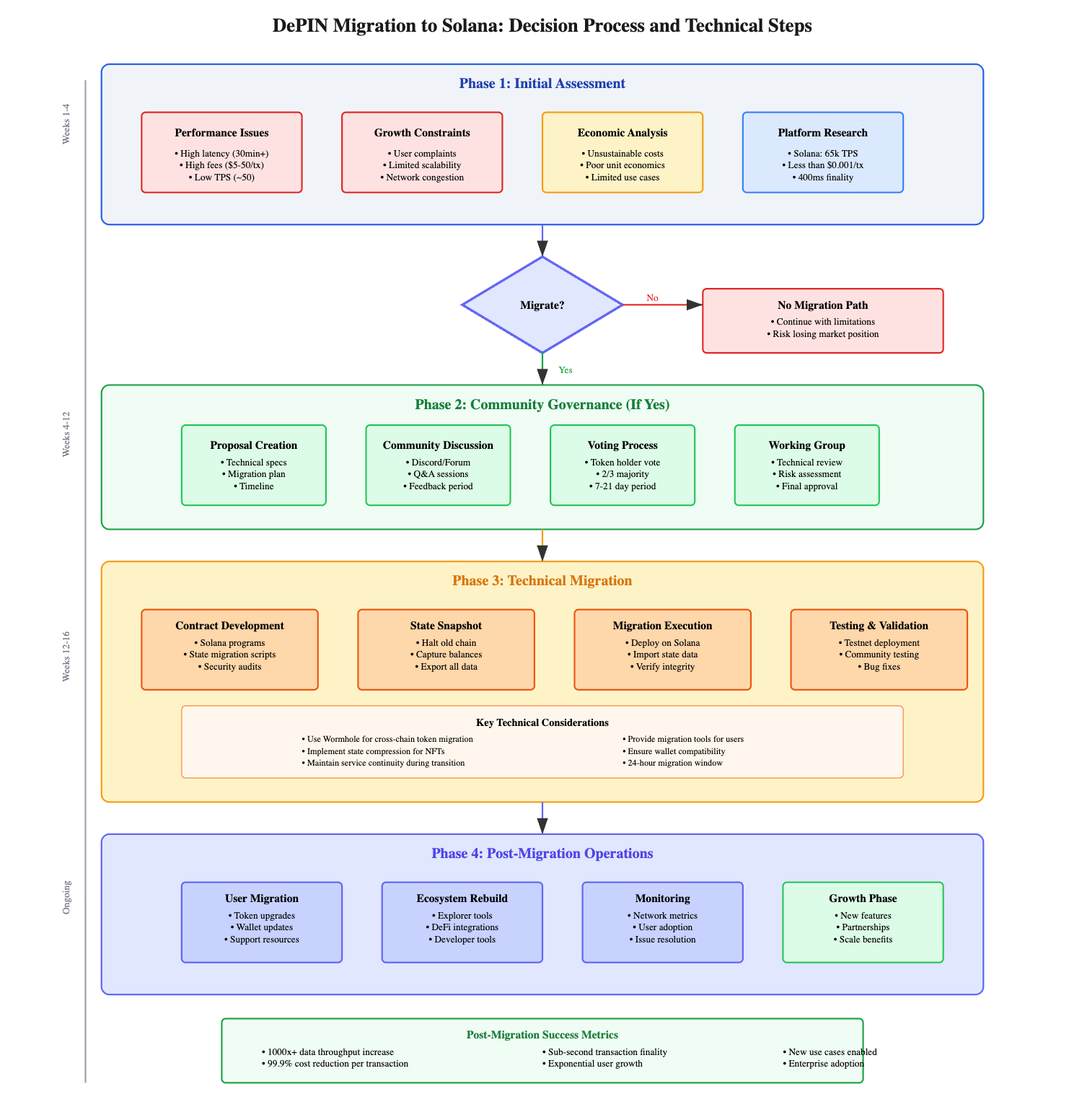
Examples and reference code
Check out these sample reference implementations that might be useful as you build your DePIN:- Reward Distribution examples using an offchain oracle and an anchor program writing temperature data and rewarding the users in SPL tokens
- Build a DePIN Rewards Distributor with Raspberry Pi: a video build of a device that pays out onchain rewards based on its activity, from the Building DePIN projects course
- Data Anchor by Termina: Anchor large batches of device data directly on Solana
- Write Sensor data onchain: How to write sensor onchain using a Solana Pay transaction request
- Claiming Rewards (Helium’s approach)