In short
A transaction is a signed request to change the shared ledger. It either fully happens or doesn’t happen at all, and once confirmed anyone can look it up.You’ve used this in: Quickstart Step 2 Payments Overview Payments Step 1 Payments Step 2 Pay-per-call Step 1 Tokenized asset Step 1 Trade settlement Overview
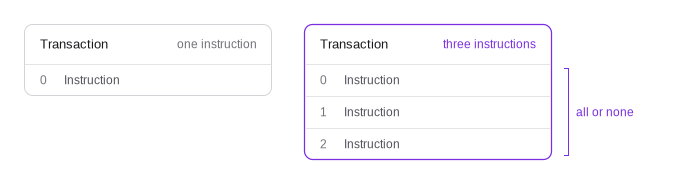
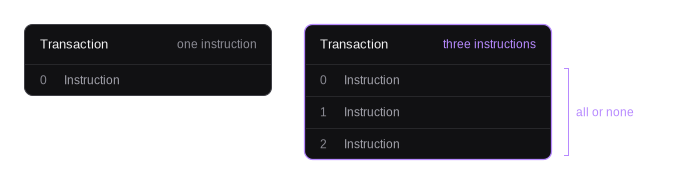
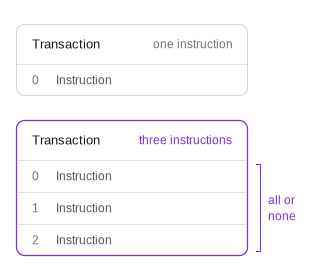
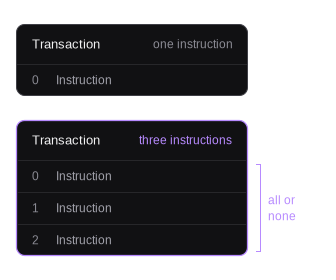
A transaction holds one or more instructions, the
signatures that authorize them, and a recent blockhash. Its instructions run
together: if any fails, the whole transaction fails and every change is
reverted.
Transaction structure
Signatures, the message format, binary encoding, and the size budget, with
a SOL transfer example.
Versioned transactions
Legacy, v0, and v1 formats, and Address Lookup Tables.
Transaction Pipeline
The 8 processing stages from receive to commit, and validation errors.
Durable nonces
Sign offline without the 150-slot blockhash expiry.
Production readiness
Landing, retries, priority fees, and confirmation on mainnet.
Signatures
Every transaction is signed by the wallets it spends from. The first signature doubles as the transaction’s ID, which is what your code gets back and looks up later. Each required signer approves the whole transaction, and the network verifies every signature before it runs any instruction. See Wallets & signatures for how keys and signing work.You’ve used this in: Quickstart Step 4 Payments Step 2 Pay-per-call Step 2
Key facts
- Atomic execution: All instructions succeed or all revert. Fees are still charged on failure.
- Size limit: 1,232 bytes maximum, derived from the IPv6 minimum MTU (1,280 bytes) minus 48 bytes for network headers. The v1 format raises this to 4,096 bytes.
- Signatures: Each signer provides one 64-byte Ed25519 signature.
- Blockhash expiry: A transaction’s recent blockhash is valid for 150 blocks, about 30 seconds at 200ms slots.
Limits
| Limit | Value | Source |
|---|---|---|
| Max transaction size | 1,232 bytes | PACKET_DATA_SIZE |
| Max accounts per transaction | 64 (96 for v1 with SIMD-0596) | Enforced limit |
| Blockhash expiry | 150 slots | MAX_PROCESSING_AGE |
| Signature size | 64 bytes (Ed25519) | — |
| Base fee per signature | 5,000 lamports | Fees |
| Max executed instructions | 64 (top-level + CPIs) | MAX_INSTRUCTION_TRACE_LENGTH |
| Max signatures per packet | 12 | MAX_SIGNATURES_PER_PACKET |