Run the KYC, sanctions, and travel-rule checks offchain, as they run today.
Publish only the result onchain, as an attestation asserting a narrow claim:
“this address passed sanctions screening, valid until this date.” The token’s
gate reads the attestation. The evidence behind the claim stays in your systems
or your provider’s.
Personal data and a public ledger
A gated token needs an onchain answer to “may this address hold the token?” The inputs to that answer (identity documents, screening hits, and beneficial-ownership records) are personal data, which data-protection obligations may keep off a public ledger. Attestations separate the check from its evidence. The check runs where it always ran, inside your compliance function or your vendor’s. What lands onchain is a signed statement that the check ran and what it concluded.Attestation data is stored onchain and is public and permanent. The pattern
protects personal data only because you choose to attest a narrow conclusion.
Putting a name, a document number, a date of birth, a residential address, or
a raw screening payload into an attestation publishes it permanently. Attest
booleans and coarse categories, never the inputs.
The three objects
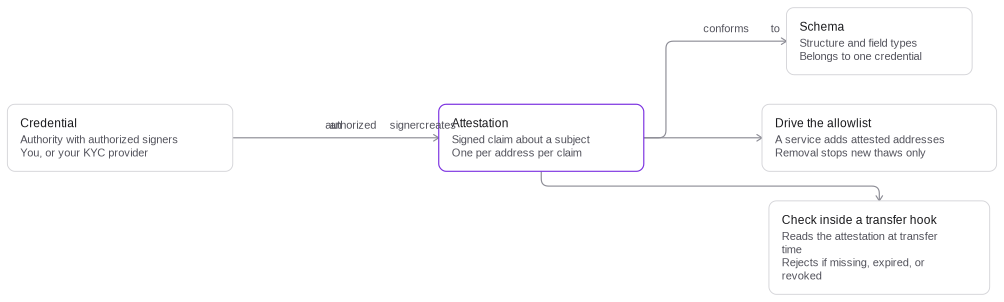
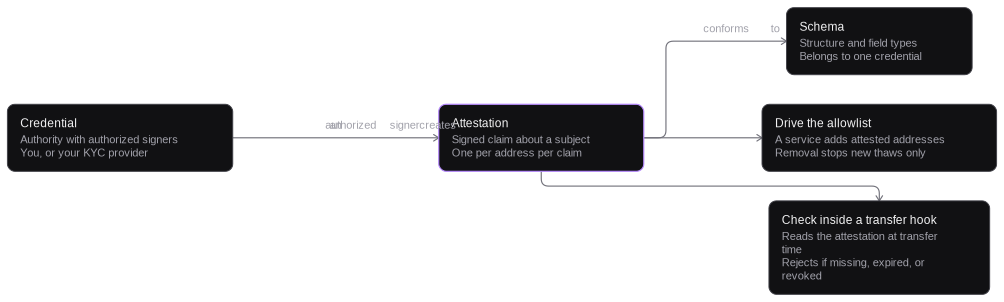
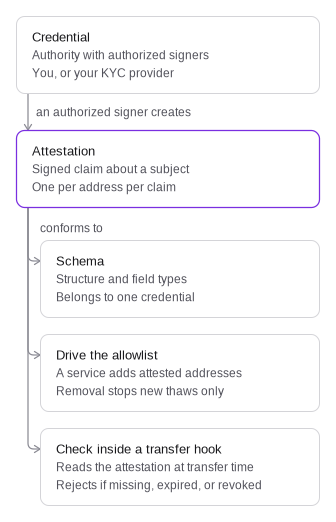
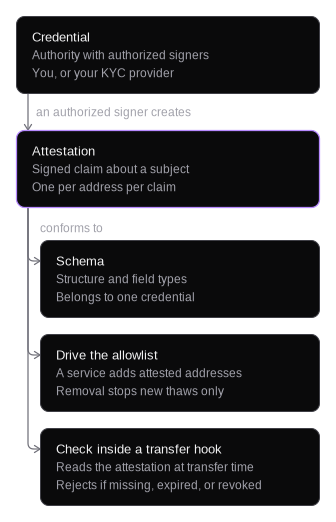
Solana Attestations is built from three onchain objects. Mapped to who owns what in an issuance:| Object | What it is | Who owns it in practice |
|---|---|---|
| Credential | An attestation authority, with a list of authorized signers | The institution standing behind the check: you, or your KYC provider |
| Schema | The structure and field types a valid attestation must conform to | One credential: its authority creates the schema, and only that credential’s signers can attest against it |
| Attestation | A signed claim about a subject, conforming to a schema | Created by an authorized signer of the credential, one per address per claim |
Who signs
The credential’s list of authorized signers is a compliance decision. A schema belongs to the one credential it was created under, and an attestation must use the credential that owns its schema: a signer from another credential can’t attest against it (the program rejects it withInvalidCredential). Three
arrangements:
- You attest. Your compliance function holds the credential and signs. You are asserting your own conclusion.
- Your provider attests in your format. You hold the credential and its schema, and add your KYC or screening vendor’s signing key to the credential’s authorized signers. Every attestation uses one shared format, and you can remove the vendor’s key when the engagement ends.
- Your provider attests under its own credential. Your vendor holds a credential and its own schema, and signs. You rely on their claim and their format.
Designing the schema
Schema design determines how much the pattern exposes. Keep every field to the narrowest thing that supports the gate decision. Reasonable fields:- A boolean: screening passed, accreditation confirmed, eligibility met.
- A coarse jurisdiction code, where the rule varies by jurisdiction.
- A tier or category, where holding limits differ by investor class.
- A validity window, which the expiration timestamp already gives you.
- An opaque reference to your own case file, meaningful only inside your systems and not derivable from onchain data.
Wiring an attestation to the gate
The claim can be enforced in two places, with different costs.| Drive the allowlist | Check inside a transfer hook | |
|---|---|---|
| How it works | A service adds attested addresses to the allowlist; holders thaw against it | A transfer hook reads the attestation account at transfer time and rejects the transfer if it is missing, expired, or revoked |
| Cost per transfer | None; the check happens before any transfer | Compute on every transfer, plus extra accounts the sender must supply |
| Revocation | Removing the address stops new thaws but does not freeze an already-thawed account; freeze it explicitly | Takes effect on the next transfer, which fails |
| Operations | An offchain service, kept running and monitored, with latency between an attestation and the list update | The hook program, audited and maintained |
| Use for | Eligibility claims about the holder | Rules that need a current claim at transfer time |
Lifecycle
An attestation records a check at one point in time. Decide these before you launch:- Expiry. Set an expiration that matches your re-screening cycle.
- Re-attestation. Who re-runs the check, on what schedule, and does the holder have to do anything? Prefer renewal that completes without holder action over a lapse discovered at transfer time.
- Revocation. Plan for a sanctions hit against an existing holder; see wiring an attestation to the gate for how each pattern handles it.
- A holder whose attestation lapses while holding a balance. They still hold the asset. A lapse does not change the account’s state by itself; the options are a freeze, transfers only to redeem, or a grace period.
Limits
- It is not proof the check was done well. An attestation is a signature on a claim. Its value depends on the standing of whoever signed it.
- It does not carry travel-rule data. Where a travel rule applies, originator and beneficiary information moves between institutions, and regimes may differ. That is personal data and stays offchain, on your existing rails. What an attestation can do is assert that the counterparty is an institution you have a travel-rule arrangement with.
- It does not hide who holds the token. Addresses, balances, and the fact that an address carries an attestation are all public. If holder relationships need to stay private, see privacy and transfer controls.
- It does not resolve identity across chains or institutions. An attestation is about an address, not a person. Two addresses attested by the same provider are not linked by the attestations themselves, though issuance patterns may still support inference, and a case-file reference reused across both would link them directly.
Related
- Gate the holders: the allowlist end to end
- Token ACL: the gate the allowlist path thaws against
- Attestations: the program reference