How to create a mint with Confidential Balances
Confidential Balances enables private token transfers by adding extra state to
the mint account. This section explains how to create a token mint with the
required extension enabled.
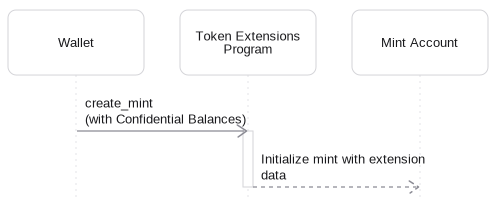
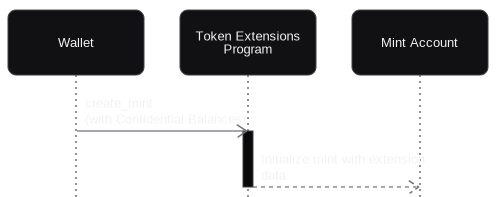
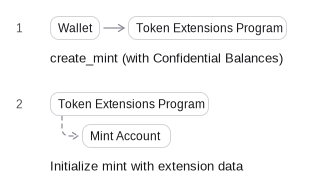
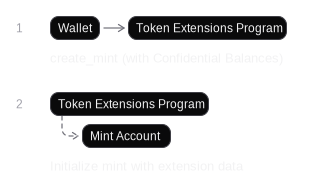
The following diagram shows the steps involved in creating a mint with the
Confidential Balances extension:
Create Mint with Confidential Balances
Confidential Balances Mint State
The extension adds the
ConfidentialTransferMint
state to the mint account:
#[repr(C)]
#[derive(Clone, Copy, Debug, Default, PartialEq, Pod, Zeroable)]
pub struct ConfidentialTransferMint {
    /// Authority to modify the `ConfidentialTransferMint` configuration and to
    /// approve new accounts (if `auto_approve_new_accounts` is true)
    ///
    /// The legacy Token Multisig account is not supported as the authority
    pub authority: OptionalNonZeroPubkey,

    /// Indicate if newly configured accounts must be approved by the
    /// `authority` before they may be used by the user.
    ///
    /// * If `true`, no approval is required and new accounts may be used
    ///   immediately
    /// * If `false`, the authority must approve newly configured accounts (see
    ///   `ConfidentialTransferInstruction::ConfigureAccount`)
    pub auto_approve_new_accounts: PodBool,

    /// Authority to decode any transfer amount in a confidential transfer.
    pub auditor_elgamal_pubkey: OptionalNonZeroElGamalPubkey,
}
ConfidentialTransferMint contains three configuration fields:
-
authority: The account that has permission to change Confidential Balances
settings for the mint and approve new confidential accounts if auto-approval
is disabled.
-
auto_approve_new_accounts: When set to true, users can create token
accounts with Confidential Balances enabled by default. When false, the
authority must approve each new token account before it can be used for
confidential transfers.
-
auditor_elgamal_pubkey: An optional auditor that can decrypt transfer
amounts in confidential transactions, providing a compliance mechanism while
maintaining privacy from the general public.
Required Instructions
Creating a mint with Confidential Balances enabled requires three instructions
in a single transaction:
-
Create the Mint Account: Invoke the System Program’s
CreateAccount
instruction to create the mint account.
-
Initialize Confidential Balances: Invoke the Token Extension Program’s
ConfidentialTransferInstruction::InitializeMint
instruction to configure the
ConfidentialTransferMint state for the
mint.
-
Initialize Mint: Invoke the Token Extension Program’s
Instruction::InitializeMint instruction to initialize the standard mint
state.
The spl_token_client crate’s create_mint method can build and send all
three in one call. The examples below build the three instructions directly, so
you can see each one.
Example Code
The following code demonstrates how to create a mint with Confidential Balances
enabled.
Confidential Balances depends on the ZK ElGamal Proof program, which is enabled
on mainnet and devnet. The Token-2022 program bundled with
solana-test-validator is built without confidential-transfer support, so
Deposit and the steps after it fail with InvalidInstructionData. Run the
examples on devnet (the code’s default; get devnet SOL from the
Solana faucet) or on a mainnet-forking local
validator such as Surfpool. The payer is the wallet at
~/.config/solana/id.json, and the example creates its own mint, so there are
no addresses to replace.
The mint’s auditor key comes from a second wallet. Create it before you run the
example:
solana-keygen new -o ~/.config/solana/auditor.json
Rust
// Imports: dependencies used by this example.
use anyhow::{Context, Result};
use solana_client::rpc_client::RpcClient;
use solana_commitment_config::CommitmentConfig;
use solana_keypair::Keypair;
use solana_signer::Signer;
use solana_system_interface::instruction as system_instruction;
use solana_transaction::Transaction;
use solana_zk_sdk::encryption::derivation::derive_confidential_keys;
use solana_zk_sdk_pod::encryption::elgamal::PodElGamalPubkey;
use spl_token_2022::{
    extension::{
        confidential_transfer::instruction::initialize_mint as initialize_confidential_transfer_mint,
        ExtensionType,
    },
    instruction::initialize_mint as initialize_mint_base,
    state::Mint,
};

fn main() -> Result<()> {
    let rpc_client = RpcClient::new_with_commitment(
        String::from("https://api.devnet.solana.com"),
        CommitmentConfig::confirmed(),
    );

    let payer = load_keypair(".config/solana/id.json")?;
    let mint = Keypair::new();
    let decimals: u8 = 2;

    // Allocate space for a mint that carries the ConfidentialTransferMint
    // extension, then fund it for rent exemption.
    let space =
        ExtensionType::try_calculate_account_len::<Mint>(&[ExtensionType::ConfidentialTransferMint])?;
    let rent = rpc_client.get_minimum_balance_for_rent_exemption(space)?;

    // The auditor ElGamal key lets the issuer decrypt transfer amounts for
    // compliance. Pass `None` to create a mint with no auditor. Derive it from
    // the auditor's own wallet (`solana-keygen new -o
    // ~/.config/solana/auditor.json`); in production the auditor sends the
    // public key alone.
    let auditor_wallet = load_keypair(".config/solana/auditor.json")?;
    let (auditor, _auditor_aes_key) = derive_confidential_keys(&auditor_wallet, &[])
        .map_err(|e| anyhow::anyhow!("derive auditor keys: {e}"))?;
    let auditor_pubkey: PodElGamalPubkey = (*auditor.pubkey()).into();

    let create_account_ix = system_instruction::create_account(
        &payer.pubkey(),
        &mint.pubkey(),
        rent,
        space as u64,
        &spl_token_2022::id(),
    );

    // The confidential-transfer extension must be initialized before the base
    // mint and cannot be added later.
    let init_confidential_ix = initialize_confidential_transfer_mint(
        &spl_token_2022::id(),
        &mint.pubkey(),
        Some(payer.pubkey()), // authority that can update confidential settings
        true,                 // auto-approve new accounts
        Some(auditor_pubkey),
    )?;

    let init_mint_ix = initialize_mint_base(
        &spl_token_2022::id(),
        &mint.pubkey(),
        &payer.pubkey(), // mint authority
        None,            // freeze authority
        decimals,
    )?;

    let blockhash = rpc_client.get_latest_blockhash()?;
    let transaction = Transaction::new_signed_with_payer(
        &[create_account_ix, init_confidential_ix, init_mint_ix],
        Some(&payer.pubkey()),
        &[&payer, &mint],
        blockhash,
    );
    let signature = rpc_client.send_and_confirm_transaction(&transaction)?;
    println!("Created confidential mint {}: {signature}", mint.pubkey());
    Ok(())
}

fn load_keypair(relative_path: &str) -> Result<Keypair> {
    let keypair_path = dirs::home_dir()
        .context("could not find home directory")?
        .join(relative_path);
    let bytes: Vec<u8> = serde_json::from_reader(std::fs::File::open(keypair_path)?)?;
    let mut secret = [0u8; 32];
    secret.copy_from_slice(&bytes[0..32]);
    Ok(Keypair::new_from_array(secret))
}
[package]
name = "confidential-mint"
version = "0.1.0"
edition = "2021"

# spl-token-2022 11 requires solana-system-interface 3.2 (which needs
# solana-instruction >= 3.4), so this example uses the granular solana-* crates
# instead of the solana-sdk umbrella. Keep solana-client on the 4.3 line (rustc
# 1.97.1 or later): 4.4 moved to solana-transaction 5, so it no longer matches
# the solana-transaction 4 that this example builds transactions with.
[dependencies]
solana-client = "~4.3"
solana-pubkey = "4.2"
solana-keypair = "3.1"
solana-signer = "3.0"
solana-transaction = "4"
solana-commitment-config = "3.1.1"
solana-system-interface = { version = "3.2.0", features = ["bincode"] }
solana-zk-sdk = "7.0.1"
solana-zk-sdk-pod = "0.1.2"
spl-token-2022 = { version = "11.0.0", features = ["zk-ops"] }

anyhow = "1.0"
dirs = "6.0.0"
serde_json = "1.0"
Typescript
// Imports: dependencies used by this example.
import { getCreateMintInstructionPlan } from "@solana-program/token-2022";
import { deriveConfidentialKeys } from "@solana-program/token-2022/confidential";
import {
  createClient,
  createKeyPairSignerFromBytes,
  generateKeyPairSigner,
  some
} from "@solana/kit";
import { solanaRpc } from "@solana/kit-plugin-rpc";
import { signerFromFile } from "@solana/kit-plugin-signer";
import { readFile } from "node:fs/promises";
import { homedir } from "node:os";
import { join } from "node:path";

const client = await createClient()
  .use(signerFromFile(join(homedir(), ".config/solana/id.json")))
  .use(
    solanaRpc({
      rpcUrl: "https://api.devnet.solana.com"
    })
  );
const payer = client.payer;

const mint = await generateKeyPairSigner();

// The auditor ElGamal key lets the issuer decrypt transfer amounts for
// compliance. Omit `auditorElgamalPubkey` to create a mint with no auditor.
// Derive it from the auditor's own wallet (`solana-keygen new -o
// ~/.config/solana/auditor.json`); in production the auditor sends the
// public key alone.
const auditorSigner = await createKeyPairSignerFromBytes(
  new Uint8Array(
    JSON.parse(
      await readFile(join(homedir(), ".config/solana/auditor.json"), "utf8")
    )
  )
);
const { elgamalKeypair: auditor } = await deriveConfidentialKeys({
  signer: auditorSigner
});

const plan = await getCreateMintInstructionPlan(client, {
  payer,
  newMint: mint,
  decimals: 2,
  mintAuthority: payer,
  extensions: [
    {
      __kind: "ConfidentialTransferMint",
      authority: some(payer.address),
      autoApproveNewAccounts: true,
      auditorElgamalPubkey: some(auditor.elgamalPubkey)
    }
  ]
});

const result = await client.sendTransaction(plan);

console.log(
  `Created confidential mint ${mint.address}: ${result.context.signature}`
);
{
  "name": "confidential-mint",
  "version": "0.1.0",
  "type": "module",
  "dependencies": {
    "@solana-program/system": "^0.15.0",
    "@solana-program/token-2022": "^0.19.0",
    "@solana/kit": "^8.4.0",
    "@solana/kit-plugin-rpc": "^0.19.0",
    "@solana/kit-plugin-signer": "^0.19.0",
    "@solana/zk-sdk": "^0.5.1"
  },
  "devDependencies": {
    "@types/node": "^24.10.0",
    "typescript": "^5.8.3"
  }
}