In short
Every transaction pays a small flat network fee, currently a fraction of a cent, whatever the amount. The transaction’s fee payer pays, and that can be your app rather than your customer.You’ve used this in: Quickstart Step 2 Payments Overview Pay-per-call Overview
Every transaction pays a fee in SOL, in two parts:
a base fee that pays validators to verify signatures, and an optional
prioritization fee that makes the current leader more likely to schedule
your transaction ahead of others.
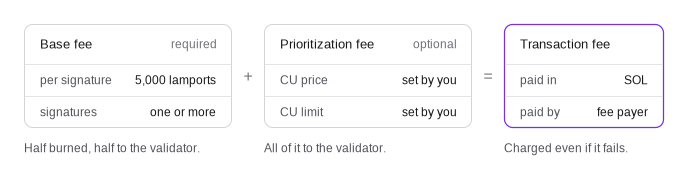
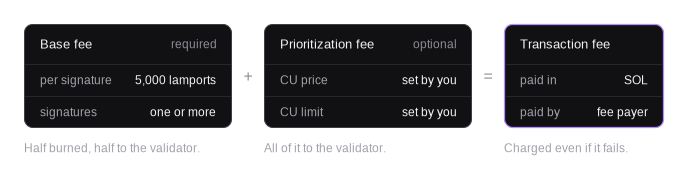
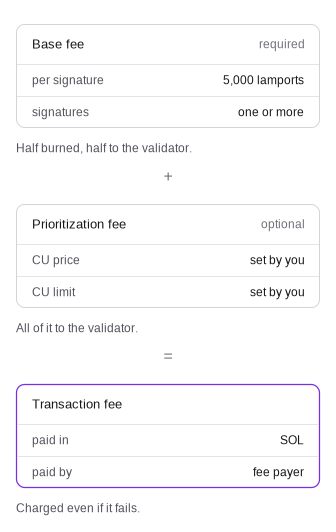
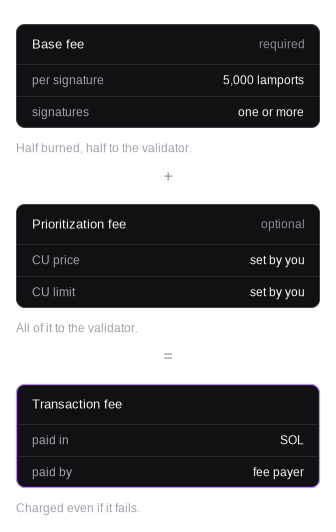
Fee structure
How each fee is calculated and distributed, with code for setting them.
Compute budget
Compute unit limits, ComputeBudget instructions, and block limits.
Key facts
- Base fee: per-signature, split 50% burned / 50% to the validator.
- Prioritization fee:
ceil(compute_unit_price * compute_unit_limit / 1,000,000)lamports. 100% to the validator. In the v1 format the fee is an absolute lamport total set in the message config instead.
Limits
| Limit | Value | Source |
|---|---|---|
| Base fee per signature | 5,000 lamports | lamports_per_signature |
| Default CU limit / instruction | 200,000 | DEFAULT_INSTRUCTION_COMPUTE_UNIT_LIMIT |
| Builtin instruction default CU | 3,000 | MAX_BUILTIN_ALLOCATION_COMPUTE_UNIT_LIMIT |
| Max CU limit / transaction | 1,400,000 | MAX_COMPUTE_UNIT_LIMIT |
| Micro-lamports per lamport | 1,000,000 | MICRO_LAMPORTS_PER_LAMPORT |