Both legs of a trade can be accounts on the same ledger, so one transaction can
exchange them or leave both positions unchanged. The decision is which cash
instrument settles against the asset: a stablecoin, a token representing a
deposit at a bank, or a payment on existing rails recorded onchain. That choice
and the mint’s controls constrain each other.
Atomic exchange in one transaction
The runtime applies every instruction in a transaction or none of them. Where
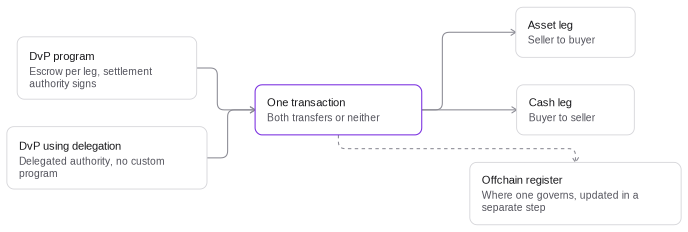
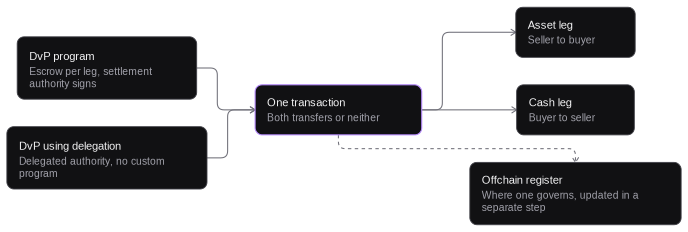
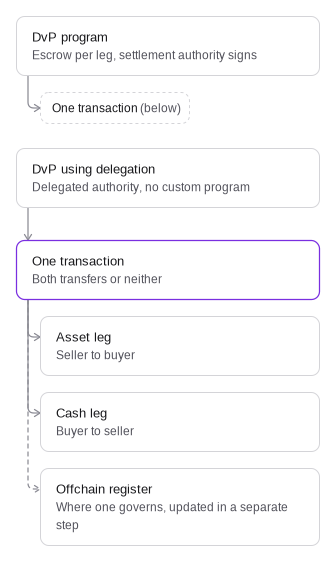
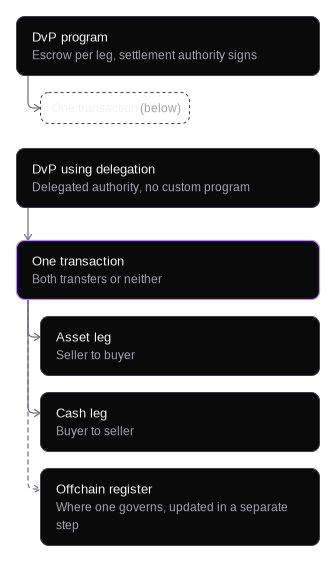
the asset and the cash are both token accounts on Solana, a single transaction
moves the asset one way and the cash the other, and either both transfers take
effect or neither does. No clearing house is needed between the legs, though a
settlement agent or authority still signs (see below). Two patterns use this:
the DvP program holds each leg in a
program-owned escrow and lets a named settlement authority settle both, and
DvP using delegation settles a Token-2022
asset against a stablecoin through delegated authority, with no custom program.
Atomicity covers the two onchain legs only. Where an offchain register
governs, its update is a separate step; see
finality and the register of record.
Signing authority for both legs
A transaction that moves two positions needs authority over both. In the
delegation pattern, each side approves a delegate for its own leg and a
settlement agent signs the combined transaction, holding neither position at
any point. The issuer can also act on the asset leg through a permanent
delegate, or one party can sign both legs against a delegation granted in
advance.
Two constraints follow. A token account carries one delegate at a time, so a
position pledged to one settlement arrangement is not available to another at
the same time. And whoever signs is an operational dependency, in the same way
as the mint authorities. See
split authorities from the start.
The DvP program uses no delegation, so the one-delegate limit does not apply
to it.
Choosing the cash instrument
Deposit tokens from two banks are not fungible: a venue that accepts more than
one introduces a conversion between two claims denominated in the same
currency. This is known as singleness of money; the settlement mechanism does
not resolve its operational, legal, and accounting aspects.
Stablecoin and deposit-token regimes may differ by jurisdiction, including on
whether an issuer may pay or pass through yield.
Mint controls and the cash leg
The mint’s controls and the cash instrument limit each other: