- SPL tokens are partly self-protecting. The Token Program rejects a transfer whose accounts don’t match the expected mint, so a misdirected token transfer fails without losing funds. Most of this page covers SPL token sends.
- Native SOL has no such guard. A System Program transfer succeeds into any account, so an incorrect recipient permanently locks the SOL. See Sending native SOL.
See How Payments Work on Solana for core
payment concepts.
Understanding Solana Addresses
Solana accounts have two types of addresses, on-curve and off-curve.On-Curve Addresses
Standard addresses are the public keys from Ed25519 keypairs. These addresses:- Have a corresponding private key that can sign transactions
- Are used as wallet addresses
Off-Curve Addresses (PDAs)
Program-derived addresses are deterministically derived from a program ID and seeds. These addresses:- Do not have a corresponding private key
- Can only be signed for by the program the address was derived from
Account Types in Payments
Use the address to fetch an account from the network, check its program owner and account type to determine how to handle the address.Knowing whether an address is on-curve or off-curve does not tell you what
type of account it is, what program owns it, or whether an account exists at
that address. You must fetch the account from the network to determine these
details.
System Program Accounts (Wallets)
Accounts owned by the System Program are standard wallets. To send SPL tokens to a wallet, you derive and use its Associated Token Account (ATA). After deriving the ATA address, check whether the token account exists onchain. If the ATA does not exist, you can include an instruction to create the recipient’s token account in the same transaction as the transfer. However, this requires paying rent for the new token account. Since the recipient owns the ATA, the SOL paid for the rent cannot be recovered by the sender. System accounts can exist off-curve. If your user wants to send tokens to an off-curve address, it is recommended to prompt the user to verify they intend to send funds to a smart wallet.Without safeguards, subsidizing ATA creation can be exploited. A malicious
user could request a transfer, have their ATA created at your expense, close
the ATA to reclaim the rent SOL, and repeat.
Token Accounts
Token accounts are owned by the Token Program or Token-2022 Program and hold token balances. If the address you receive is owned by a token program, you should verify the account is a token account (not a mint account) and matches the expected token mint account before sending.The Token Programs automatically validate that both token accounts in a
transfer hold tokens of the same mint. If validation fails, the transaction is
rejected and no funds are lost.
Mint Accounts
Mint accounts track the token supply and metadata of a specific token. Mint accounts are also owned by Token Programs but are not valid recipients for token transfers. Attempting to send tokens to a mint address results in a failed transaction, but no funds are lost.Other Accounts
Accounts owned by other programs are valid but are governed by the authority rules set forth by the respective owning program. It is recommended to prompt the user to verify they intend to send funds to a smart wallet.Sending native SOL
The classification above determines where SPL tokens can go. Native SOL is stricter: the only safe recipient is a System Program wallet (or an unfunded on-curve address that becomes one). A System Program transfer adds lamports to any account, including mints, token accounts, programs, and PDAs. Lamports can only be moved out by the account’s owning program, so sending SOL to an incorrect recipient may result in funds being permanently lost. Unlike an SPL token transfer, the transaction does not fail when the recipient is an unexpected address. When sending native SOL, only anIS_WALLET result is acceptable.
IS_TOKEN_ACCOUNT is not: a token account holds SPL tokens, and SOL sent
there is outside the sender’s control.
This is a common way SOL is lost: a user pastes a token’s mint address (or a
program address) into a SOL withdrawal. The transfer succeeds and the SOL is
unrecoverable. Always classify the recipient before signing a SOL transfer.
Verification Flow
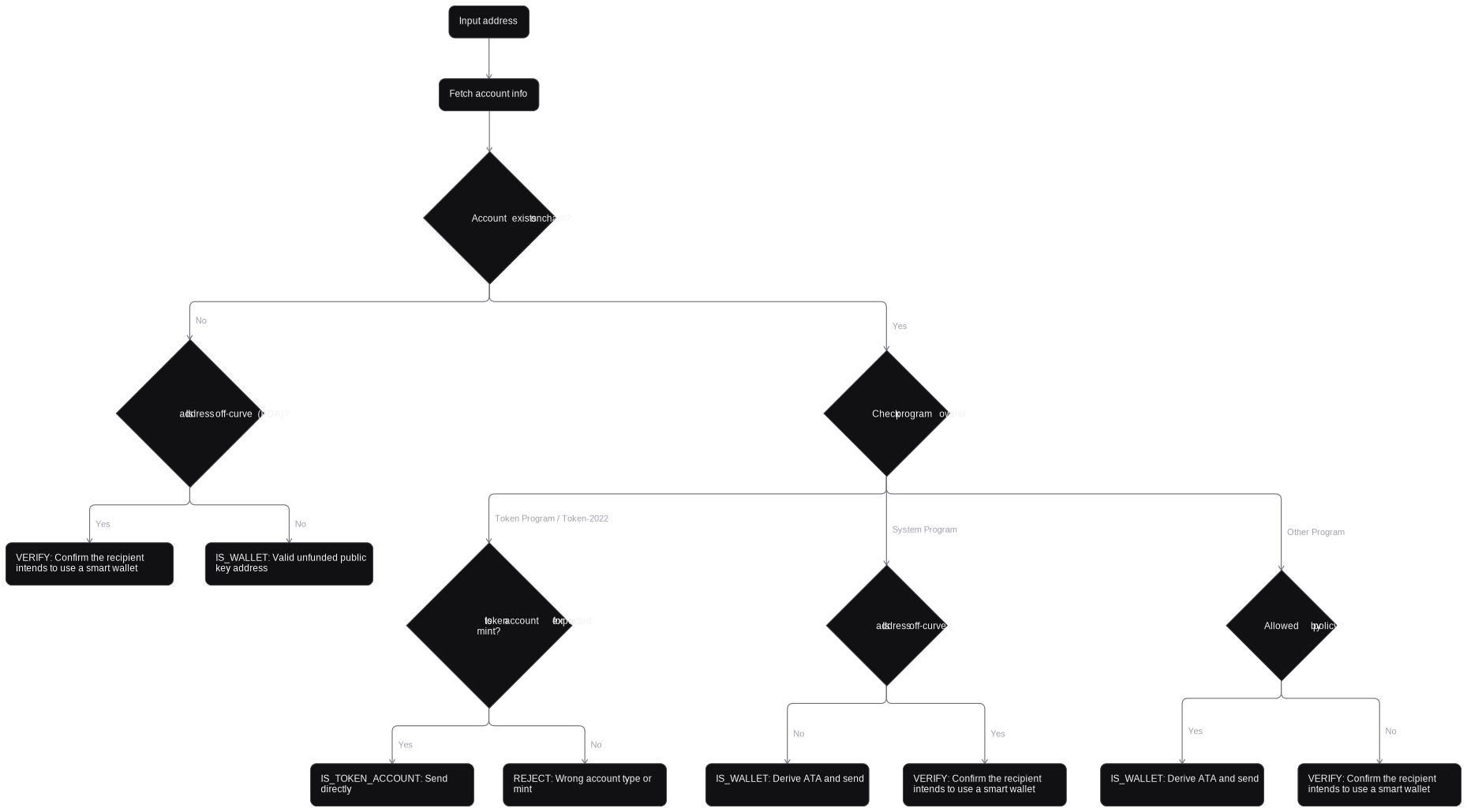
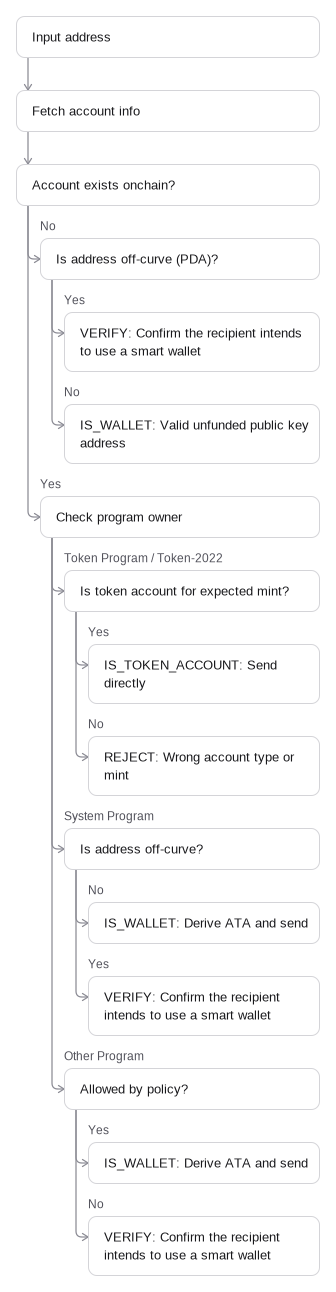
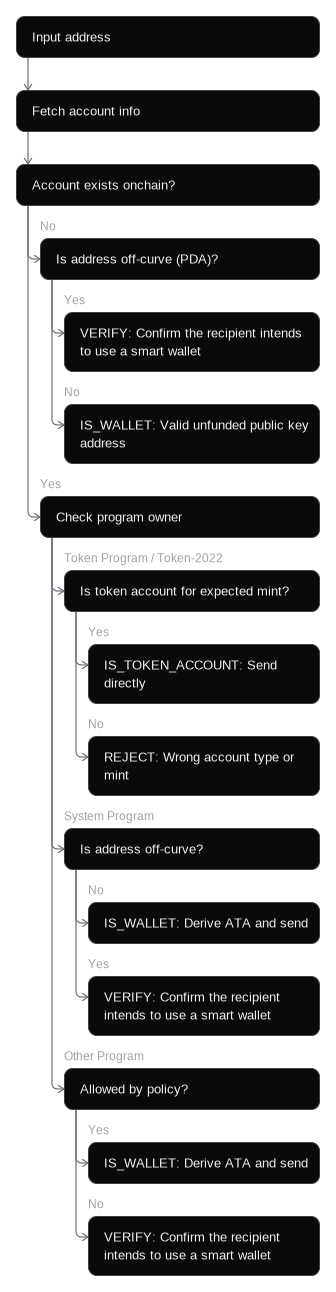
The following diagram shows a reference decision tree for validating an address: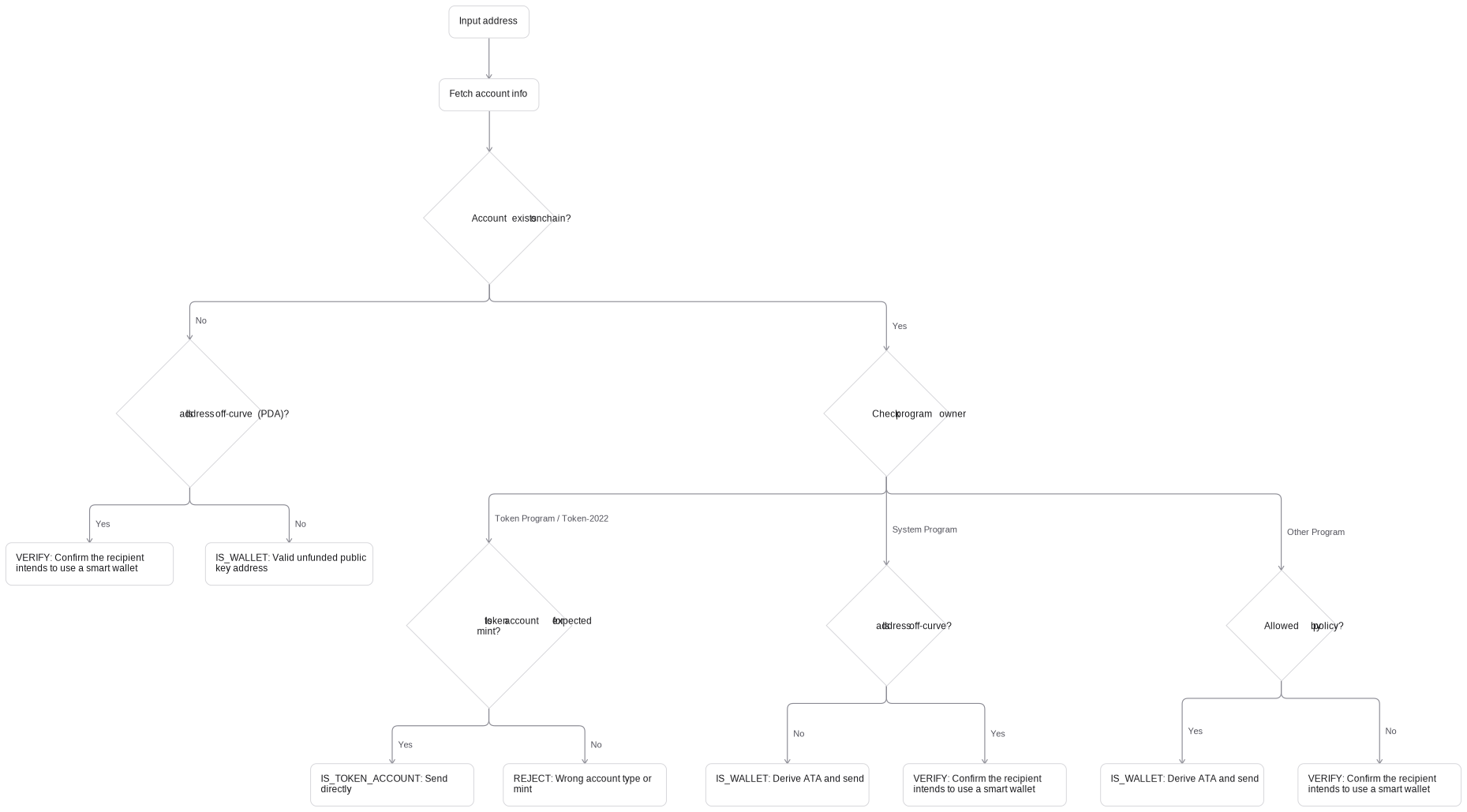
Address Verification Flow
1
Fetch account
Use the address to fetch the account details from the network.
2
Account does not exist
If no account exists at this address, check whether the address is on-curve or
off-curve:
- Off-curve (PDA): Require explicit recipient verification before creating an ATA or sending SPL tokens. Without an existing account, you cannot determine from the address alone which program derived this PDA or whether the recipient’s program can access its ATA.
- On-curve: This is a valid wallet address (public key) that hasn’t been funded yet. Derive the ATA, check if it exists, and send tokens to it. You must make a policy decision whether to fund the creation of the ATA if it doesn’t exist.
3
Account exists
If an account exists, check which program owns it:
- System Program: This is a standard wallet. Derive the ATA, check if it exists, and send tokens to it. You must make a policy decision whether to fund the creation of the ATA if it doesn’t exist.
- Token Program / Token-2022: Verify the account is a token account (not a mint account) and that it holds the token (mint) you intend to send. If valid, send tokens directly to this address. If it’s a mint account or a token account for a different mint, reject the address.
- Other Program: Programs like multisig wallets are acceptable owners of token accounts. Require the user to confirm they intend to send to a smart wallet. Some common smart wallets:
Demo
The following example shows only the address validation logic. This is reference code for illustration purposes.The demo does not show how to derive an ATA or build a transaction to send
tokens. Refer to the token
account
and token transfer documentation for
example code.
validateAddress takes the mint you intend to send and that mint’s token
program. A token account passes only if it holds that mint under that program,
so a USDC account is rejected when you are sending PYUSD. The demo uses four
possible outcomes:
| Result | Meaning | Action |
|---|---|---|
IS_WALLET | Valid wallet address | Derive and send to associated token account |
IS_TOKEN_ACCOUNT | Token account for the expected mint | Send tokens directly to this address |
USER_VERIFICATION | Address requires recipient confirmation | Require explicit review before sending SPL tokens or funding an ATA |
REJECT | Invalid address, or the wrong mint | Do not send |
canReceiveNativeSol
(wallets only) and canReceiveSplToken (wallets or token accounts). A
USER_VERIFICATION result is not automatically accepted; your application
should have a user confirm their intent before sending SPL tokens. A token
account returns IS_TOKEN_ACCOUNT, so it can receive SPL tokens but not
native SOL — the distinction that prevents SOL from being locked.
Demo