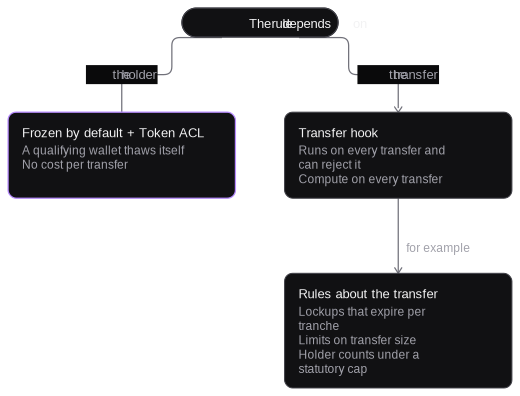
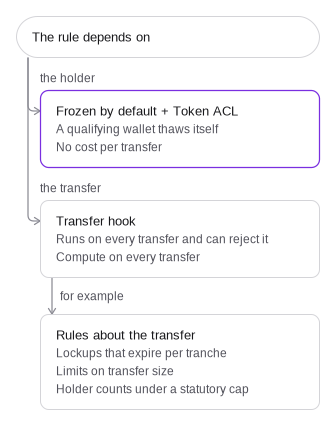
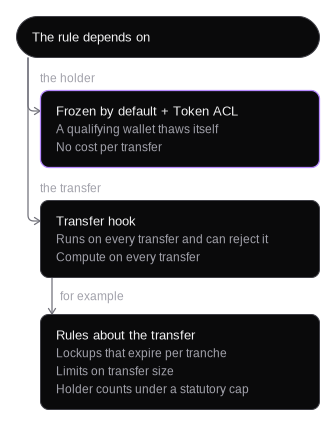
Frozen-by-default accounts with Token ACL add no compute to each transfer and
keep the token usable in venues that do not run custom code on every transfer.
A transfer hook suits rules that cannot be expressed as whether an account may
hold the token at all.
Three ways to restrict who holds a token
On networks where each token is its own contract, transfer restrictions run as code on every transfer. On Solana most of these controls are extensions enforced inside the Token-2022 program itself, so they are shared standards rather than code you maintain.| Approach | How it works | Cost per transfer | Composability |
|---|---|---|---|
| Frozen by default + Token ACL | Every new token account is created frozen. A qualifying wallet thaws itself against an onchain list | None | High: the mint reads as an ordinary Token-2022 mint, though integrators must handle accounts created frozen |
| Transfer hook | A program you write is invoked on every transfer and can reject it | Compute on every transfer | Lower: integrating venues must support hooks and account for your program |
| Manual freeze and thaw | You hold the freeze authority and act on each account yourself | None | High, but you are a liveness dependency for every new holder |
Frozen by default with Token ACL
Default Account State creates every token account frozen. On its own, no address can hold the token until the issuer thaws it individually. Token ACL removes the issuer’s signature from each thaw. The freeze authority is delegated to a shared program that exposes a permissionless thaw, and that program delegates the allow-or-deny decision to a pluggable gate. With an address-based list as the gate, a wallet on the allowlist thaws itself; in allowlist mode the issuer, or its operator, still adds each holder to the list. The issuer keeps an override throughout: freeze or thaw directly, swap the gate, or reclaim the freeze authority. Integrators read it as an ordinary Token-2022 mint, but need a path for accounts that are created frozen and thaw through the gate.Token ACL is deployed on devnet and mainnet and specified in sRFC-37. Its
releases are pre-1.0 as of October 2026; check the current state on
Token ACL.
When a hook is required
A transfer hook fits rules that depend on the transfer rather than on the holder. Lockups that expire per tranche, jurisdiction-dependent limits on transfer size, and holder counts that must stay under a statutory cap cannot be expressed as a list of permitted addresses. A hook is also a program to audit and maintain.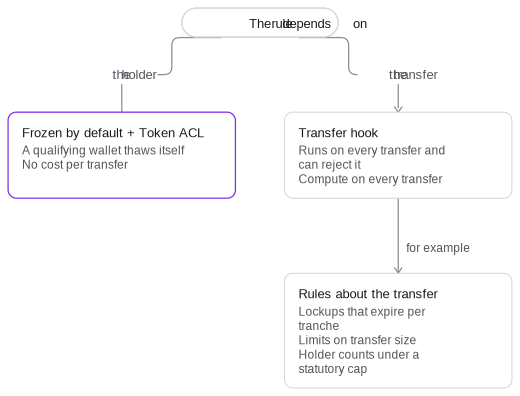
Allowlist or blocklist
Token ACL’s pluggable gate supports either. They differ in the default: admitted or denied. An allowlist defaults to denied: nobody holds the token until they are admitted. This suits a supervised issuance, where every holder has been onboarded and you can name them. It also fails safe: a gap in your onboarding pipeline stops new holders rather than admitting unchecked ones. A blocklist defaults to permitted: anyone holds the token unless excluded. This suits a broadly circulating asset where the obligation is to exclude specific addresses rather than to vet every holder. It fails open, so the list’s completeness and freshness determine whether it works.Split authorities from the start
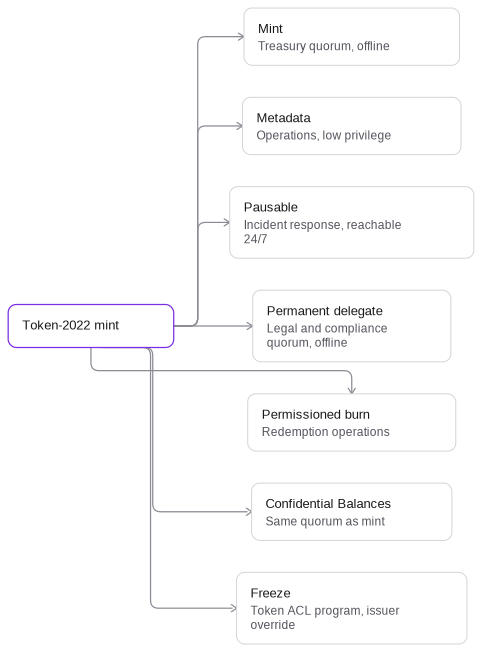
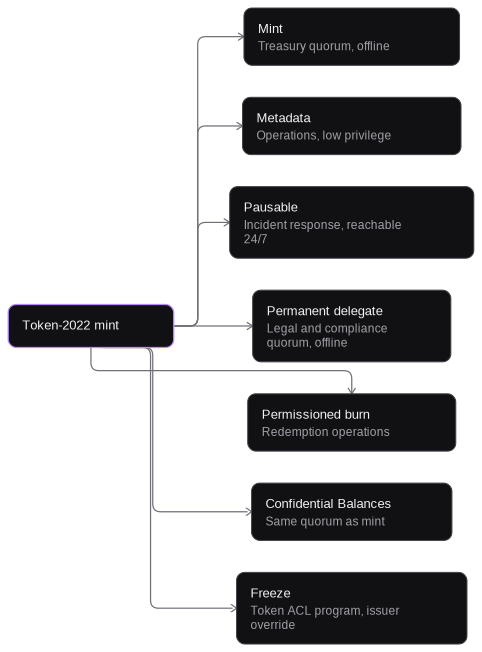
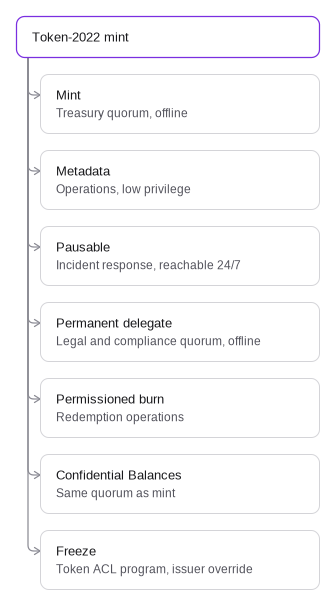
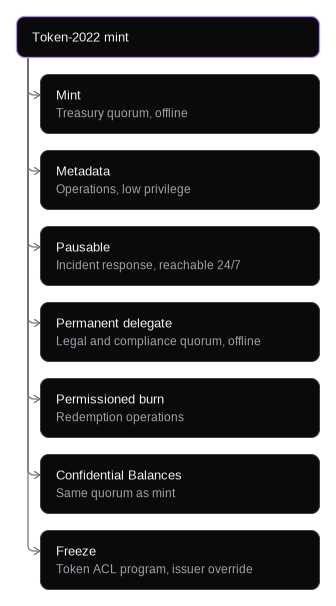
Token-2022 lets each power sit on a different key. If one key holds the mint, pause, and permanent delegate authorities, one compromise exposes all three.| Authority | What it can do | Suggested holder |
|---|---|---|
| Mint | Create new supply | Treasury quorum, offline |
| Metadata | Change name, symbol, URI, and additional fields | Operations, low privilege |
| Pausable | Halt all mint, burn, and transfer activity | Incident response, reachable 24/7 |
| Permanent delegate | Move or burn any holder’s balance | Legal and compliance quorum, offline |
| Permissioned burn | Co-sign redemptions | Redemption operations |
| Confidential Balances | Configure confidential transfer settings | Same quorum as mint |
| Freeze (via Token ACL) | Freeze and thaw accounts | Delegated to the Token ACL program, with issuer override |
Related
- Program and authority design: which key or multisig holds each authority the controls create
- Issue a gated token: build a mint that carries these controls
- Gate the holders: Token ACL end to end
- Choosing the cash leg: what the controls chosen here let the asset settle against