Spot and perps
There are two ways to trade on Solana. Spot trading, where you buy a token and own it. And perpetual futures, usually shortened to perps, where you take a position on a token's price without ever holding it. They work differently and they carry different risks, so it's important to understand the mechanics of both.
Spot trading
Spot is the simple version. You exchange one token for another at the current price, and what you buy is yours to hold for as long as you like.
You own the asset: Buy $500 of SOL and you hold SOL. It sits in your wallet, and you can send it, hold it, or sell it whenever you choose.
Your risk is capped at what you paid: If the price halves, your $500 is worth $250. If the token goes to zero, you lose $500. You cannot lose more than you put in.
There's no clock: Nobody closes your position for you. A trade you're down on is only a loss when you decide to sell it.
Profit comes from the price rising: You buy at $100, you sell at $130, you keep the $30 per token.
Perpetual futures (perps)
A perp lets you take a position on a token's price without owning the token.
The word perpetual means the position has no expiry date. It stays open until you close it, or until it's closed for you.
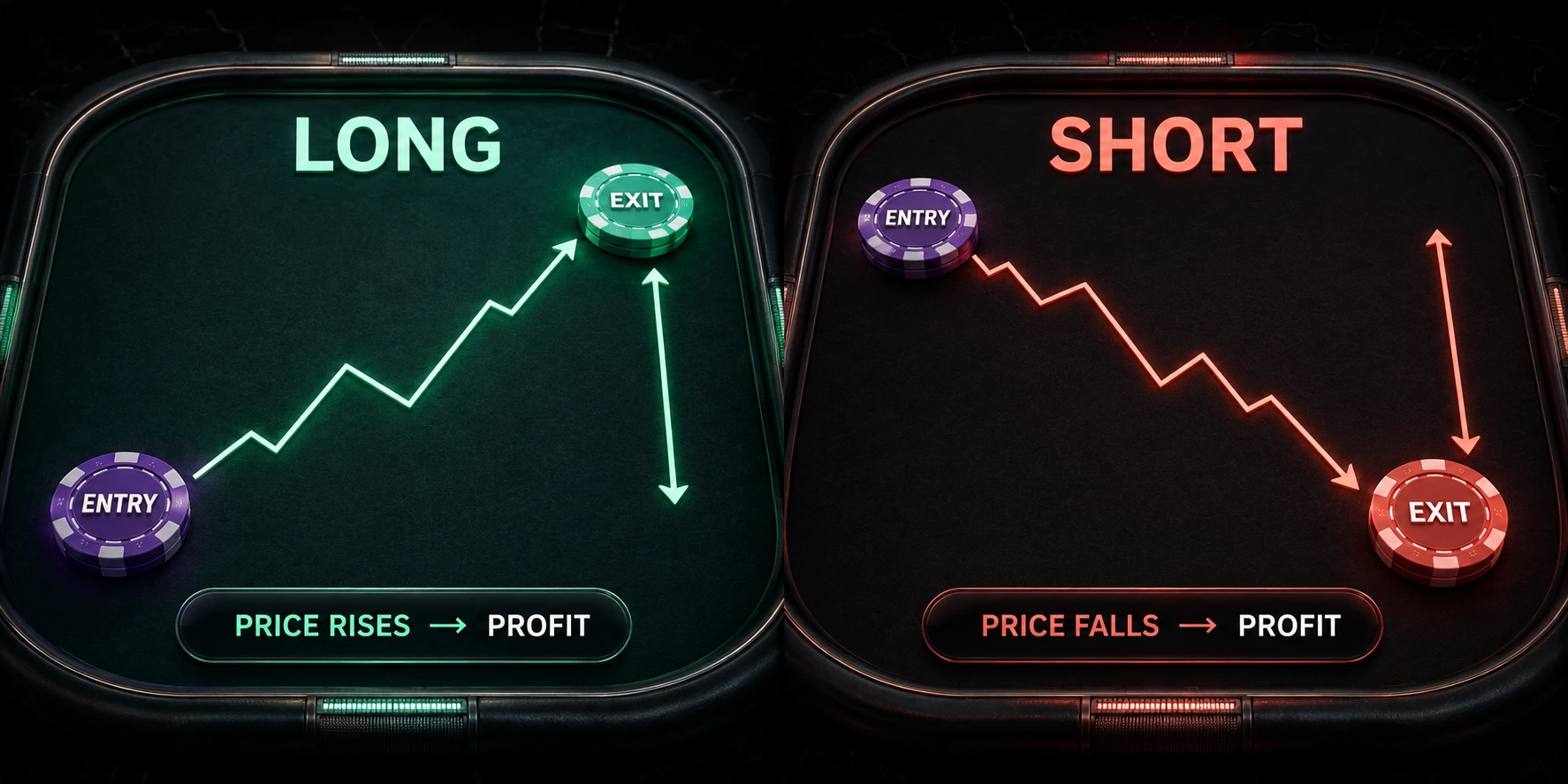
Long
You profit when the price goes up. Open a long on SOL at $150, and if it rises to $165, you're up.
Short
You profit when the price goes down. Open a short on SOL at $150, and if it falls to $135, you're up. Spot gives you no way to do this; it is a perp-only mechanic.
Leverage and collateral
Perps let you take a position larger than the money you put up; this is called leverage. The money you put up is your collateral, also called margin. It's held against the position for as long as the position is open, and it's what you stand to lose.
Say you post $1,000 of collateral and open a 10x leverage long. Your position is $10,000, ten times the money behind it. Every 1% move in the price now moves your position by $100, which is 10% of your collateral.
The price rises 5%: Your $10,000 position gains $500. Against $1,000 of collateral, you're up 50%.
The price falls 5%: Your position loses $500. You're down 50%, and half your collateral is gone.
The price falls 10%: Your position loses $1,000. That's all of your collateral, and the position is closed, or liquidated.
Liquidation
When your losses reach the collateral committed to the position, the exchange closes it automatically and that collateral is gone.
The leverage figure tells you how far the price can move against you before that happens. At 10x, roughly 10%. At 20x, roughly 5%. At 50x, roughly 2%. Daily moves of that size are not unusual in crypto. These figures assume the position is backed only by the collateral you posted; holding more collateral than the position requires moves the liquidation point further away.
Liquidation is automatic: Once the price hits the liquidation level, the position closes. There's no margin call to respond to and no pause to add collateral at that point.
A liquidated position doesn't recover: If the price dips 12% and then rises 40%, the call was right, but you were liquidated on the dip and are no longer in the trade.
Risk
Leverage does not change the odds of your call being right. It changes the size of the outcome in both directions, and it sets a price level at which the position closes whether you want it to or not. A spot holder facing the same 12% dip still owns the token.
Never risk more than you can afford to lose. Start on spot, and if you move to perps, start at low leverage.