Read the venue
Solana has a number of places to trade. Some handle spot only, some offer perps, and they vary in cost, available liquidity, and in how long they have been running.
Centralized and decentralized exchanges
There are two types of exchanges, and the difference is in who holds your funds while you trade.
A centralized exchange, or CEX, takes custody of your funds, much like a typical online poker site. You open an account, verify your identity, and deposit funds with them. They hold the funds and match your trades internally. If you bought crypto on an exchange and withdrew it to your wallet, you have already used one.
A decentralized exchange, or DEX, mostly runs onchain and never takes custody of your funds. Some DEXs let you trade straight from your wallet. Others, particularly for perps, ask you to move collateral into a trading account first. Either way you keep sole control of the funds, and nobody else can move them or withhold them from you.
Types of DEXs
DEXs work in one of two ways, and the difference is in how your order gets filled.
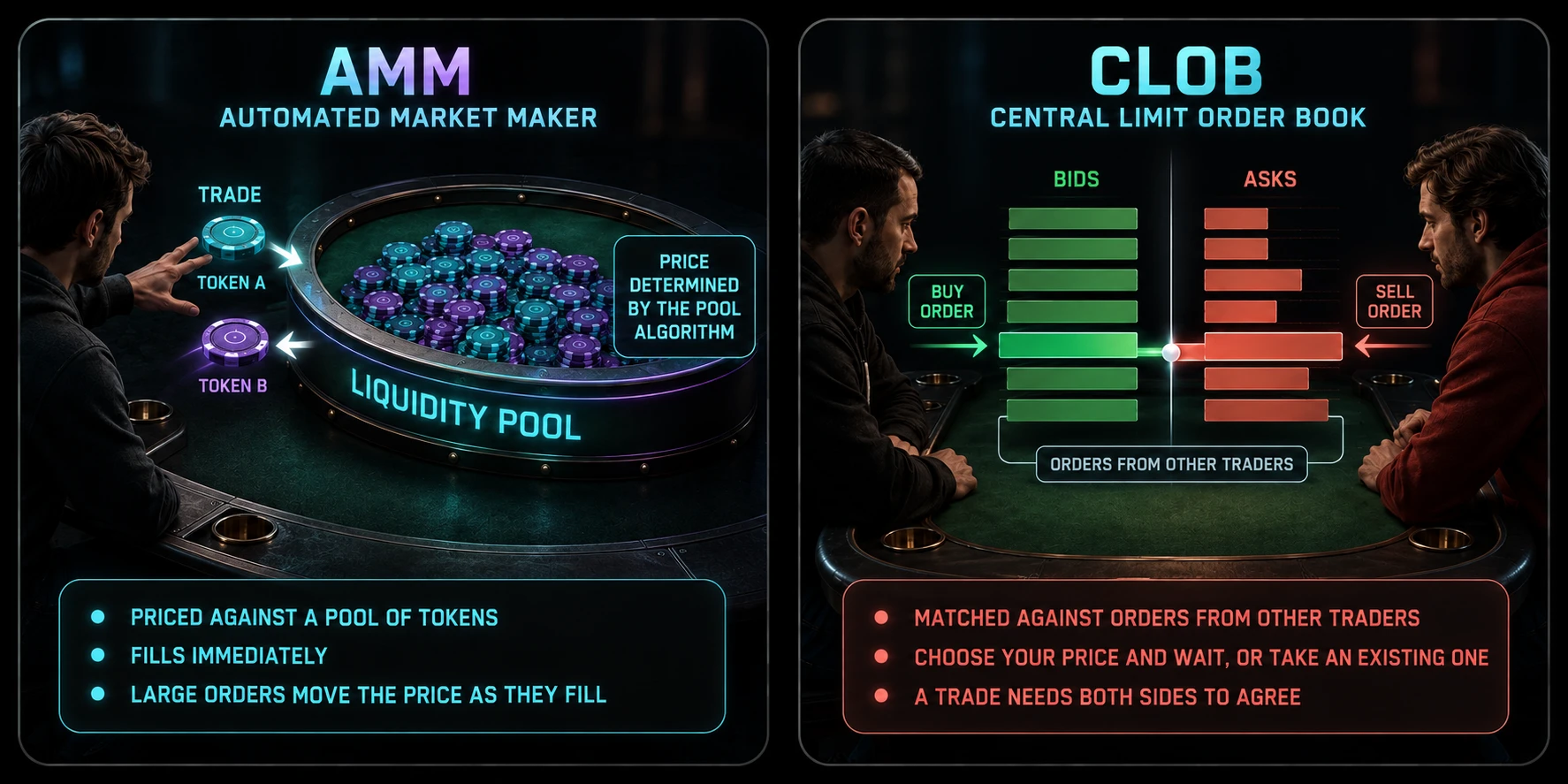
An automated market maker, or AMM, prices your trade against a pool of tokens rather than against another trader. The pool always has a price and it always takes the other side, so your trade fills immediately. The price you get depends on the size of your order relative to the size of the pool. A large order against a small pool moves the price as it fills, and you end up paying more than the price you were quoted. This is slippage.
A central limit order book, or CLOB, matches your order against orders placed by other traders. This is the same model used by traditional exchanges. You can place an order at a price you choose and wait for someone to take it, or take an existing order at the price on offer. A trade only happens when both sides agree on a price.
On Solana, spot trading is mostly done through AMMs, and perps mostly through order books.
What to look for
Liquidity: How much is being traded, which determines whether your order fills near the price you saw. In a thin market the price moves against you as you buy, and again when you sell. Volumes are published, though they can be inflated, so treat a big number as a starting point rather than proof.
Fees: Rates differ between exchanges, and the difference compounds if you trade often. The fee schedule is usually published on the exchange's website, alongside documentation on its mechanics and failure cases.
Spot or perps: Some exchanges offer one, some both. The risks differ, so know which you are using.
Track record: How long the exchange has operated, how much has been traded through it, and how it performed in volatile conditions. An exchange that kept working through a sharp drawdown has been tested in a way a newer one hasn't.
Verify the URL: Fake versions of well-known exchanges exist to drain the wallets that connect to them. Bookmark the real one and use the bookmark.
Start small. A first trade with a small amount confirms the exchange works as expected, fills, fees and withdrawals included, before you put real size through it.