
Streamlining Cross-Border Payments in Latin America and Beyond
Overview
Takenos is a payments platform that services Latin America’s globally paid workforce. Each year, over US$100 billion is sent into Latin America as cross-border income flows, largely originating from workers and earners abroad, highlighting the scale of USD-denominated payouts entering the region. But the legacy correspondent banking network makes these transfers slow, expensive, and an operational mess.
Their solution was to create a reserve-backed stablecoin on Solana, ensuring seamless, secure money movement across borders. This model replaces traditional SWIFT and international wires with global payments that settle in seconds.
- US$500M+ in payment volume processed to date
- US$10M+ in onchain monthly volume
- Rapid expansion across LatAm, with more than 500k users in 20+ countries
- ~20% month-over-month growth in 2025
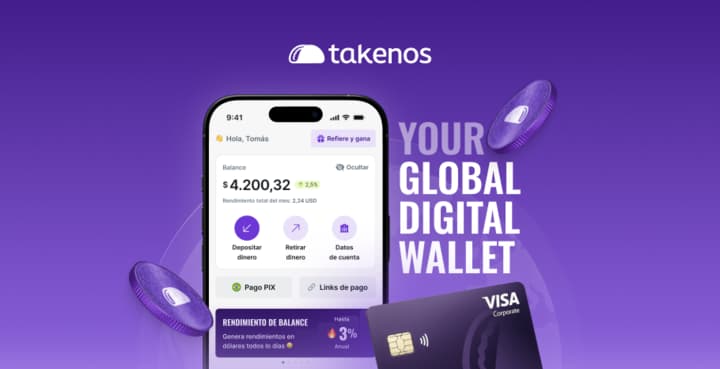
This enables more efficient and flexible payment options for workers worldwide. Employers abroad fund payroll in USD, which workers then receive directly in their Takenos wallet. From there, they can spend their funds via a virtual card or withdraw to their local bank account. Employers also benefit from routing contractor payouts through Takenos, reducing transaction costs and operational overhead.
By pairing regulated, off-chain USD reserve management, held and attested by a licensed financial partner, with Solana’s execution layer, Takenos bypasses the limitations of legacy payment rails without compromising security or ease of use.
The Problem: Friction in Cross-Border Payments
Settlement across borders still depends on correspondent banking networks built for low-frequency, high-value bank transfers, not for recurring payouts to contractors, creators, and vendors operating across markets.
In regions like Latin America, where income is often earned in other markets, these constraints directly affect peoples’ access to income, working capital, and financial stability. Receiving money from abroad through traditional banking is slow and expensive, and these issues cannot be resolved using legacy financial rails alone.
| User Challenges | Structural Causes |
|---|---|
| Slow Transfers: Traditional bank transfers can take anywhere from 2-5 business days to clear. High Costs: Users often lose between 3-10% of their money to foreign exchange spreads and wiring fees. Unreliable Outcomes: Payments can fail, stall, or be reversed without clear explanation or recourse. | Batch-Based Settlement: International wires clear through legacy systems that do not operate in real time. Layered FX and Fees: Currency conversion and wire fees compound costs across multiple intermediaries. Jurisdictional Fragmentation: Local capital controls and banking failures regularly disrupt transfers. |
Solution: Programmable stablecoins that can be sent to millions, globally and cheaply
“I’ve been able to deposit my salary without worry. And in Argentina, that’s no small feat. I spent years getting paid through different channels, losing a huge percentage to commissions and waiting days to receive my money” - Renato Piermarini, Takenos User
Takenos identified three core needs for its users:
- A reliable way to hold value pegged to the US dollar.
- Instant settlement to get access to their working capital quickly.
- A transparent, auditable system that partners and regulators could trust.
To enable the above, Takenos deployed its own USD-pegged stablecoin on the Solana network. This stablecoin is backed by offchain reserves, which are held and regularly attested by a regulated partner (Bridge). This asset serves as the platform’s primary internal rail for settling payments.
The team chose to create their own stablecoin rather than using an existing one. This approach gave them direct control over three key areas:
- Revenue & Float Management: Managing their own USD-backed reserves enables Takenos to capture net interest margin on balances, optimize treasury operations, and support sustainable revenue generation aligned with payment volume.
- Auditable Supply: Now they could tie all minting and burning of the coin directly to their reserve attestations. This makes the supply fully auditable.
- Programmatic Compliance: It allows them to build their compliance rules and policies directly into the program that controls the stablecoin.
- Predictable Unit Economics: Operating its own stablecoin allows Takenos to control issuance, settlement, and internal transfers without relying on third-party stablecoin providers, keeping per-transaction costs predictable and aligned with payout volume as the platform scales.
Takenos’ setup requires onchain infrastructure that can execute quickly, apply predefined rules consistently to every transaction, and keep costs low and stable at scale. Solana provides the execution environment that makes this approach practical at scale.
How it Works: Takenos’ Stablecoin Architecture
Takenos’ stablecoin combines the performance of Solana with the compliance guardrails of regulated banking. This system is designed to ensure that every dollar in circulation is fully backed, accounted for, and settled predictably even as payment volume grows.
| Step | What Happens | System Components |
|---|---|---|
| 1. User action | A user initiates a payment, payout, or conversion through Takenos | Takenos app / API |
| 2. Compliance & pre-checks | Identity checks, sanctions screening, transaction limits, and reserve availability are validated offchain | Takenos backend (KYC/AML, policy engine) |
| 3. Onchain policy enforcement | The request is submitted onchain, with rules enforced before any supply change | Controller program (built with Anchor) |
| 4. Reserve verification | The system confirms USD reserves are attested and sufficient to back the requested action | Reserve custody with bridge + controller program |
| 5. Data sanity checks | Reference pricing and data freshness are validated | Oracles (e.g., Pyth) |
| 6. Execution | If all checks pass, the stablecoin is minted, burned, or transferred | SPL token program (with multi-sig mint & freeze authority) |
| 7. Recording & monitoring | Events are recorded and streamed for real-time tracking and auditing | Multiple RPC providers + indexing + internal ledger |
| 8. User access & payout completion | The user accesses the settled funds in their Takenos wallet, where they can hold USD, spend via card, transfer, or withdraw to a local bank account. | Takenos wallet + card / local payout rails |
Measuring Impact
Takenos’ stablecoin payment rail is live and delivering measurable economic relief across Latin America. By replacing international wires with onchain USD settlement, their system increases payment speed, cost, and reliability for thousands of users transferring funds across borders.
- Volume & Scale: The platform has processed over US$500M in total volume, with US$10M settled onchain each month.
- Growth: Takenos saw ~20% month-over-month growth throughout 2025 following this deployment.
- User traction: Takenos is now active across 20+ countries, and consistently ranks among the top-3 finance apps in the Bolivia app store.
Solana as the Foundation
Underpinning this system is Solana, which provides the high-performance execution environment required for real-time settlement at scale.
| Fast finality: ~400 ms block times enable settlement in under two seconds, replacing multi-day wire transfers. | Low, predictable fees: Median fees around $0.001 keep small-dollar payouts viable, even under load. | High throughput: Parallel execution supports thousands of concurrent transfers during peak periods. |
| Cost stability under load: Fees remain consistent during regional payout waves and network traffic spikes. | Mature RPC infrastructure: Multiple production-grade RPCs enable near real-time reconciliation and monitoring. | Network reliability: QUIC networking and stake-weighted QoS reduce dropped transactions during high demand. |
A New Standard for Cross-border Settlement
Takenos shows that cross-border payments can reach new levels of efficiency, transparency, and reliability when built on modern infrastructure rather than legacy rails. The platform is expanding into Peru and recently received $5M in seed funding, as their stablecoin deployment increasingly powers everyday financial use across Latin America.
| Join Takenos for a better way to get paid on time, keep more of what you earn, and ensure funds arrive when expected. takenos.com | Interested in building on Solana? Deploy new financial services that settle instantly, scale effortlessly, and operate reliably. payments.org |