
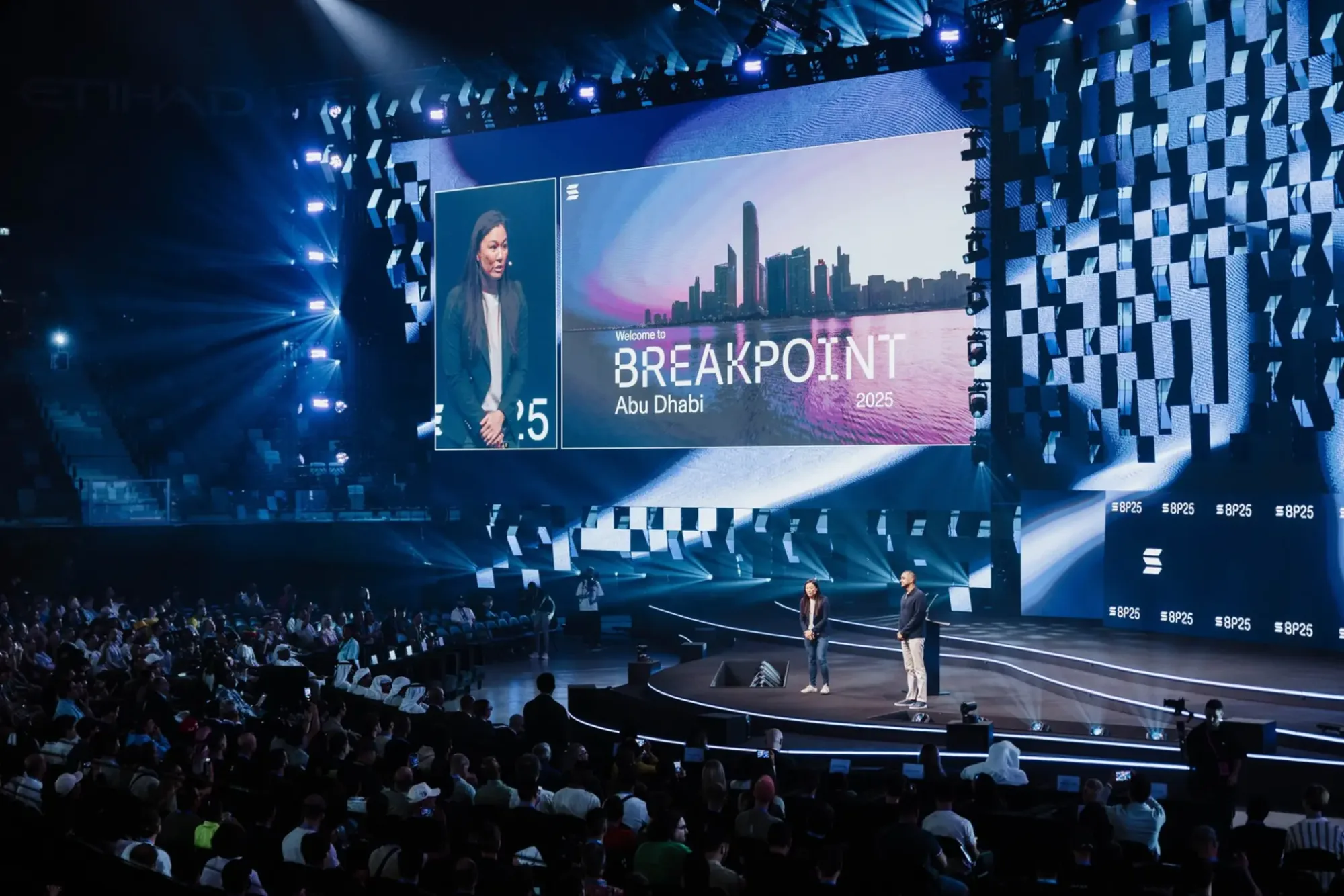
Opening the event at the Etihad Arena in Abu Dhabi, Solana Foundation President Lily Liu asserted "We ship in production. We ship at real scale, with real capital, and with a real community around us."
Solana's Breakpoint has been defined by distinct phases throughout the years. In 2025, the focus was primarily on Revenue.
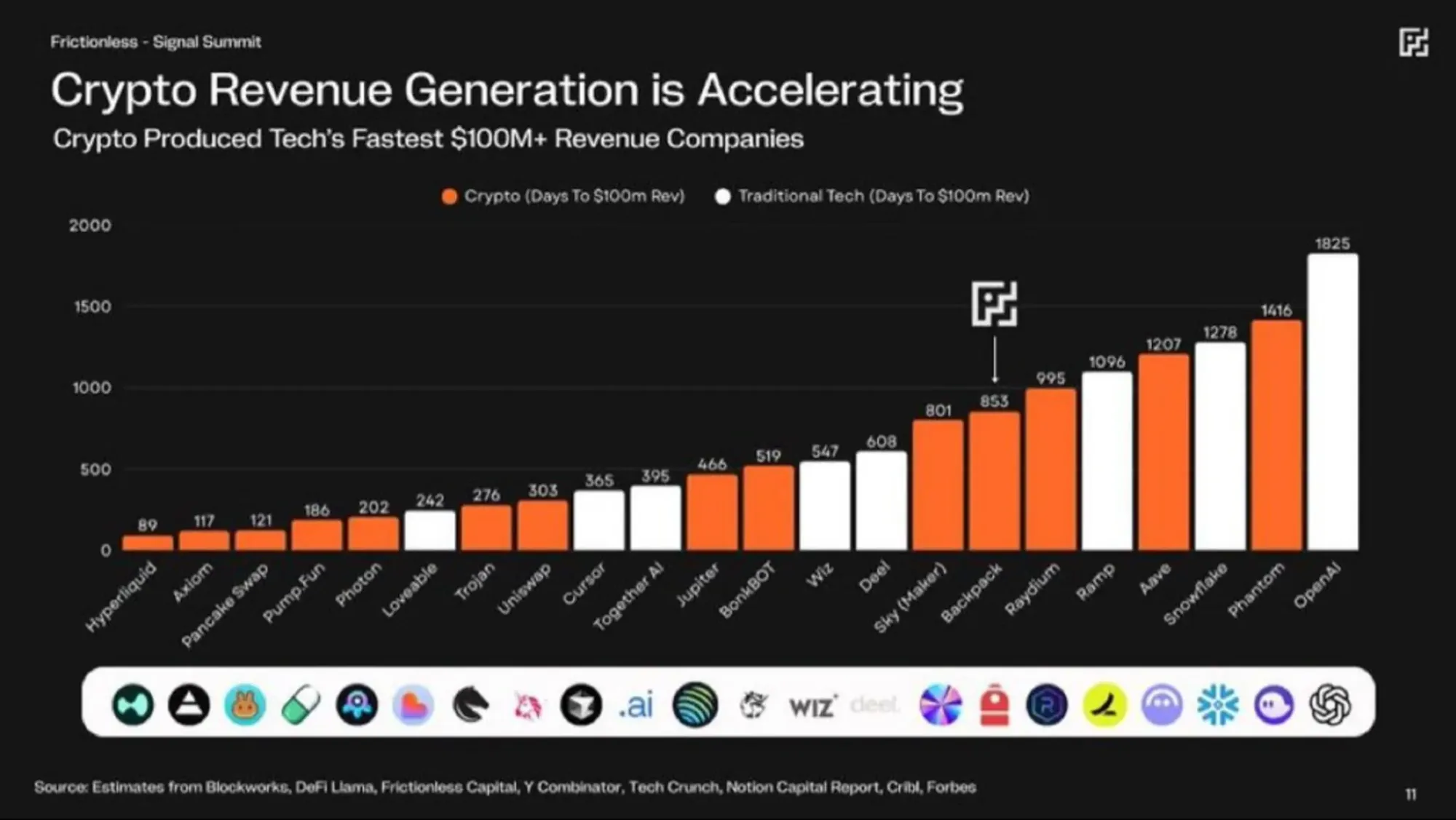
The Abu Dhabi edition marked a transition from "crypto-native" gatherings to a top-tier financial summit.
By selecting the "capital of capital" alongside events like Abu Dhabi Finance Week, Solana signaled that it is no longer a crypto sub-sector. It is the Silicon Valley of the Internet: a decentralized jurisdiction where garage startups have matured into unicorns.
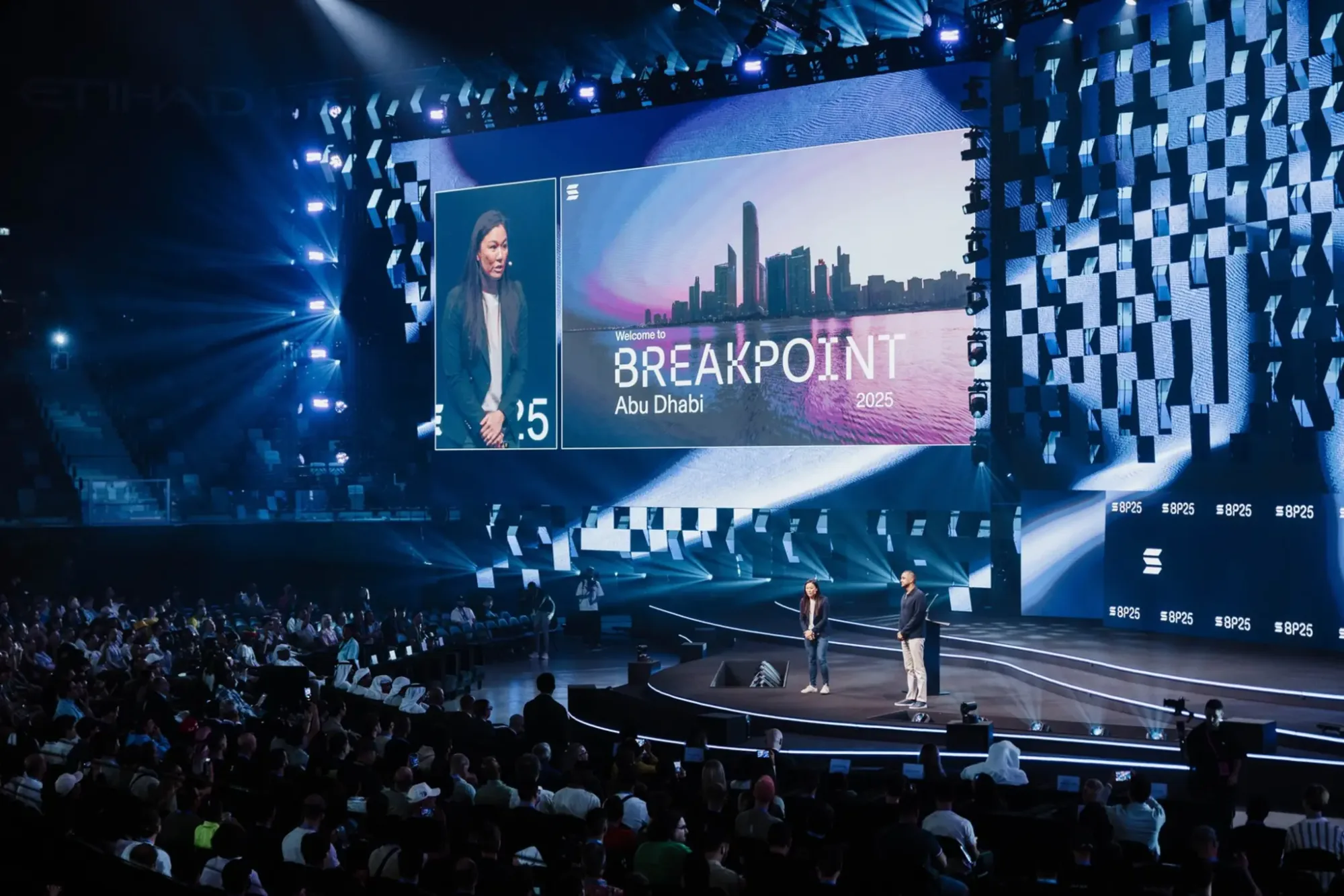
Breakpoint 2025 was not about a single flagship announcement. Across keynotes, technical sessions, and firesides, a consistent theme emerged: It's no longer just about raw throughput, but how economic activity organizes itself at scale. Across 80+ sessions, a singular vision crystallized: Solana as the "Everything Chain".
The Revenue Pivot
Early in the event, Ben Nadareski from Solstice mapped Solana's financial evolution into three distinct phases:
- Phase One (2020-2022): Subsidies pretending as yields. Token emissions drove capital. When the "fake" money ran out, capital evaporated.
- Phase Two (2022-2025): The Purge. Capital rotated toward protocols with audited risk frameworks. Real yield emerged from liquid staking, MEV distribution, and trading fees.
- Phase Three (2025–Present): Institutional scale. Sustainable returns driven by real market activity.
The numbers aren't abstract. They translate to up to 20% APY for sophisticated investors combining LST, MEV, and hedged strategies. These yields are uncorrelated to traditional markets, forcing institutional allocators to pay attention.
The Capital Layer: Institutional Convergence & Sovereign Scale
Galaxy's Michael Marcantonio framed the inevitability of the institutional pivot by asking how the industry moves the $500 trillion securities market onchain. His conclusion was simple: "Solana is the only blockchain at scale that can warehouse the global capital markets." This wasn't theoretical. Galaxy has already tokenized its own publicly traded stock on Solana.
The next section represents the most significant structural shift in the ecosystem. The announcements below detail how the world's largest financial entities and sovereign nations are deploying production-grade capital infrastructure on it.
The Banking & Securities Stack
The "Capital Layer" is now live. Major US and global financial institutions are bypassing legacy rails in favor of Solana's high-speed settlement.
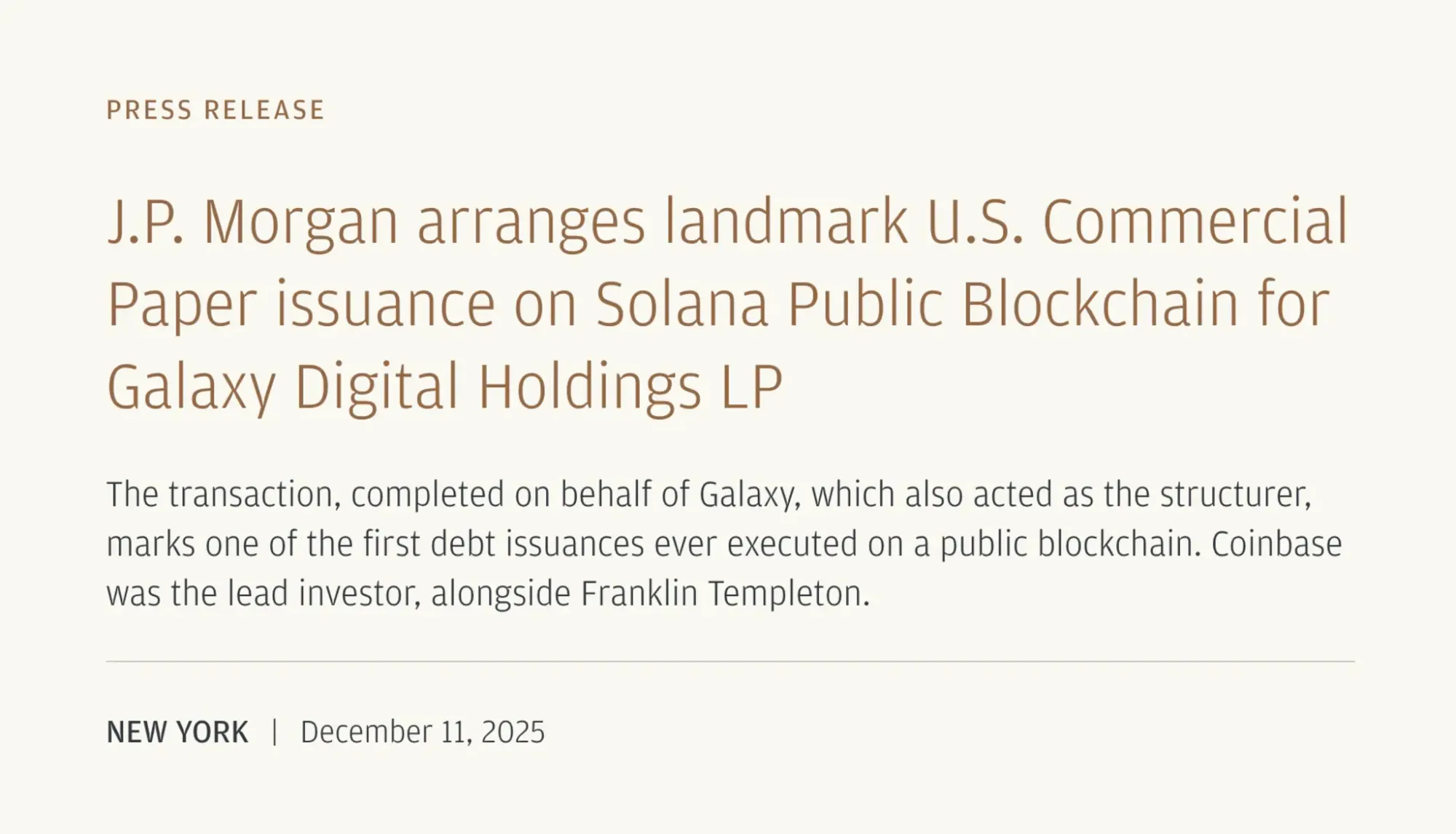
- J.P. Morgan U.S. Commercial Paper: In a historic move, J.P. Morgan arranged a U.S. commercial paper issuance for Galaxy Digital on Solana. By executing this on a public mainnet rather than a private ledger, J.P. Morgan validated the thesis that public chains like Solana offer superior liquidity and settlement guarantees
- State Street: With $50 trillion assets in custody, State Street announced plans to launch the State Street Galaxy Onchain Liquidity Sweep Fund (SWEEP), a tokenized private liquidity fund on Solana in early 2026. This tokenized money market fund will allow 24/7 subscriptions and redemptions via PayPal's PYUSD. It's a first for a Global Systemically Important Bank
- Paxos’ SEC Bid: Paxos filed for SEC clearing agency status to issue native onchain securities that settle instantly. CEO Charles Cascarilla was explicit about the ambition: to make Solana the settlement layer where you prefer to buy assets because the settlement is instant, unlike the T+2 standard of the NASDAQ
- Figure’s Onchain IPO: Figure filed for SEC approval to natively issue a second IPO on Solana. Unlike a traditional IPO that lists on the NYSE or Nasdaq, this equity would be born, traded, and settled entirely onchain
- Marketnode and Lion Global Investors: Are bringing their Singapore Physical Gold Fund onchain. This creates a regulated bridge for Asian capital to access onchain commodities
- Singapore Gulf Bank (SGB): Enabled direct minting/redeeming of USDC/USDT on Solana, providing a regulated onramp for the Asian capital
Sovereign Assets & Commodities:
The "Internet Capital Markets" are now hosting nation-state assets and physical commodities, moving far beyond digital-native tokens.
The Geopolitical Layer
- Bhutan's Gold Standard: In a geopolitical first, the Royal Government of Bhutan announced it will tokenize its sovereign gold reserves on Solana via DK Bank. The $TER token will be 1:1 backed by physical gold. This is a G2 (Government-to-Chain) integration where a nation-state uses a public blockchain to manage its national wealth
- Kazakhstan's Economic Zone: Kazakhstan is establishing Solana economic zones with full government backing, recognizing the network as a compliant digital asset jurisdiction
Commodities
- Uranium Digital: Showcased giving institutions access to tokenized physical uranium. This creates a spot market for a strictly controlled commodity, offering transparency and liquidity to a traditionally opaque, bilateral market
- Oro Gold: Introduced StGOLD, the first yield primitive for composable gold. This allows tokenized gold to be used as collateral in DeFi, earning yield while maintaining exposure to the commodity effectively turning gold into a productive asset
- Huma Finance: Partnered with Obligate and TradeFlow to provide stablecoin liquidity via Solana for commodity trade finance
Enterprise Infrastructure, RWAs and Stablecoins
- In partnership with the Solana Foundation, Blockworks unveiled Lightspeed, crypto's first Investor Relations (IR) platform. As public blockchains function like public companies, they need standardized reporting, metrics, and communication channels for institutional investors. Lightspeed fills this gap
- R3: Announced Corda, a regulated RWA Marketplace on Solana launching in early 2026. This marketplace connects traditional issuers (who need distribution) with onchain capital (which needs yield)
- Keel Finance: Announced a massive $500M fund. In partnership with Sky, this initiative offers a total allocation of up to $500M for native tokenized assets on Solana
- RockawayX: Announced the arrival of three curated vaults in January 2026, simplifying institutional access to onchain yield strategies
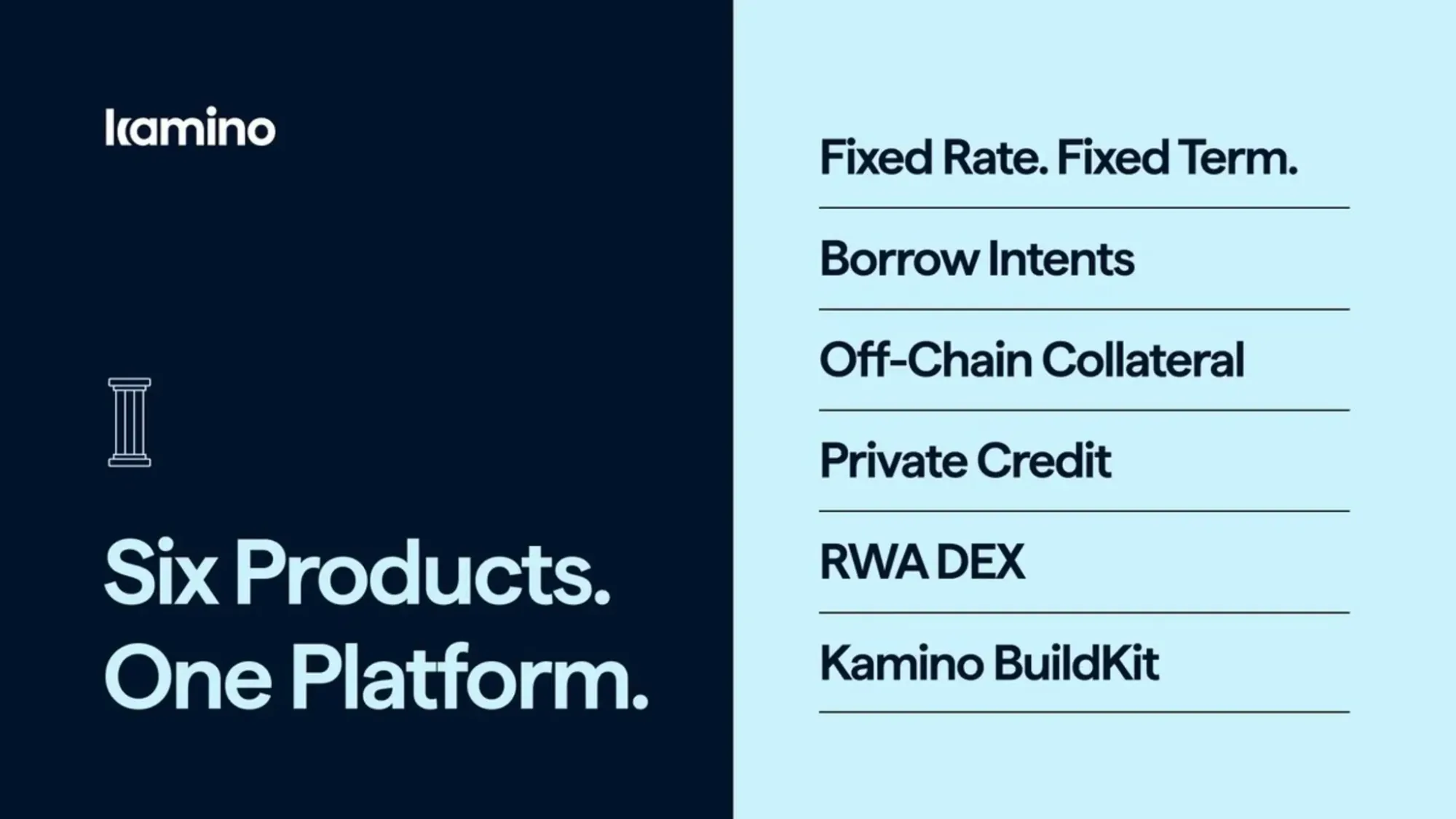
- Kamino's Institutional Pivot: Kamino announced six new products, effectively evolving from a lending protocol into a full-stack institutional yield layer: Fixed Rates, Borrow Intents, Off-Chain Collateral, Private Credit, RWA DEX, BuildKit
- Altitude: Announced a suite of tools designed to streamline onchain financial operations (payroll, treasury management, bookkeeping), solving the operational headache for crypto-native CFOs
- Abra: Introduced AbraFi, along with USDAF and sUSDAF, a suite of institutional-grade DeFi products and stablecoins designed for regulated entities
- D3 and InterNetX partnered via the Doma Protocol to tokenize 46 million+ domain names. By treating domains as liquid RWAs, they unlock a massive new asset class
- Streamflow: Minted USD+, a yield-bearing stablecoin that streams daily yield payouts
- Jupiter: Announced the launch of JupUSD, a stablecoin integrated across the entire Jupiter ecosystem
Equities & Expansion
Tokenization is reaching into the core of the global equities and domain markets.
- Animoca Brands: The gaming giant announced it will tokenize its equity via Republic on Solana. This allows for broader access to pre-IPO equity and potential secondary market liquidity
- xStocks opened xPort: A bridge allowing institutions to deposit real-world equities and mint tokenized stocks on Solana
- WisdomTree: The asset manager, is bringing its suite of tokenized RWAs to Solana
- The Solana Company: Positioned Solana as the "Chain for China," hinting at strategic inroads into the massive Asian market
- XRP is coming to Solana: Hex Trust and LayerZero will bridge and issue $wXRP, a Solana DeFi-ready token redeemable at any time 1:1 for XRP on the XRP Ledger
The cumulative message was clear: Solana isn't a network for a particular use case. It's the settlement layer for all use cases.
Market Structure 2.0
The "everything chain" vision requires robust market structure.
Phoenix Perps:
- Ellipsis Labs is taking their spot market dominance into derivatives and launching Phoenix Pers. They are utilizing the Prop AMM design to crush the spread difference between onchain and offchain venues
Phantom:
- Phantom launched prediction markets natively within the wallet, powered by Kalshi. This allows users to trade on outcomes (e.g., Fed rate cuts, election results) directly from the Phantom wallet
Access & Aggregation
- Coinbase: Coinbase previewed in-app DEX trading specifically for Solana tokens, acknowledging that the "long tail" of assets lives on Solana. It’s live now in the U.S.
- Bitget UEX: Bitget released UEX, a feature letting its 100M+ users trade any Solana token instantly without bridging, blurring the line between CEX and DEX
- dYdX: In a major strategic expansion, dYdX chose Solana to launch its first-ever spot trading product
Transitioning from Memes to ICM
- While meme-driven activity provided the initial stress test, the ecosystem is aggressively rotating towards non-speculative asset issuance. Models like MetaDAO are the frontrunners in this shift, utilizing futuristic market designs for corporate governance and capital formation.
- Ranger Finance announced its intention to raise $6 million on MetaDAO, the highest fundraising target in the platform's history
The New Physics of the Chain
While the capital layer grabbed headlines, the infrastructure layer moved quietly.
Firedancer is Live: The long-awaited validator client is officially on mainnet. Solana is no longer a single-client network; now begins the era of true client diversity.
In parallel, Anza confirmed that the Agave client has achieved over 1 million transactions per second in lab settings. The most significant protocol-level revelation was Multiple Concurrent Proposers (MCP), a redesign of block production
Anza also revealed staggering statistics about Solana:
- Solana has processed 200 billion transactions in the last two years alone
- It is more than all other blockchains combined
Scaling State & Privacy
- Arcium: Showcased powerful privacy primitives, showing that Solana can now support confidential computation. Their presentation centered on the below components:
- CSPL: The Confidential SPL standard enabling encrypted balances and transfers that remain composable with Solana programs
- Cerberus (Dishonest-majority MPC): A multi-party computation protocol that remains secure as long as one node is honest
- Light Protocol: Unveiled the Light Token, a new standard using ZK Compression that is 200x cheaper than standard SPL tokens. This is critical, you cannot onboard a billion users if every account costs dollars to provision
The infrastructure improvements will create a flywheel. Temporal's Ben Coverston showed what one of the aspects looks like: a block building marketplace where competition replaces capture. JITO's Lucas Bruder explained BAM, programmable infrastructure where applications can define their own sequencing rules. Anza's Brennan Watt outlined Alpenglow, a consensus engine that cuts finality times to 150 milliseconds.
This is the maturation of the network.
AI x Crypto
Another theme at Breakpoint 2025 was the intersection of AI and crypto. AI agents cannot open bank accounts, but they can hold Solana wallets. Positioning Solana as the primary financial settlement layer for the non-human economy.
- Solflare: Demoed Magic AI, a natural language interface where users type "Swap my USDC for SOL if the price increases above $150." The wallet handles the routing, slippage, and execution, abstracting away the blockchain entirely
- Meridian: Showcased an intelligent conversational analysis and trading tool, allowing users to "chat" with the market data to find edge
- Render Network: Launched "Dispersed." This customer-facing subnet processes generative AI models on decentralized GPUs at scale
- Wingbits: Debuted an AI intelligence layer to query global aviation data. By aggregating flight tracking onchain, they enable users to query complex datasets, democratizing access to institutional-grade logistics data
- Glider: Announced an AI-driven investing app that automates portfolio management strategies previously reserved for hedge funds
- BAXUS: Creating a decentralized price-mapping layer for RWAs, using AI to accurately price illiquid assets like whiskey and wine onchain
- Send AI: Teased Suzi, an AI investment banker on Solana
Mobile & Payments
Breakpoint 2025 also showcased a push to make crypto usable for the remaining 99% of the world.
The Payments Revolution
- Jeremy Allaire, CEO of Circle: Highlighted Solana's USDC volume supremacy as the ultimate validation: the market has chosen Solana as the payment rail of the future
- Solana Mobile: Unveiled its Hardware Integration Kit, moving beyond the need for standalone crypto devices, to embed the Solana stack directly into the Android ecosystem. Announced plans to partner with major chipset manufacturers with a potential distribution footprint of over 2 billion devices
- Drift and Sanctum: Both announced launching their native mobile app
- Solflare Shield: In a massive "Oprah moment," Solflare gifted its new Shield hardware wallet to all Breakpoint attendees. The device is a battery-free, card-shaped wallet that uses NFC to sign transactions. It removes the friction of cables and charging, bridging the security gap for mobile-first users
- Helium: Announced the expansion of its network coverage to Mexico and Brazil, solidifying its role as the connectivity layer for distributed devices
- Xelio: Presented an SMS-based bank (can be accessed w/o internet connection) and a Solana payment network which can be accessed inside WhatsApp. This allows users in emerging markets to transact on Solana using feature phones and existing chat apps
- Tala: Outlined how it uses Solana to support real-world credit infrastructure, emphasizing reliability and cost predictability. It is bringing trustless lending to its 10 million+ users. By integrating Solana rails, they can offer undercollateralized loans in emerging markets with instant settlement
- KAST: Unveiled virtual USD accounts, and an enterprise product ("Kast for Business"), positioned to make cross-border payroll and payments routine
Beyond the headlines of AI and mobile, a new cohort of developers is also building on Solana. Raise, a leader in the gift cards and rewards space is tokenizing the gift card market. Fundl is aiming to disrupt the crowdfunding sector by replacing user churn with tangible onchain upsides. Meanwhile, Crypto Fantasy League (CFL) is gamifying trading into a social and competitive game.
The Human Layer: "Proof of Stake network, but a Proof of Work community."
But beneath all the infrastructure and market structure innovation was something more important: The people of Solana.
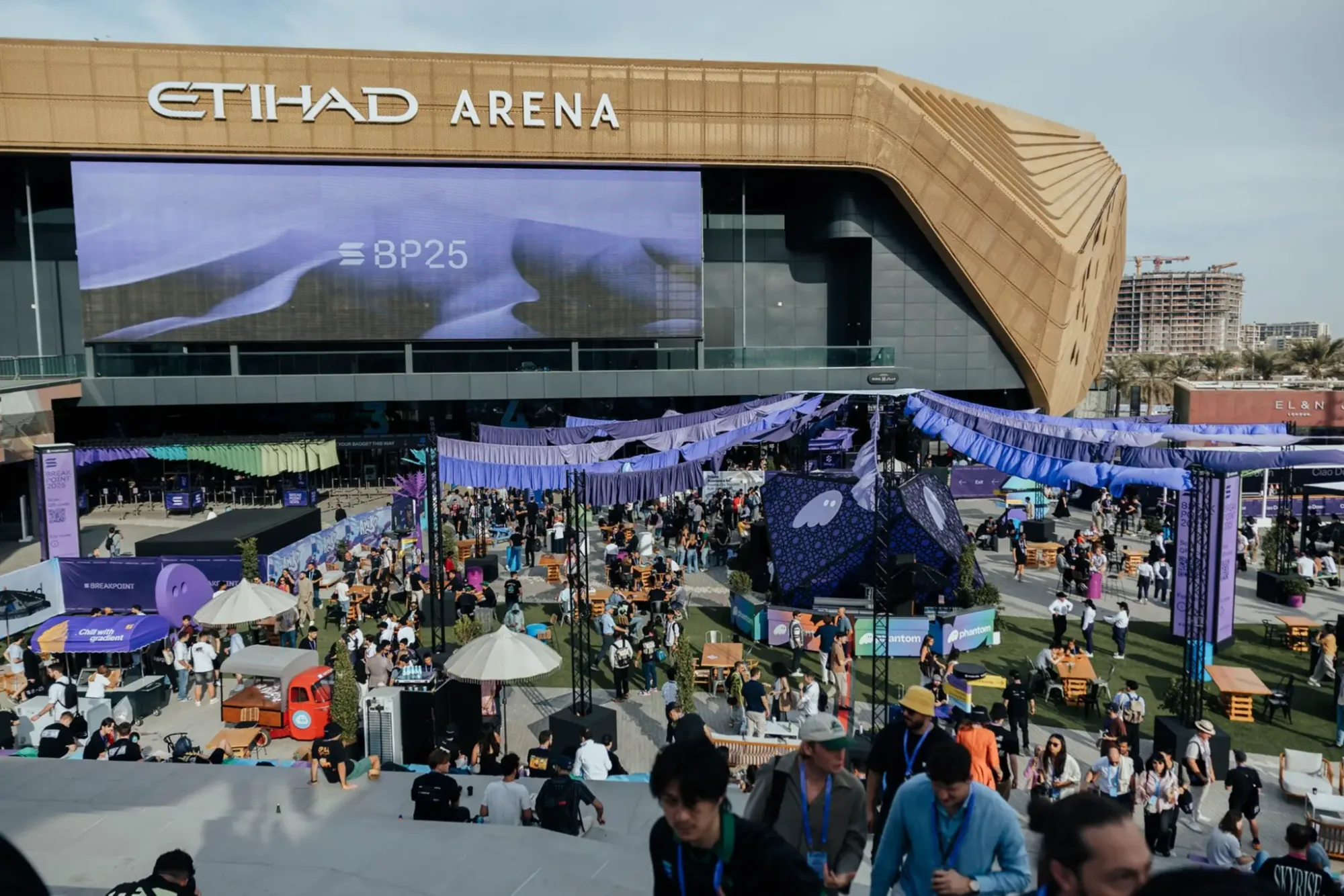
This edition was the first Breakpoint in the Middle East and it was a sold-out event. Alongside the keynotes and fireside chats, Community Spotlight Awards powered by Solflare and Solana Foundation celebrated the ecosystem's top builders, creators, and culture shapers.
The revolution isn't about just faster transactions or lower fees (though those matter). It's about access. This is why a hackathon team can launch a product that competes with decades-old financial institutions. This is why Solana attracts builders along with the users.
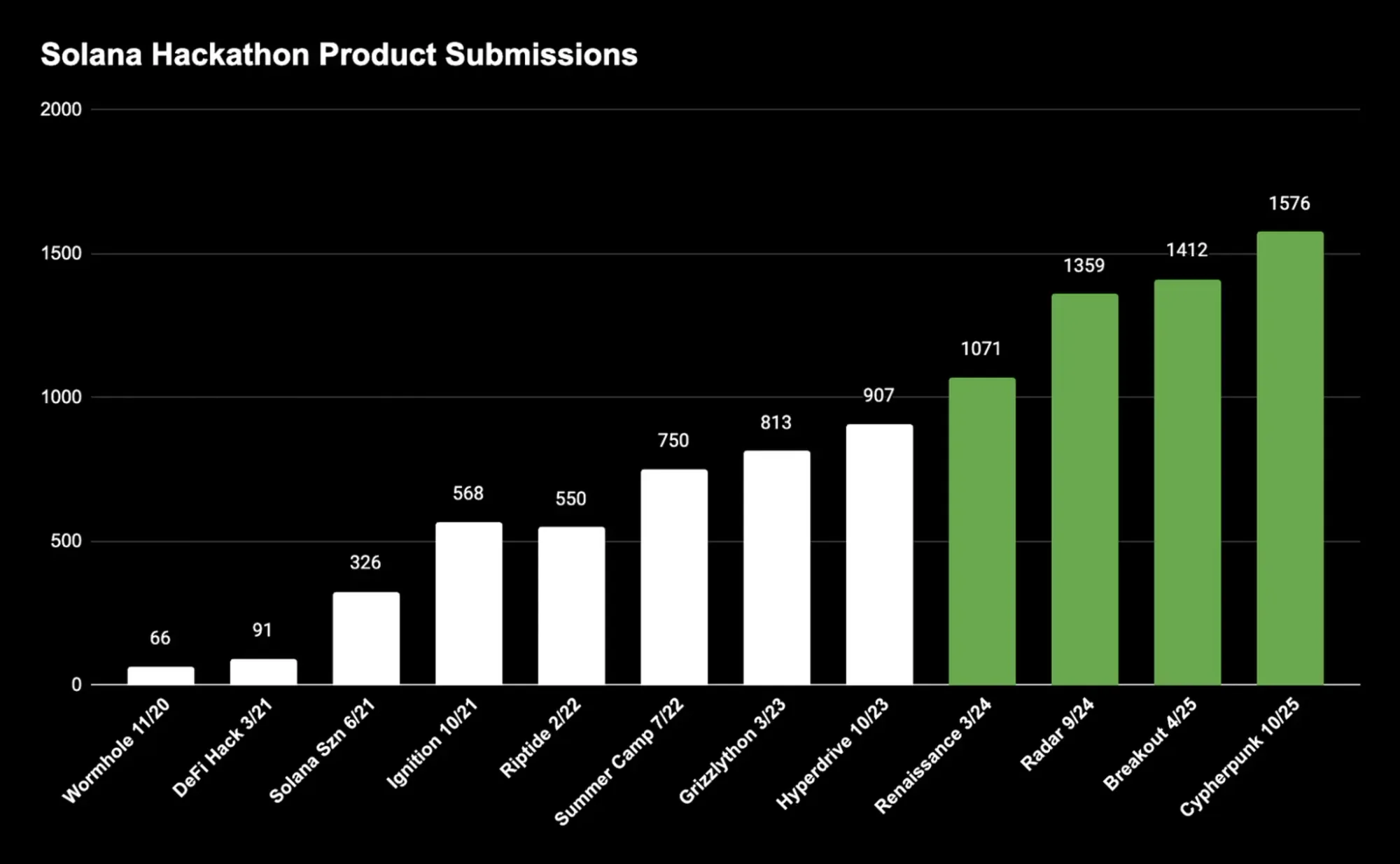
The Colosseum team hosted Colosseum's Breakpoint Arena for all Breakpoint attendees. The workspace featured technical workshops from leading Solana developers as well as desks setup to get work done.
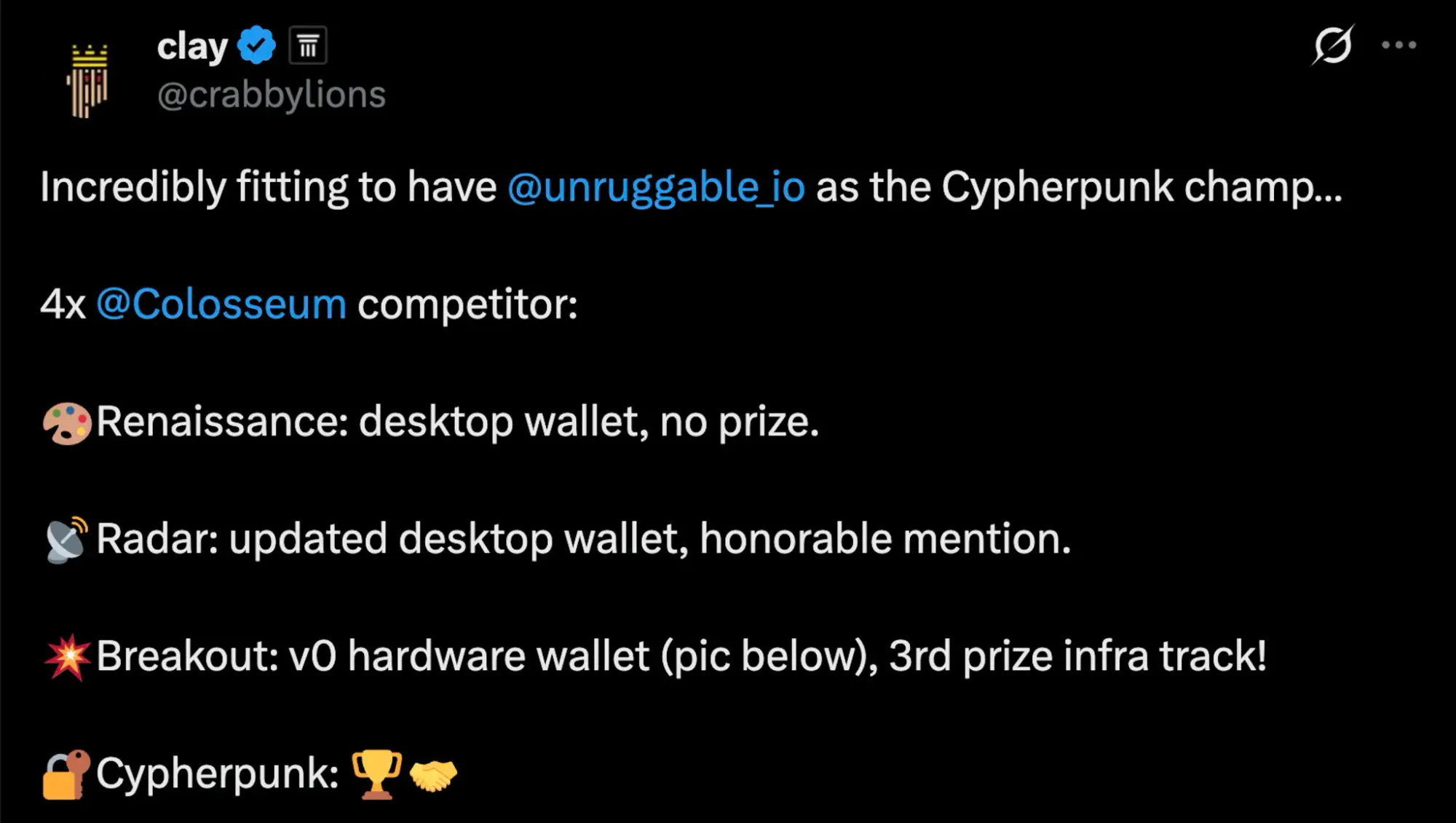
They also announced the winners of this edition of Colosseum hackathon.
What's Next?
The meta-narrative of Breakpoint 2025 is convergence.
- Convergence of Capital: TradFi assets like are merging with DeFi rails to create a unified global ledger
- Convergence of Latency: Onchain markets are now competing with CEXs on speed and price
- Convergence of Users: The line between Web2 and Web3 is dissolving
Developers are building businesses, not demos. Reflecting on the successful U.S. commercial paper issuance, Scott Lucas of J.P. Morgan noted that just one year ago, this had a "zero probability" of happening.
Solana has moved beyond the question of "will it survive?" to "how fast can it scale?" The answer is: remarkably fast.
The next stop? London. Book your tickets here: Breakpoint 2026