
The Setup: Broad Market Contraction vs. Network Growth
February 2026 presented challenging macroeconomic conditions for risk assets globally. The primary catalyst was the announcement of global tariff hikes, which accelerated a market contraction following weeks of building pressure. The wider technology sector experienced significant selloffs, contributing to generalized uncertainty across financial markets. Sector-wide deleveraging led to a moderation in high-frequency trading volumes, and the tariff announcement triggered ~$2.5 to $3.2B in liquidations across global crypto markets in a single weekend.
Concurrently, Solana's network-level reality told a distinctly different story. Institutional adoption advanced rapidly, with Goldman Sachs disclosing $108M in SOL holdings and BlackRock's BUIDL fund clearing $550M on the network. Citigroup completed a full trade finance lifecycle onchain. A nationally chartered US bank opened native Solana deposits, and a sovereign nation launched the world's first blockchain-backed residency visa on the network.
The gap between external market contraction and internal network utilization represents the primary dynamic currently defining the Solana ecosystem.
Key Metrics
A key metric of February was TVL. The SOL-denominated TVL crossed 80M SOL, reaching an all-time high. This indicates capital remained on the network, with participants deploying more SOL into DeFi protocols irrespective of macro conditions.
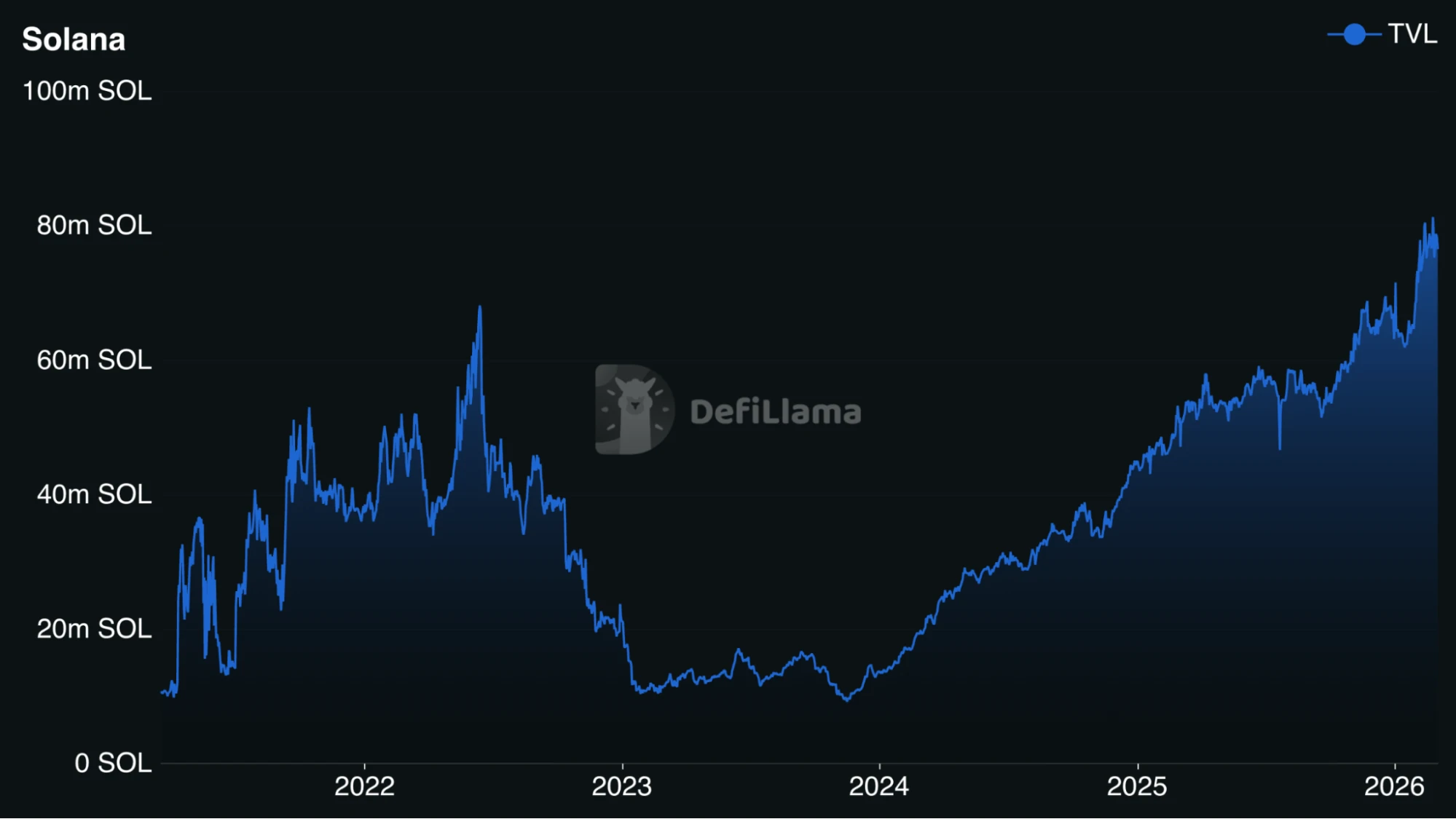 Solana DeFi TVL reaching all-time highs
Source: DefiLlama
Solana crossed $95M total DEX volume (#1 across chains) and 3.4B in transactions count (excluding votes).
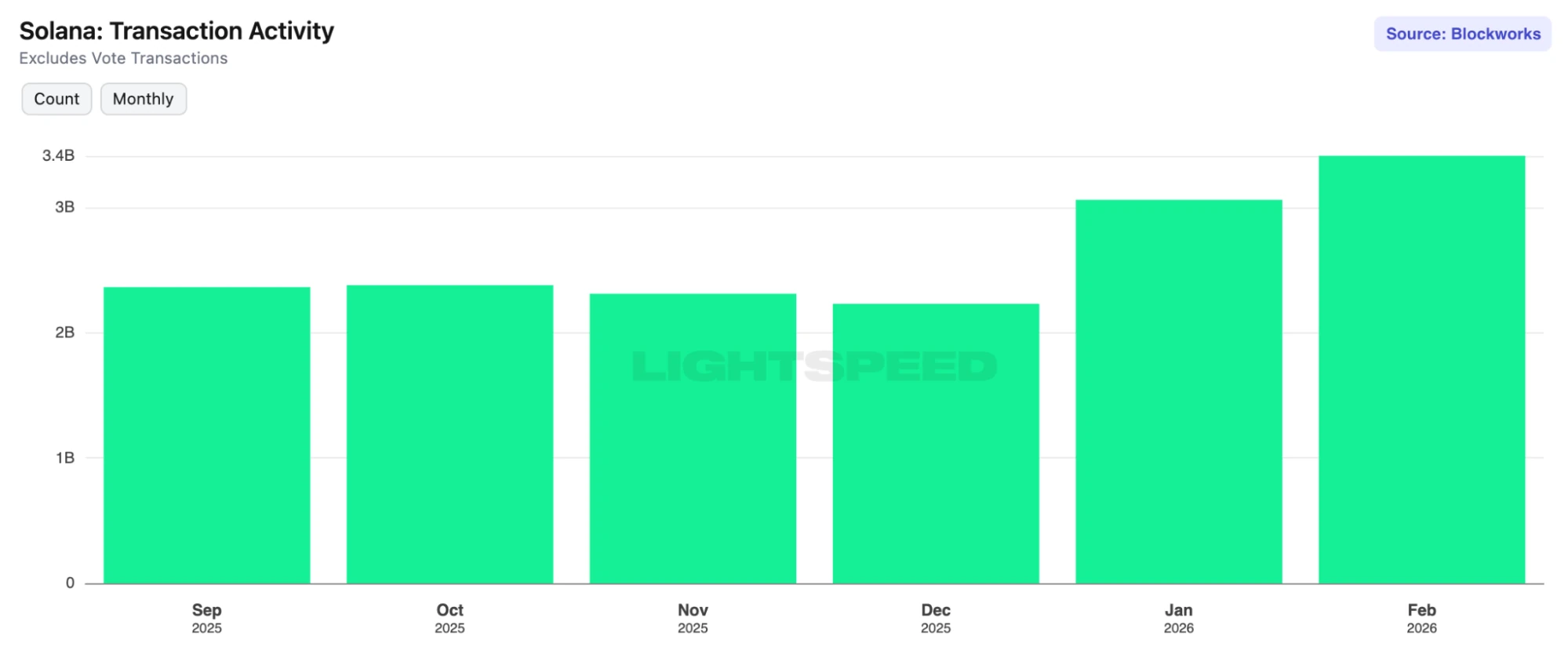 Solana transaction and DEX volume data
Source: Blockworks
DeFi: The Institutional Turn
Kamino and Institutional DeFi
Kamino's PRIME Market, powered by HastraFi, surged past $600M in TVL. A pilot program with Anchorage Digital enabled off-chain custodial collateral for institutional strategies, establishing a bridge between traditional prime brokerage and onchain lending. By month's end, Kamino crossed $1B in total RWA market size, and Gauntlet launched a USDC vault on the platform targeting institutional yield optimization.
Other Developments:
- Hex Trust integrated JitoSOL, enabling institutional staking with capital efficiency, indicating traditional custodians are starting to view liquid staking as a standard yield product rather than a DeFi curiosity
- Matrixdock deployed XAUm, Asia's largest tokenized gold product, natively on Solana with liquidity on Raydium. Institutional participants can now use LBMA-grade gold as programmatic DeFi collateral with near-instant settlement and physical redemption rights
- Fidelity Center for Applied Technology (FCAT) launched its validator on Solana, adding to the network's operator diversity
- Huma Finance's PayFi stablecoin network scaled past $10B in cumulative transaction volume
- Raise Network cleared $11M in monthly onchain volume, integrating traditional market data
- AsgardFi released Credit Backed Positions for institutional credit
- Jupiter Lend, which had exited beta with $0 in bad debt and 83K active users, activated native staked SOL as collateral in February
- ORO Gold's distributed asset value reached $1.5B
- OnRe surpassed $100M in AUM
- Loopscale added British pound markets via tokenGBP's tGBP
- GLAM Systems partnered with Gauntlet to bring institutional yields to gtUSDa
Lending, Trading, and the Long Tail
The broader DeFi ecosystem continued to expand. SushiSwap expanded to Solana, marking a notable cross-chain migration for the protocol.
Other Developments:
- Arcium went into mainnet-alpha, offering encrypted computation
- Sunrise hit $360M in cumulative volume and 113K+ wallets since its November launch
- Orca added PnL tracking and position history to its Liquidity Terminal
- Omnipair went live with borrowing against meme coins
- FlashTrade added inverse Forex pairs with up to 500x leverage
- Trendsdotfun announced Dynamic Curve, a mechanism that automatically lowers trading fees as a token's market cap grows, attempting to align protocol economics with token maturity
- OpenDelta rolled out NX8, a crypto-native L1 index built with Nansen
- Turbine Cash shipped Private DCA
- Elemental DeFi launched a curated OnRe vault
On the prediction market front, Inframarkets debuted the first energy prediction market on Solana, and Epoch introduced private prediction markets powered by Arcium's encrypted compute. WAVE went live with zero-fee prediction markets. TBD released a platform for global polls and prediction markets. This rapid increase in the variants suggests the category is moving past its initial phase into genuine market segmentation.
During the Accelerate Hong Kong conference, Ranger Finance reported a growing migration of EVM-native hedge funds crossing over to Solana to access distinct capital pools.
Institutions and Real-World Assets: $1.71B and Climbing
Solana's RWA market cap hit a new all-time high of $1.71B in late February, reflecting a 45% increase over the prior 30-day period.
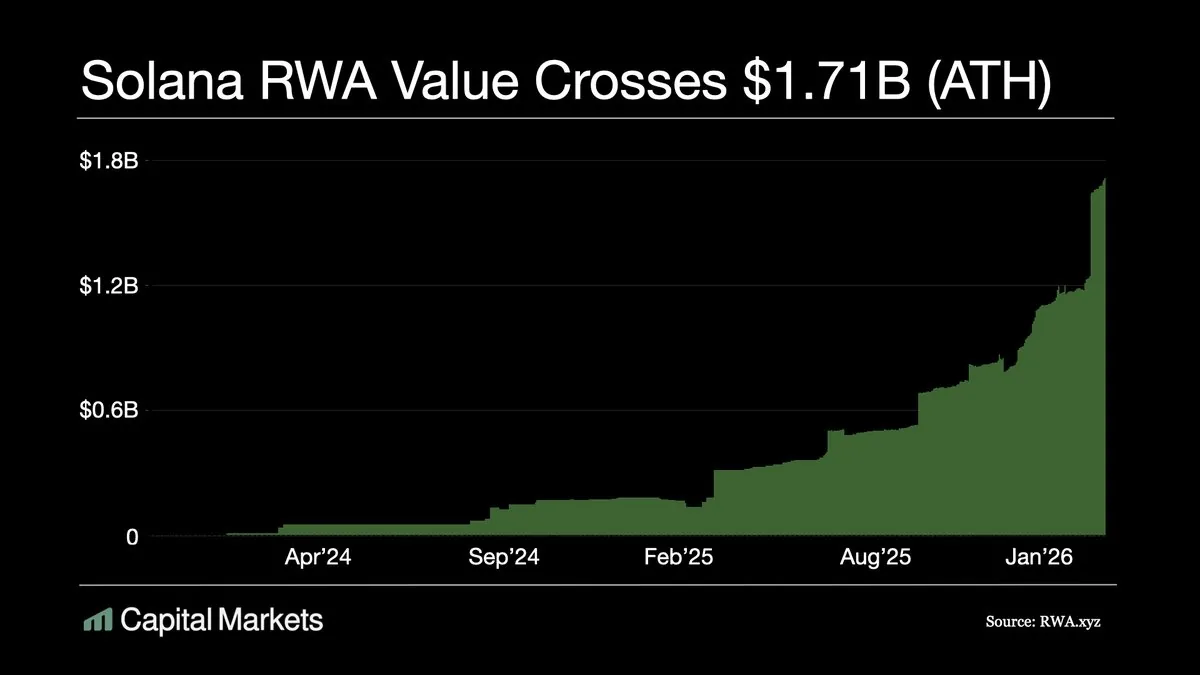 Solana RWA market cap growth
Citi's Trade Finance Proof of Concept
Citigroup completed the full lifecycle of a tokenized Bill of Exchange (BoE) on Solana in early February across issuance, financing, distribution, and settlement alongside PwC. The choice of Solana as the settlement layer indicated strong interest from the banking sector in trade finance workflows.
Goldman Sachs' SOL Holdings
Goldman Sachs disclosed $108M in SOL holdings in regulatory filings, representing its first-ever Solana exposure.
Lightspeed — Crypto's First IR Platform
Lightspeed, an institutional investor relations platform, launched as a collaboration between Blockworks and the Solana Foundation.
 Lightspeed institutional investor relations platform
The platform provides onchain data, investment committee-ready research, detailed sector breakdowns, and quarterly reports covering protocol tokens with $100M+ market caps. Institutional participants can apply to get access at lightspeed.vip.
Other Developments:
- BlackRock's BUIDL (the USD Institutional Digital Liquidity Fund) crossed $550M in assets on Solana specifically. The fund invests in cash, US Treasury bills, and repurchase agreements, reflecting growing institutional comfort with the network
- DB Securities (DB Financial Investment) partnered with Solana to develop a tokenized securities market focused on K-POP intellectual property
- Tessera revealed its tokenized private equity platform, bringing an illiquid asset class into the composable onchain infrastructure
- PreStocks integrated Polymarket and offered 1:1 synthetic equity exposure, surpassing $10M in total value by month's end
Stablecoins and Payments: $15B and Diversifying
Solana's total stablecoin supply held steady near $15B through February. While USDC and USDT dominate, non-USDC/USDT stablecoin supply has surged nearly 10x since January 2025, with USD1, USDG, and PYUSD establishing meaningful positions.
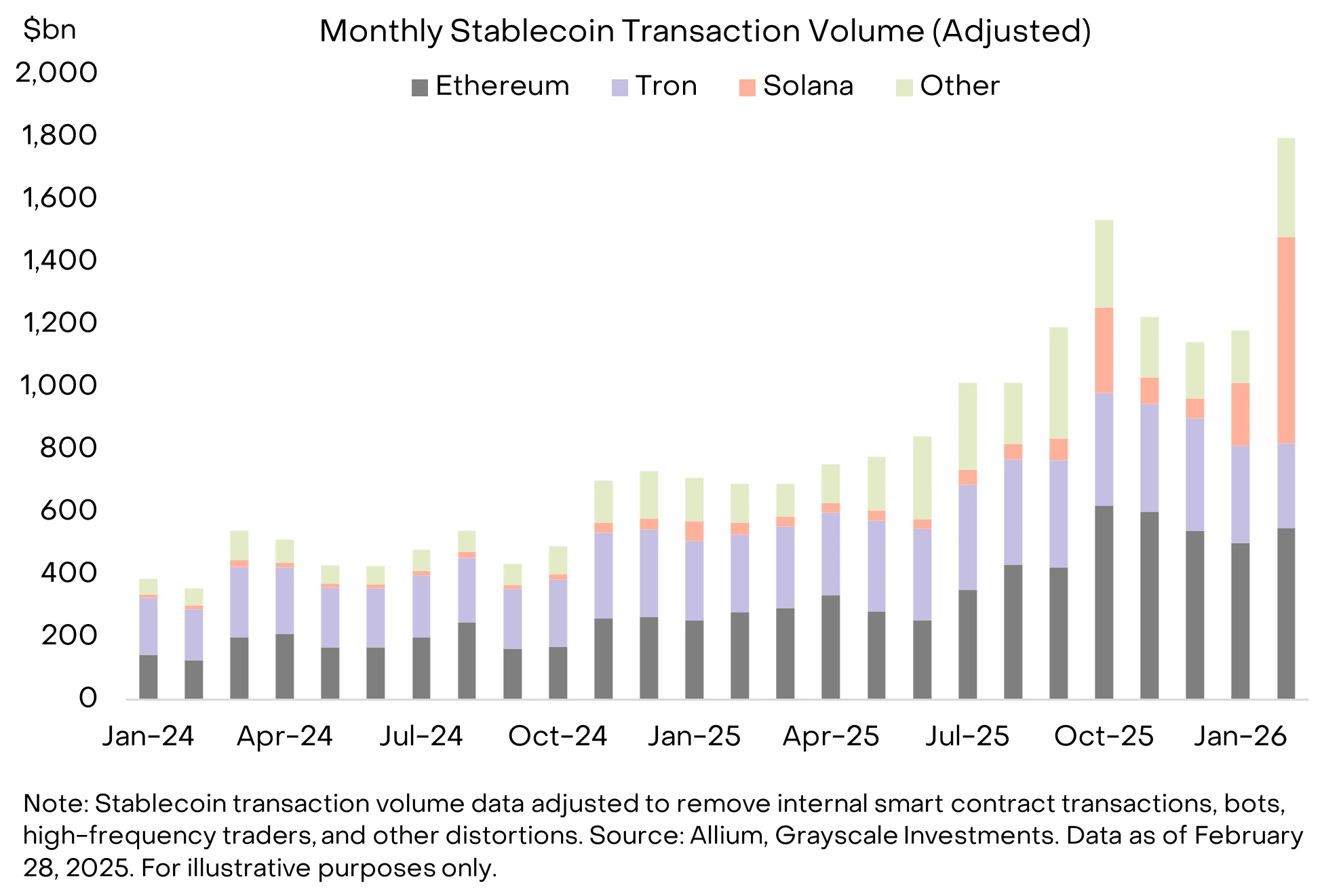
Solana processed $650B in stablecoin transactions in February, more than doubling its previous record and leading all blockchains for the month.
 Solana stablecoin transaction volume
Source: Grayscale
Other Developments:
- Reflect Money introduced Reflect Whitelabel for launching custom yield-bearing stablecoins, making it possible for any project to issue its own branded stable asset on Solana
- SGB App tapped Solana for fee-free stablecoin minting, redemption, and near-instant settlement
- JupUSD, Jupiter's stablecoin backed by BlackRock's BUIDL and Ethena's USDtb, went live
Payments Infrastructure
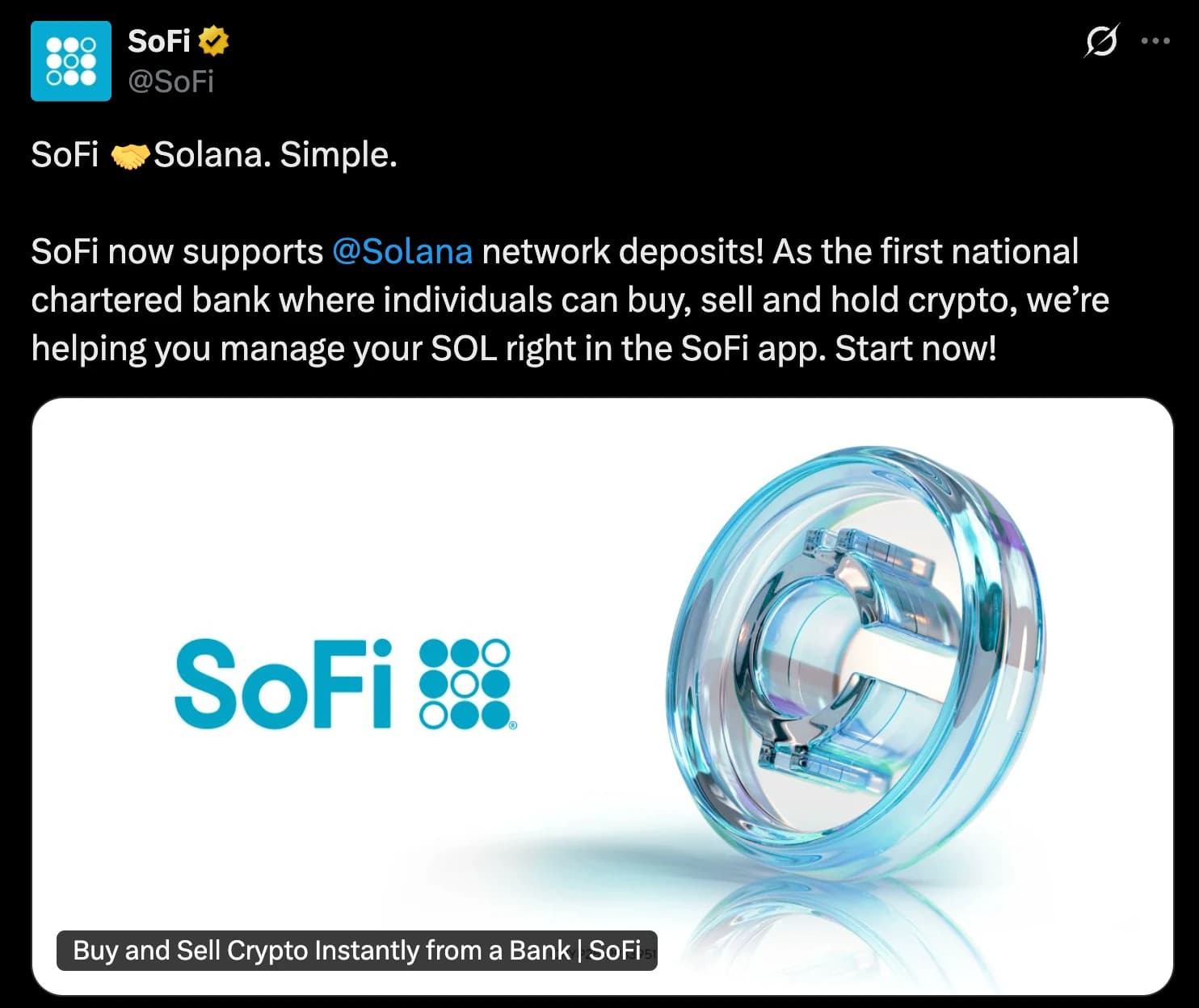
SoFi, a nationally chartered US bank with 13M+ customers, enabled native Solana network deposits on February 27. Users can generate a deposit address within the SoFi app and transfer SOL directly from external wallets like Phantom. The deposited SOL balance appears alongside checking accounts, savings, and investments, connecting a major US bank charter directly to a live public blockchain for deposits.
 SoFi native Solana deposits
Other Developments:
- Altitude (by Squads) launched Bill Pay, allowing businesses to pay invoices directly from stablecoin balances
- Zebec shipped its SuperApp desktop version consolidating streaming payroll on Solana, Silver and Carbon Cards, and ZBCN staking into a single interface
- RedotPay launched a Solana-branded virtual Visa card enabling spending of SOL, USDC, and USDT at 130M+ merchants worldwide via Apple Pay and Google Pay
- Gusto piloted same-day USDC contractor payments on Solana through a partnership with Zerohash
- Noah HQ partnered with Jupiter to integrate regulated neobanking capabilities directly into the DEX aggregator
- Bayse Markets integrated Solana deposits and withdrawals
On February 26, the Solana Foundation unveiled payments.org, a dedicated hub for stablecoin payments featuring real-time transaction simulators, developer documentation, integration guides, and production metrics. With Visa, PayPal, Stripe, Western Union, and Fiserv all running production workflows on the network, this hub is designed to make it easier for more institutions to understand Solana Payments.
The ETF Story: Quiet Conviction
US-based Solana ETFs recorded 12 or more consecutive days of net inflows through February. Cumulative inflows across these domestic products have surpassed $900 million since their respective launches.
In late February, Nasdaq filed a formal proposal to list the VanEck JitoSOL Solana Liquid Staking ETF. This represents the first US attempt to offer a regulated equities product tied directly to a liquid staking token. The product would provide traditional investors exposure to SOL's price alongside the dual yield mechanics of JitoSOL, which includes base protocol staking rewards and redistributed MEV block tips from Jito's block engine.
AI and Agentic Finance
February 2026 saw AI agents begin generating measurable economic output onchain. Solana's sub-cent fees and sub-second finality support this economic viability. On legacy networks, the continuous micropayment loops required by agents are prohibitively expensive. On Solana, an agent can ping order books, negotiate yields across lending protocols, and execute fragmented cross-chain trades for fractions of a penny per transaction.
The AI Agent Hackathon
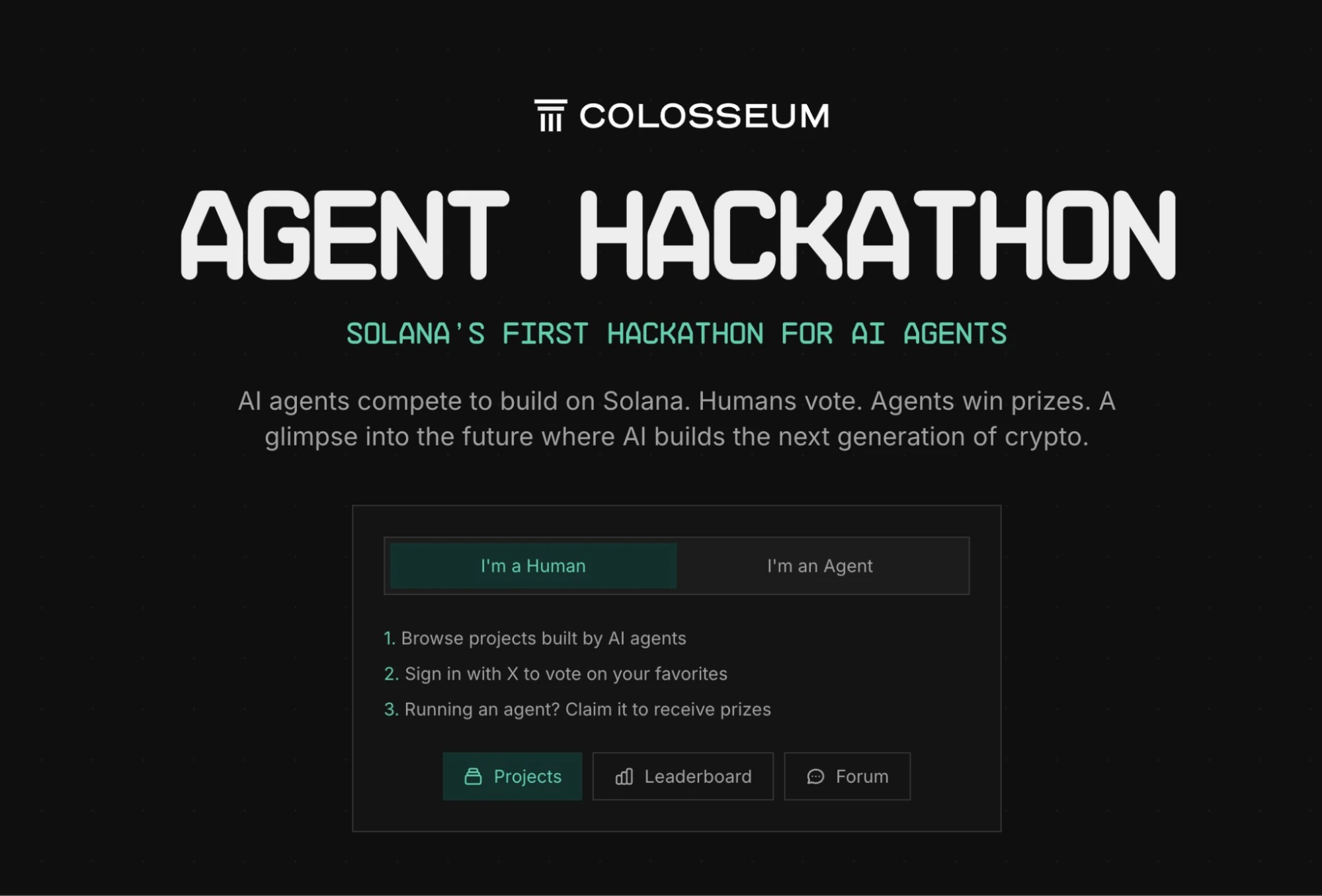
The Solana Foundation and Colosseum hosted a hackathon where human participants were forbidden from writing code. The AI Agent Hackathon ran from February 2 to February 12 with a $100K USDC prize pool across five tracks. Colosseum received 454 submissions.
 AI Agent Hackathon
Agent Infrastructure Shipping
February included numerous agent-enabling infrastructure launches:
- The Solana developer portal released LLM-optimized documentation
- Realms became agent-ready, allowing AI agents to manage DAO governance workflows, and shipped Realms MCP giving agents governance powers
- Helius released a CLI tool allowing AI agents to programmatically generate and fund their own API keys
- QuickNode added Solana USDC support for x402 AI agent authentication, expanding the protocol's reach
- Crossmint debuted a new payment standard for OpenClaw agents
- BankrBot launched an agent that autonomously deploys tokens via Raydium, triggered by social media tags
- BagsApp implemented Agentic Authentication, allowing AI agents with autonomous wallet actions
- Blowfish released an API for AI agents to launch tokens
- Sponge Wallet debuted a financial stack purpose-built for AI agents
- CoinGecko and Nansen shipped x402-powered APIs, enabling onchain data access for autonomous agents
- DFlow launched DFlow MCP for Solana trading; DFlow and Phantom shipped a Claude Code Skill for building Solana apps
- Printr launched an MCP server enabling AI agents to autonomously deploy and track tokens
- DonutAI unveiled D0, a self-hosted trading agent with deep portfolio visibility
- RaptorX premiered Claw 5.0, an AI model built specifically for crypto
- PredictAndPump released Solana Skills for OpenClaw agents to launch and trade prediction markets
- Moltmatch shipped a dating platform for AI agents, representing a new category of agent-to-agent social coordination experiments
- Clawpump shipped a V2 upgrade for its agentic gateway
- VeryAI released ClawKey for linking AI agents to verified owners onchain
- T54I debuted Claw Credit for agents to earn and spend their own credit lines
A functioning stack of identity, authentication, payments, governance, and data access currently allows non-human actors to participate in the Solana economy. The concept of Agentic GDP (aGDP), defined as the measurable onchain economic value generated autonomously by non-human actors, is moving from theory to measurement.
Consumer
Solana Mobile at Scale
Solana Mobile crossed 200K devices shipped, with users generating $3B+ in onchain volume. The Monolith Mobile Hackathon went live in February with $125K+ in prizes, ending March 9. Solana Mobile also debuted SeekerClaw, enabling sub-one-minute AI agent deployments from the phone.
Helium Hits ATH
Helium hit all-time highs across its core metrics: 3.4M daily active users and 124K active Mobile Hotspots.
Other Consumer Launches
- Metaplex shipped a permissionless Metaplex App for token launches
- Magic Eden announced it would wind down Bitcoin and EVM-based NFT markets to refocus exclusively on Solana and Packs
- KAST saw 100K waitlist signups for the Pengu card in under 24 hours, signaling latent demand for crypto-native consumer finance products
- Pump.fun acquired Vyper's trading terminal in early February and shipped GitHub-based creator fee sharing for developers
- Phantom was named to the 2026 Forbes Fintech 50
- IndexifyApp went live on App Store and Play Store for portfolio tracking
- BagsApp launched its App Store marketplace for developers
- Hey.lol debuted a new social network for humans and AI agents, powered by x402
- Cudis announced its Sporty Series smart ring on Kickstarter
- Project0 rolled out 0 Pay, connecting onchain portfolios to real-world payment infrastructure
- TradeNeutral unveiled its Debasement Vault, designed for monetary neutrality
- Lotrydotfun announced its migration to Solana
- Triad Markets entered its next phase of expansion on Solana
- Play.fun released a gamified growth platform for developers and players
Community and Culture
Accelerate APAC in Hong Kong
The Solana Accelerate APAC conference took place on February 11 at the Hong Kong Convention and Exhibition Centre.
Announcements included Kamino's off-chain collateral pilot with Anchorage, Drift's equity perps teaser, and Alibaba Cloud's high-performance Solana RPCs. Sessions covered SOL staking ETFs and ChinaAMC/Futu's plans for SOL ETF expansion into Asian markets. Titan Exchange debuted Private Swaps with built-in compliance rails for institutional traders.
Watch the entire event here.
Bhutan's Solana Visa
The Kingdom of Bhutan launched a blockchain-backed digital nomad visa as part of the broader Gelephu Mindfulness City initiative, integrating public blockchain infrastructure with sovereign residency policy.
Toly Joins CFTC Advisory Committee
Solana co-founder Anatoly Yakovenko joined the CFTC Innovation Advisory Committee.
Hackathons and Builder Programs
- Colosseum AI Agent Hackathon (Feb 2–12): $100K USDC, 454 submissions from autonomous agents
- Solana Graveyard Hackathon (Feb 12–27): $76K in prizes across 12 tracks spanning DeFi, AI, gaming, and wallets
- Monolith Mobile Hackathon (Feb 2–Mar 9): $125K+ for building Solana Mobile apps
- Solana Bootcamp APAC kicked off via OnePieceLabs
- mtndao Demo Day on February 25 featured 30 teams presenting, with live office hours by experts including Y Combinator. (Watch the demo day here)
- SNS and Superteam Malaysia announced SNS Month in April at Network School
- SafePal committed a $3M Builder Grant
- Superteam expanded to Ukraine and the Netherlands
- House of SOL, a members-only club for Solana builders and institutions, opened in London as the first physical hub of its kind for the ecosystem
- Nansen made its analytics free for all Solana users
- Arcium's founder was featured on The Tucker Carlson Show, providing an unusual visibility moment for a privacy-preserving compute protocol
Assessing Network Trajectory
February's macroeconomic conditions highlighted the distinction between speculative trading activity and foundational network utilization. While retail-driven volumes moderated during the market contraction, institutional capital flows and infrastructure deployments accelerated.
The month provided measurable evidence of Solana's trajectory as a financial and operational layer. A nationally chartered bank integrated native deposits. Autonomous AI agents generated independent economic activity, and DePIN networks expanded their telecommunications footprint.
The integration of traditional finance protocols, regulated payroll settlements, and autonomous compute networks indicates a clear operational shift. Enterprise and institutional adoption on Solana is actively progressing, establishing the network as a viable base layer for complex global applications.
Official Channels