
What Gossip is
Your badge carries programs: little creatures, each with an address, a look and traits that decode from that address. While you walk around, your badge tells the badges near it which program it carries, and listens to theirs. Stand near someone long enough and their program can jump to you. The server decides who caught what, grows each program’s family tree, and pays the people who spread it.
The game runs in Solana OS itself; The Lab, an app in the App Store, is where you play it: your creatures, the radar, items, roles and the boss fight. The Gossip pages of the Guide are earned by playing it.
Start playing
- Update to Solana OS 2.4.0. On the badge: Settings, Software update (Wi-Fi, a card and a charged battery or USB). Or flash it from your browser.
- Claim your badge on your profile and link X there: everyone plays, but only X-linked owners of a real badge earn.
- Install The Lab from the App Store (on the web or on the badge). It’s free.
- Pick a class (below). You can change it again after … hours.
- Deploy your first program. You get … to start with: a brand-new creature of your own, the root of its own tree. Make it active and walk into a crowd.
Gossip is on by default once the badge is claimed. It needs the time, which the badge learns from its first sync, so it listens but doesn’t spread until it has been online once since it was switched on.
How programs spread
Every few seconds each badge broadcasts a small hello. With Gossip on, the hello says which program the badge is gossiping, signed with the badge’s own key. Every badge that hears it starts a hearing meter for that program.
- Signal is everything. Each second the meter fills by how close you are: the strongest signal (from … dBm up) counts …, from … dBm …, from … dBm …, and from … dBm …. The program’s virulence, the spreader’s boost and some traits scale it.
- Walk away and it drains, … a second, after five seconds without hearing it.
- Exposed at …: the LEDs flicker in the program’s colour, the badge notifies you, and the program shows as incubating.
- The server decides. At the next sync the server checks the spreader’s signature, that they really hold the program, and rolls the odds: … to start, scaled by traits, classes and boost, never above …. A hit is an adoption: you’re in that program’s tree, one level below whoever gave it to you. A miss resets the meter.
Nothing your badge says can award anything by itself: what it heard is only a claim, and every reward is the server’s call. After an adoption you can’t adopt another program for ….
Reading a creature
A program’s address is all there is: hash it, and the bytes give the colour, the body, the eyes, the markings, the traits, three stats and the rarity. Every badge, the Lab and this site decode it the same way, so a creature looks the same everywhere. Here are the parts, drawn by the Lab’s renderer.
Body
 Blob
 Egg
 Slime
 Box
 Diamond
 Ghost
 Spiky
 Cat
Eyes
 Round
 One big eye
 Sleepy
 Dots
 Looking aside
 Three eyes
 Cross
 Visor
Markings
 Spots
 Stripes
 Diagonal stripes
 Belly patch
 Freckles
 Ring
 Zigzag band
 Chevrons
Eight bodies, eight eyes and eight markings in 32 placements, over 256 colours.
Rarity
 Common
 Rare
 Epic
 Legendary
About four in five programs are common; legendary ones are about one in 128. The frame shows it: grey, blue, purple, and green with purple corners. Rarer programs drop better items when they reach you.
Traits
Every program has two traits, and one in four has a third.
| Trait | What it does |
|---|---|
| Gossip-native | Catches from far away, down to −90 dBm, but weakly; the server’s odds …. |
| Direct | Counts only up close (−55 dBm and stronger), half as fast again there; odds …. |
| Hot path | Faster in a crowd: up to four times with twenty badges around. |
| Scheduled | Its new carrier rests it for half an hour, then gossips it twice as hard. |
| Durable nonce | Keeps building up for ten minutes after you last heard it. |
| Off-peak | Three times as strong in the event’s quiet hours, half as strong otherwise. |
Stats
- Virulence
- How fast its meter fills (1 to 10).
- Hardiness
- How well it gets past “already seen” (below).
- Stability
- Low means it forks often when it’s adopted.
Some creatures
 59qk…Mruo Hot path · Scheduled V10 H2 S7 · rare
 G2Qq…2JWC Durable nonce · Gossip-native V9 H9 S3 · rare
 31UF…5Cdj Hot path · Durable nonce · Gossip-native V5 H4 S4 · rare
 EuPo…wE7j Gossip-native · Direct V2 H6 S8 · legendary
 AjJj…LRfs Gossip-native · Off-peak V10 H5 S3 · epic
 kZdV…JMwj Scheduled · Direct V6 H8 S10 · rare
 HVSN…3fNf Durable nonce · Hot path V4 H9 S9 · common
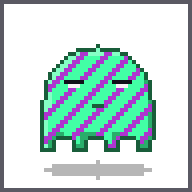 Gk6t…gWTZ Off-peak · Hot path V2 H8 S4 · common
Slots, already seen and forks
You hold up to … programs in slots (five with Account Space) and gossip one, the active one. A new adoption takes a free slot, or waits in the inbox (three; the oldest falls out). In the Lab you choose what to gossip, move programs between inbox and slots, and drop the ones you’re done with: you stay in their trees either way.
What to gossip? A program spreads best when people near you don’t have it yet: rare traits, high virulence, a fresh family. Every adoption you cause pays you Stake, and so do the ones further down your branch.
Already seen
A program you’ve adopted never takes again. For … hours after an adoption, its close relatives (its parent and children) are hard to catch too, unless their hardiness breaks through.
Forks
When you adopt a program it may fork: a new program, child of the one you caught, with its own address and look, and you as its deployer. The chance starts at … in a thousand and grows as stability drops. The fork takes the parent’s place in your slots; you still count as an adopter of the parent. A program with … adoptions can be named once by its deployer.
The four classes
| Class | What it does |
|---|---|
| RPC Node | Adoptions you cause are likelier: odds …. |
| Validator | Shrugs off spam (its odds …) and cures it on nearby badges. |
| Indexer | Sees adoption counts and other badges’ creatures on the radar; drops …. |
| Builder | Forks twice as often, and … free CPI or Upgrade Authority a day. |
You choose in the Lab and can change after … hours.
Stake and Rank
Stake is Gossip’s experience (not !LAMPs, not your Level). When someone adopts a program from you, you get … Stake, the three nodes above you in that tree …, … and …, and the new adopter …. Roles, cures and milestones add more.
Rank follows Stake: Localnet, Devnet at …, Testnet at …, Mainnet at ….
Items
Items are ordinary inventory items: they show in your inventory, trade in Trade, and are used in the Lab. The badge only asks; the server uses the item at the next sync and tells you what happened.
| Item | What it does | Where from |
|---|---|---|
| Priority Fee | Boost … on your hello for … minutes, so you spread faster. | Shop, … !LAMPs; drops |
| Stake-weighted QoS | Nothing new reaches you for … minutes. | Shop, … !LAMPs; drops |
| Explorer | See nearby badges’ creatures for … minutes, as an Indexer does. | Shop, … !LAMPs; drops |
| Close Account | Empties a slot, + … Stake. | Drops |
| Deny-list | Immune to one program’s whole family for … minutes. | Rare drops |
| Account Space | One more slot for good, up to five. | Rare drops |
| CPI | Two of your programs make a hybrid child with traits of both, into your inbox. | Rare drops |
| Upgrade Authority | Forks a program now. Upgrade Authority+ also picks a trait the fork must have. | Rare drops (the + is epic) |
| Deploy Buffer | One more program of your own to deploy. | Rare drops |
| Genesis Relic | Deploy a legendary genesis program. Doesn’t trade. | Finding the Anonymous Deployer |
| Cosmetics | LED patterns and creature frames. Never used up. | Shop (Aurora LEDs …, Gold Frame … !LAMPs); drops |
Drops and !LAMPs
Drops are items the server rolls for you: when a rare or better program reaches you (once per program), at milestones, for cures, roles and boss wins, for a new X Dex swap and for objectives. At most … a day.
!LAMPs come in small amounts, all under one cap of … !LAMPs a person a day:
- A program you deployed reaches 10, 100 and 500 adoptions: …, … and … !LAMPs, … Stake and a drop, each once. Its first … adopters get … Stake and a drop too.
- A tree of yours ten deep: … !LAMPs, Stake and a drop.
- Roles and boss wins (below).
Only X-linked owners of a real badge earn !LAMPs, drops and pages, once per person. Emulated badges play everything for testing and earn nothing. Everything you earn is yours, not the badge’s: releasing or resetting it touches none of it.
Epochs and objectives
Game time runs in epochs of … hours. Each epoch you get … objectives in the Lab, such as adopting a few programs, spreading one three hops deep, forking one or catching a rare one. Each one done rolls a drop.
Achievements and the fourth bounty
Gossip keeps a list of achievements, from your first adoption to the hardest feats, each worth points by its tier. Gossip is the fourth bounty: the most achievement points when the bounties close wins, with the same prizes as the other three. The standings are on the leaderboard.
There are … achievements worth … points in all: bronze …, silver … and gold … points each. Each is earned once, on a hardware badge with X linked, and stays earned; where one counts other players, it counts different people, never badges.
Leaders and roles
Now and then the server hands an opted-in badge a role: a second identity it broadcasts for a while, next to its own. Turn on Settings, “May become a leader” (or in the Lab). The server picks among badges with X linked, Wi-Fi on the mesh channel, half a battery or USB, a recent sync and the most badges nearby, and rests each for … minutes after a role. You get an offer (“you are up as Leader”); decline in the Lab within thirty seconds or it starts by itself.
Leader … min
You: pick a block of up to four programs from the bids around you; your badge gossips them in turn at full boost. Played to the end with a block: … Stake and … !LAMPs.
Everyone else: walk up and bid your program, with a Priority Fee if you like (spent only if it makes the block, and it doubles that program’s odds). Adoptions from the Leader count as yours.
MEV Bot … min
You: stay out of reach. While nobody catches you, … of the Stake everyone who hears you earns goes into your pot. Uncaught at the end: … Stake and … !LAMPs (the pot itself is gone).
Everyone else: follow its signal and get close to catch it: the pot goes back, and the catcher gets … Stake and a chance at an item.
Anonymous Deployer up to … min
You: your badge spreads a legendary genesis program as “???”. … Stake when it ends, a minute after the first find.
Everyone else: hunt it by signal and claim it up close: the first … get a Genesis Relic, and the first is named on the board.
Byzantine Leader …
You: you are the boss, started by the organisers. Spread spam and throw forks to break the room’s rhythm. … Stake win or lose.
Everyone else: the fight.
Ending early (you end it, a low battery, Collaborator or a badge beacon needing the radio, or … seconds without a sync) pays the owner nothing.
The boss fight, beat by beat
- The boss badge plays a beat at … beats a minute; open the Lab and it shows the beat track.
- Press SELECT on the beat (within 120 ms either side). Each vote in time doubles your lockout: 1, 2, 4, up to 32.
- Miss, or vote on a fork beat the boss throws (announced one beat ahead), and your lockout drops to nothing.
- Lockout 4 is confirmed (your LEDs turn purple), 32 is finalized (green).
- The block can’t be rooted before beat …, however well the room plays. From then on, the moment two thirds of the voters are finalized (at least …), the block is rooted and the players win. If … pass first, the boss wins.
- At the end your badge claims for you, by itself: it asks the boss to sign your count, and keeps asking for a minute and a half while the boss answers the whole room in turn. Stay near the boss until your Lab says the claim is signed. Gossip notices wait until the fight is over, so nothing covers the beat track.
- … minutes later the server settles it from everyone’s claims, against the beats that had passed when the fight ended: it’s won when two thirds of the claimants voted in time on a quarter of them. Won: Stake by the share of those beats you landed, up to …, a drop, up to … !LAMPs, and the spam is dead. Lost: everyone who claimed catches the spam. Voting in time on half of them earns Finalized.
Cures
A boss’s spam spreads like any program. A Validator’s Lab shows nearby badges carrying it; offer a cure and that badge agrees by itself (being cured only helps). The server removes the spam at the cured badge’s next sync and pays the Validator … Stake and a vote credit, once per person and program, at most … a day.
Privacy and turning it off
- The server learns who caught what from whom, with the signal and how long, when a program is adopted; not every badge you pass.
- The Network board shows totals. Your name shows there only if you turn on “Show me on the Network board” on your profile (off by default); a named link needs both ends to have done so.
- The board names a Leader or a boss while it plays. An MEV Bot and an Anonymous Deployer are never named or identified while they run, only after they end, so nobody can read off the board who to walk up to.
- Turn Gossip off in one step: Settings, Gossip, or Services on the badge. Your badge stops broadcasting and listening and syncs one last time.
The Gossip pages
The Guide’s ninth category is Gossip: twelve pages, each about a part of the game and the Solana idea behind it. Each is earned once, the first time you do its thing in the game (caught a program, forked one, played a role, beaten the boss, deployed a Genesis Relic…), and they turn up in packs like any page, including the Gossip Pack in the shop.