
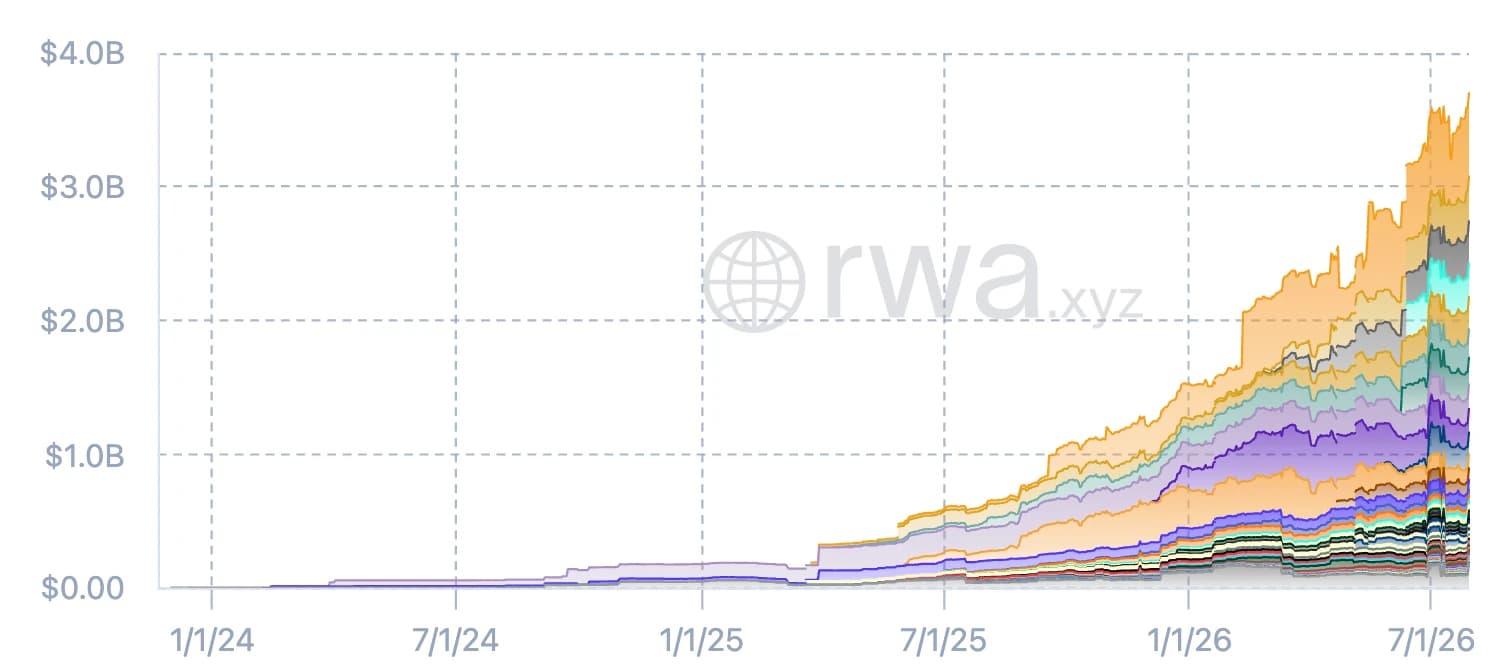
As of late July 2026, Solana hosts $3.7 billion in non-stablecoin real-world asset value across 313K holders. What began as a negligible market in early 2024 has become a multibillion-dollar ecosystem spanning tokenized Treasuries, public equities, private credit, reinsurance, sovereign debt, commodities, liquidity funds, and stablecoin settlement infrastructure.
The significance is not only the amount of value issued onchain. It is the way that value is beginning to behave. On Solana, institutional assets are not merely represented as tokens; they can be distributed to a broad holder base, settled in stablecoins, integrated with DeFi protocols, and governed through compliance-aware token infrastructure.
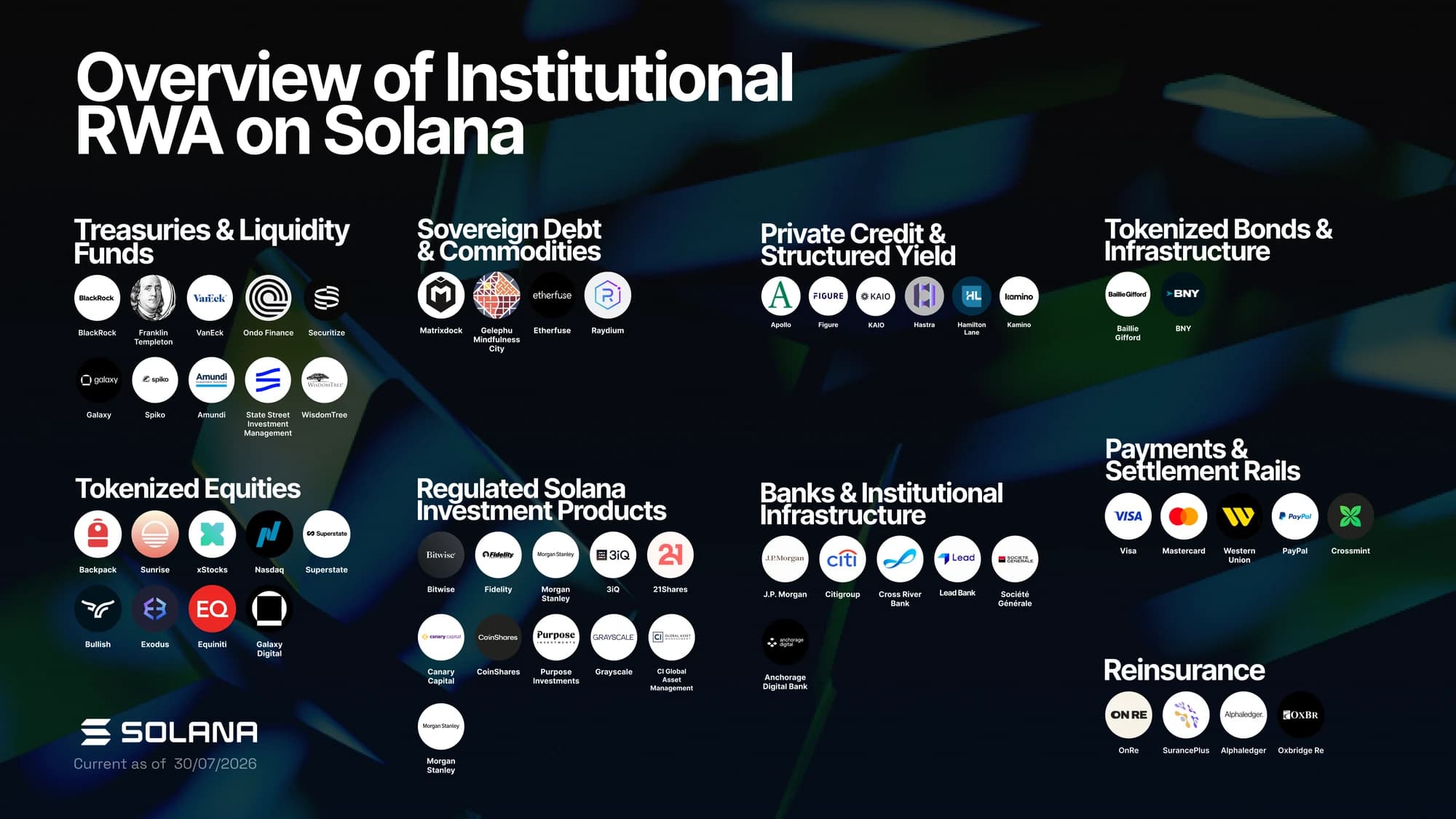
J.P. Morgan has arranged commercial paper on the network. BlackRock’s BUIDL fund is available through Securitize with over $600 million held on Solana. Apollo, Franklin Templeton, Hamilton Lane, VanEck, WisdomTree, State Street, Superstate, Securitize, Ondo, Figure, Etherfuse, OnRe, Spiko, and others have live deployments, announced products, or formal tokenization initiatives involving Solana. Payment and fintech companies including Visa, PayPal, Western Union, Paxos, Bridge, Crossmint, Anchorage Digital Bank, Cross River Bank, and Lead Bank are building stablecoin settlement rails that support the same ecosystem.
Traditional finance is building new rails on a public blockchain alongside existing DeFi protocols, and Solana has become one of the major venues where that convergence is happening.
Why Solana, Why Now
Three structural patterns distinguish Solana’s institutional RWA development: broad distribution, active financial use, and category breadth.
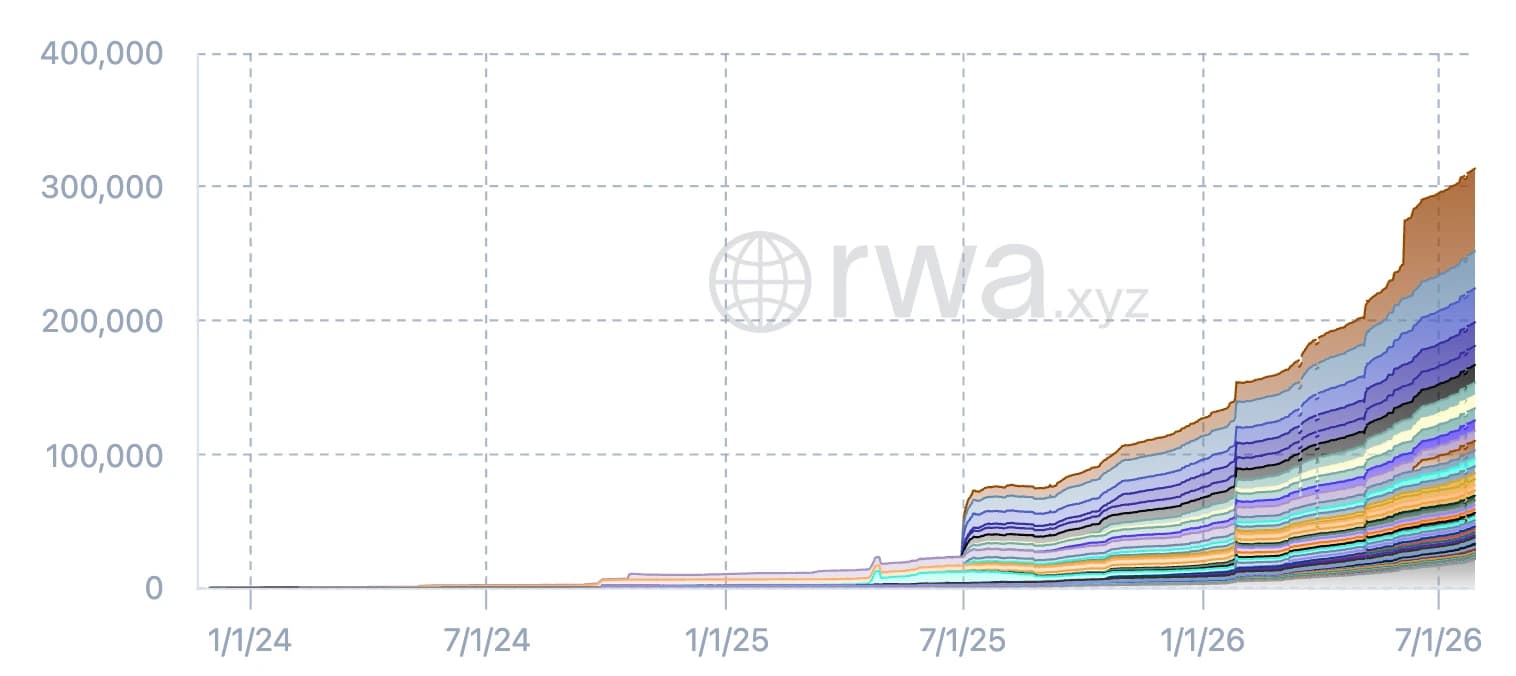
Broad distribution: Solana has more than 313K RWA holders with $3.7 billion in non-stablecoin RWA value as of late July 2026. That distribution profile looks structurally different from more concentrated institutional bases elsewhere. The reason is partly economic: Solana’s fee structure makes small-position ownership, frequent transfers, and retail-accessible distribution more viable than higher-cost environments.
Active financial use: The important question for RWAs is not only whether an asset can be tokenized. It is whether the asset can be used. On Solana, tokenized assets can interact with stablecoins, lending markets, liquidity pools, collateral systems, and trading venues within the same execution environment, subject to the compliance rules of each issuer and product.
Category breadth: Solana supports tokenized Treasuries, public equities, private credit, onchain reinsurance, sovereign debt, tokenized gold, liquidity funds, and stablecoin settlement. Each category tests a different requirement: investor eligibility, yield distribution, transfer controls, custody, auditability, redemption, price discovery, and secondary liquidity.
The Market by Asset Class
Solana’s RWA ecosystem is not concentrated in one category. Tokenized Treasuries remain a core asset class, but the fastest-moving areas now include tokenized equities, structured credit, reinsurance, sovereign debt, commodities, and settlement infrastructure.
Treasuries provide low-duration yield and collateral. Tokenized equities test distribution and secondary trading. Private credit and reinsurance test yield-bearing financial contracts. Commodities and sovereign debt broaden the asset base. Stablecoins provide the settlement layer. DeFi protocols connect these assets into lending, liquidity, and collateral markets where issuer rules permit.
Treasuries
Tokenized Treasuries are one of the foundations of the institutional RWA market. They are familiar, low-duration, yield-bearing instruments that institutions already understand, and they can serve as both cash-management products and collateral assets.
Solana has become a significant venue for tokenized Treasury products, with several large global issuers now live on the network. The significance is not only any single fund’s AUM on Solana, but the roster of names that have chosen to deploy here.
BlackRock BUIDL, the USD Institutional Digital Liquidity Fund, expanded to Solana in March 2025 through Securitize. BUIDL is one of the most important institutional tokenized Treasury products globally, and its availability on Solana placed the network inside the distribution footprint of the world’s largest asset manager.
Ondo Finance runs two Treasury-linked products on Solana. USDY is a tokenized note backed by short-term U.S. Treasuries and bank demand deposits, offering yield to non-U.S. holders. OUSG provides exposure to short-term U.S. government bonds and is backed significantly by BlackRock’s BUIDL fund. Ondo’s Solana products use compliance controls designed to enforce eligibility and transfer restrictions.
VanEck VBILL, a short-term U.S. Treasury product, launched on Solana in May 2025 via Securitize. VanEck’s deployment added another established asset manager to Solana’s tokenized Treasury market.
Franklin Templeton BENJI, the token of the Franklin OnChain U.S. Government Money Fund (FOBXX) is the first US-registered mutual fund to use a public blockchain as its system of record. It launched on Solana in February 2025.
Circle's USYC tokenized money market fund, one of the largest tokenized Treasury products globally, launched on Solana in October 2025. It's redeemable to and from USDC in near real time and issued via Token-2022 with allow-listing.
Treasuries matter because they are likely to become a base collateral asset for much of the onchain institutional economy. A tokenized Treasury can be held passively, used as a cash-management product, or integrated into lending and collateral workflows where the product’s compliance rules permit.
Bonds
Baillie Gifford launched the Baillie Gifford Enhanced Yield Fund (BAGEY) on Solana in June 2026, making it the first publicly available, fully native UK-regulated tokenized bond fund issued on public blockchains. Unlike conventional tokenized fund structures that issue blockchain receipts while maintaining ownership records offchain, BAGEY uses the blockchain itself as the legal register of record. Subscriptions and redemptions settle directly in USDC. BNY provides the tokenization platform, wallet infrastructure, custody, and integration with the fund's regulated operating model
The launch expands Solana's institutional fixed-income ecosystem beyond Treasuries and money market funds into actively managed corporate bond strategies.
Tokenized Equities
Tokenized equities are where Solana’s RWA growth is accelerating fastest. As of late July 2026, 97% of all onchain tokenized equities spot volume to date had settled on Solana. That concentration reflects Solana’s emerging role as a leading venue for tokenized equity distribution and secondary activity, even as the overall category remains early relative to traditional public equity markets.
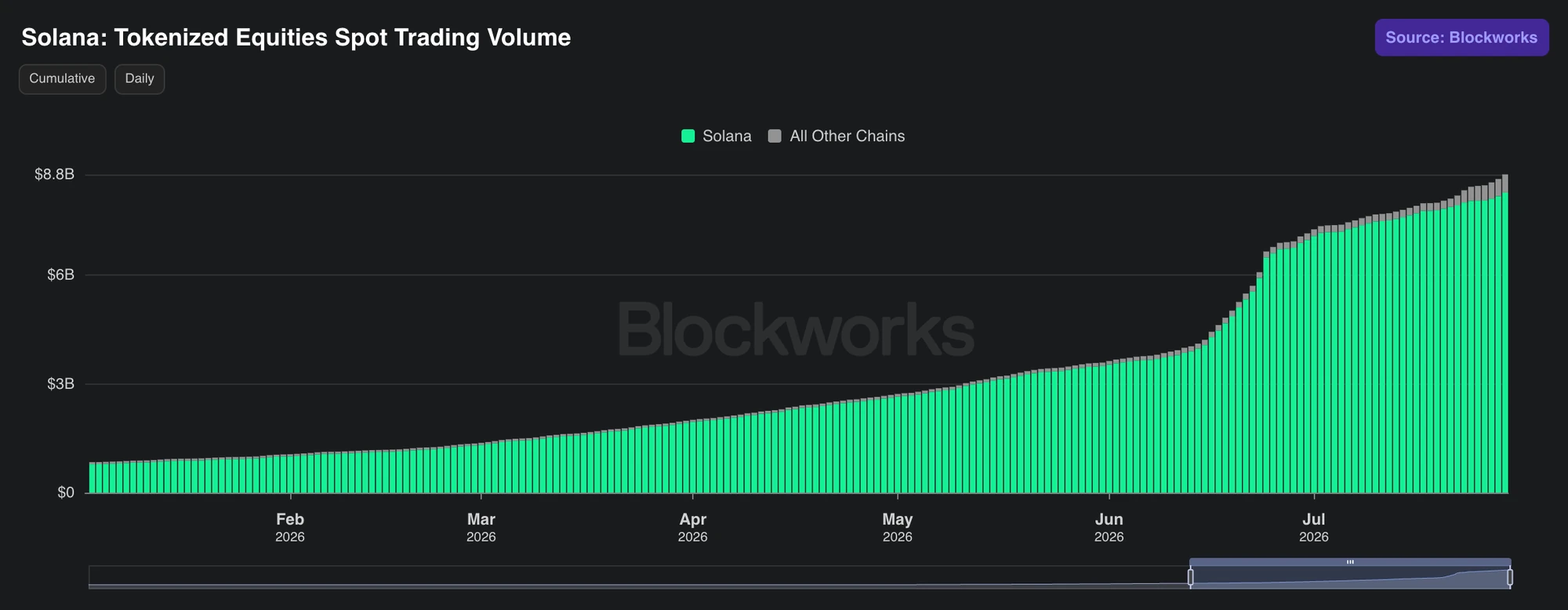
Source: Blockworks
Equities test a different set of requirements than Treasuries. They need transfer controls, corporate-action handling, custody models, redemption paths, investor disclosures, and market liquidity. They also need low transaction costs if tokenized stocks are going to be traded, distributed, and held by a broad user base.
Backpack launched Backpack Securities in June 2026, combining a brokerage platform built on established U.S. securities infrastructure with tokenized securities issued on Solana in partnership with Sunrise. Each token represents a security entitlement backed by a corresponding share held through brokerage and custody infrastructure, with 1:1 conversion between the token and the traditional security entitlement. Its first product, SPCX, went live as SpaceX began trading on Nasdaq on June 12, creating an onchain market for the newly listed stock from day one. Within its first month, six Backpack-issued securities generated $1.5 billion in trading volume.
xStocks, launched in June 2025, is a suite of 100+ tokenized U.S.-listed stocks and ETFs issued as SPL tokens. xStocks’ total value on Solana is $442 million as of late July 2026, with more than 67% market share. In March 2026, xStocks announced a framework connecting Nasdaq's tokenized equity markets with Solana DeFi.
Ondo Global Markets launched on Solana in January 2026 with 200+ tokenized U.S. stocks. The Solana catalog later grew to 250+ tokenized stocks and ETFs, expanding the network’s role in tokenized public-market access.
Superstate’s Opening Bell represents a structurally different approach to tokenized equities. Opening Bell enables SEC-registered equity tokenization directly on Solana. Galaxy Digital became the first Nasdaq-listed company to tokenize SEC-registered equity on a major public blockchain when existing GLXY stockholders were able to tokenize shares through Opening Bell on Solana starting in September 2025. Superstate acts as the registered transfer agent, and ownership updates happen onchain as tokens move between wallets.
Superstate’s Opening Bell work now extends to additional issuers and announced initiatives. Galaxy Digital tokenized GLXY shares through Opening Bell in September 2025. Exodus announced common stock tokens on Solana with Superstate in October 2025. Forward Industries launched tokenized FWDI public shares on Solana in December 2025.
Securitize began trading on the NYSE under ticker SECZ on July 2, 2026 and simultaneously made tokenized SECZ available on Solana and Avalanche, making it the first newly public company to bring its own stock onchain at the start of its life as a listed company.
Bullish announced its $4.2 billion acquisition of Equiniti, a transfer agent serving nearly 3,000 public companies including more than 30% of the S&P 500, and tokenized its entire 151M-share cap table on Solana, announced on stage at Consensus 2026 with CEO Tom Farley demonstrating a live wallet-to-wallet transfer.
The equity category moves RWA tokenization beyond yield-bearing cash equivalents. It tests whether public-company ownership, transfer-agent workflows, investor access, and onchain settlement can coexist in a public blockchain environment.
Private Credit and Structured Yield
Private credit is where Solana’s composability advantage becomes more tangible. On Solana, credit instruments can plug into lending protocols, serve as collateral, trade through decentralized venues, and settle against stablecoins within the same transaction environment, where issuer controls and eligibility rules permit.
Hastra is a Solana-based distribution layer for Figure’s credit infrastructure, built on Provenance Blockchain with yield-bearing tokens issued as SPL assets. wYLDS wraps Figure’s SEC-registered YLDS, which is backed by short-dated U.S. Treasuries and overnight repos, allowing holders to earn yield passively in-wallet. PRIME is obtained by staking wYLDS at a 1:1 ratio; it earns boosted yield from Figure’s Democratized Prime HELOC lending pools on Provenance while remaining liquid and usable as collateral. The PRIME lending market on Kamino surpassed $350M in TVL within roughly three months of launch, showing how quickly new credit-linked products can reach meaningful scale on Solana’s infrastructure.
Apollo ACRED, the Apollo Diversified Credit Securitize Fund, launched on Solana in January 2025 via Securitize. It provides tokenized access to Apollo’s diversified credit fund across corporate direct lending, asset-backed lending, and structured credit.
Hamilton Lane SCOPE launched on Solana through Libre in July 2024, bringing one of the world’s largest private-markets investment managers into Solana’s RWA ecosystem. Hamilton Lane also partnered with Republic to open retail access to its private-markets funds, including the Hamilton Lane Private Infrastructure Fund. Hamilton Lane’s presence is important because private-market funds are one of the categories where tokenization could improve access, distribution, and operational efficiency.
Private credit is a test of whether tokenized yield-bearing instruments can become usable financial primitives. If a private credit token can be held, transferred, financed, and used as collateral within the same environment, it begins to behave less like a static fund interest and more like programmable credit infrastructure.
Reinsurance
Onchain reinsurance is one of the less conventional RWA categories on Solana. It shows that the network’s RWA market is not limited to Treasuries, equities, or standard credit products.
OnRe issues ONyc, a yield-bearing SPL token backed by insurance premiums from licensed underwriting operations. As of late July 2026, ONyc is at $247 million in onchain market cap and $186 million in DeFi Active TVL, implying roughly 75% of ONyc in circulation was actively deployed across lending markets, liquidity pools, and yield strategies as of the same date, ranking it in top 6 among all RWA assets globally by DeFi Active TVL. That matters because reinsurance is a complex, multi-party financial market. It involves regulated entities, underwriting risk, yield distribution, and capital allocation.
Oxbridge Re (NASDAQ: OXBR), through its subsidiary SurancePlus, migrated its tokenized reinsurance offerings to Solana for the 2026-27 contract year via Alphaledger’s tokenization platform.
“Building on our solid performance thus far, we are proud to announce that this year’s contracts will be on the Solana blockchain and will target similar returns.” - Jay Madhu, Chairman and CEO of Oxbridge and SurancePlus
Reinsurance is still an emerging onchain category, but its presence on Solana broadens the network’s institutional RWA profile beyond the most obvious asset classes.
Sovereign Debt, Commodities, and Emerging Categories
The range of asset classes arriving on Solana continues to expand beyond core institutional categories. Sovereign debt and commodities have found operational footing on the network, each testing Solana’s infrastructure against a different set of requirements.
Etherfuse issues Stablebonds linked to sovereign debt instruments including Mexico’s CETES, U.S. Treasuries, UK gilts, Brazilian Tesouro securities, Korean Treasury Bonds, and a European government bond product. On Solana, interest-bearing token mechanics provide one available way to express accrued yield onchain.
Matrixdock, part of Matrixport, expanded XAUm to Solana in February 2026. XAUm represents one troy ounce of LBMA-standard gold, with initial liquidity on Raydium. Matrixdock also provided the tokenization technology for the sovereign gold-backed token TER, issued by Bhutan's Gelephu Mindfulness City.
These categories show Solana’s RWA ecosystem expanding horizontally. Treasuries may be the most mature tokenized asset class, but sovereign bonds, gold, and other real-world assets test different custody, redemption, pricing, and jurisdictional requirements.
Banks, Asset Managers, and Institutional Infrastructure
The asset-class map only captures part of the story. Solana’s institutional RWA ecosystem also includes banks, asset managers, transfer agents, infrastructure providers, and enterprise tokenization platforms building around the network.
J.P. Morgan arranged a $50M U.S. commercial paper issuance for Galaxy Digital on Solana in December 2025. J.P. Morgan described the transaction as one of the earliest debt issuances ever executed on a public blockchain and among the first in the U.S. to use blockchain for the issuance and servicing of securities. The token was created onchain with delivery-versus-payment settlement, and both issuance and redemption proceeds settled in USDC.
WisdomTree brought its full suite of regulated tokenized funds to Solana in January 2026 via WisdomTree Connect and WisdomTree Prime, giving both institutional and retail users native onchain access to tokenized funds across multiple asset classes.
State Street Investment Management and Galaxy Asset Management launched the State Street Galaxy Onchain Liquidity Sweep Fund, or SWEEP, in May 2026. SWEEP launched on Solana, with additional integrations planned for Stellar and Ethereum. The fund is designed for 24/7 onchain cash management via stablecoin, subject to portfolio availability and investor eligibility requirements.
Spiko went live on Solana with SAFO, a UCITS-compliant money market fund managed by Amundi, Europe's largest asset manager.
Citigroup ran a pilot program for tokenized Bill of Exchange settlements on Solana in February 2026.
Together, these deployments show that institutions are not only issuing assets on Solana. They are building the surrounding infrastructure for issuance, transfer agency, settlement, fund distribution, compliance, and DeFi access.
Stablecoin Settlement Infrastructure
Solana’s stablecoin market cap is $16B as of late July 2026. The non-stablecoin RWA stack described above settles, prices, and denominates in stablecoins. Stablecoins are not counted in the non-stablecoin RWA value figure, but they are central to how the market functions. That settlement layer is one reason institutional RWA activity can operate on Solana at a meaningful scale.
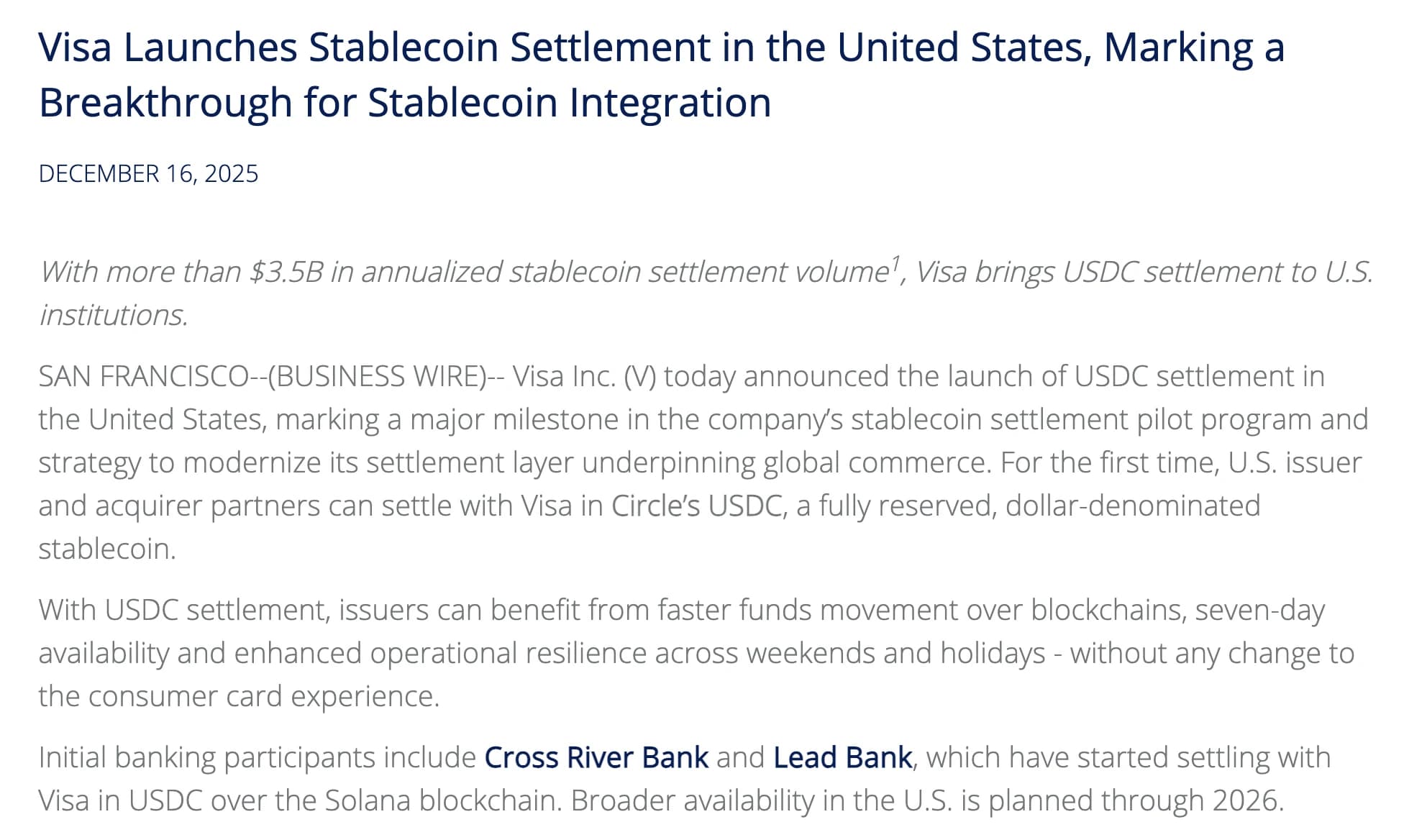
Visa launched USDC settlement for U.S. issuer and acquirer partners on Solana in December 2025. Cross River Bank and Lead Bank were the first participants. Visa also partnered with Bridge to launch stablecoin-linked Visa cards, live in 18 countries with expansion to more than 100 countries planned by the end of 2026.
Mastercard named Solana for always-on card settlement via USDC and other stablecoins in early June.
PayPal expanded PYUSD to Solana in May 2024. PYUSD, issued by Paxos Trust Company and regulated by NYDFS, was one of the earliest major stablecoins to use Solana’s Token Extensions.
Western Union launched USDPT, a U.S. dollar-pegged stablecoin, on Solana in May 2026. Anchorage Digital Bank serves as the issuing bank. Western Union is one of the leaders in global remittances, with a physical agent network across more than 360K locations. Crossmint is partnering with Western Union to support issuance and integration with its Digital Asset Network.
Global Dollar Network’s USDG went live on Solana under the MAS-regulated Paxos Digital Singapore framework.
Societe Generale issued its MiCA-compliant EUR CoinVertible (EURCV) and USD CoinVertible (USDCV) on Solana in 2025 with BNY as reserve custodian.
Stablecoin settlement rails underpin the RWA ecosystem. A tokenized Treasury, equity, credit instrument, or reinsurance product becomes more useful when it can settle against liquid, widely used digital dollars in the same environment.
ETFs
Solana exposure is also available through regulated ETFs and ETPs.
The Bitwise Solana Staking ETF (BSOL) launched on NYSE Arca in October 2025 and is the category leader with ~$600 million in AUM as of late July 2026. It stakes its full SOL holdings through Helius validator. Fidelity’s Solana Fund (FSOL) is the second-largest U.S. product with an AUM of ~125 million. Morgan Stanley Solana Trust (MSOL), Grayscale’s Solana Trust (GSOL), Franklin Templeton's Solana ETF (SOEZ), 21Shares' Solana ETF (TSOL), VanEck's Solana ETF (VSOL), and Canary Capital's Solana ETF (QSOL) round out the U.S. lineup, several with staking built into the structure from launch. Combined spot US Solana ETF assets under management crossed $1 billion by mid-May 2026.
Outside the U.S., 21Shares' Solana Staking ETP (ASOL) and CoinShares' Physical Staked Solana (SLNC) are the largest European products, trading on Xetra, SIX Swiss Exchange, and gettex alongside offerings from Bitwise (ESOL) and VanEck (VS0L). In Canada, the Purpose Solana ETF (SOLL.U), 3iQ Solana Staking ETF (SOLQ.U), CI Galaxy Solana ETF (SOLX.U), and Evolve Solana ETF (SOLA.U) trade on Canadian exchanges under Ontario Securities Commission approval, having launched in April 2025 ahead of the U.S. market.
The Technical Stack
Solana’s institutional RWA ecosystem depends on more than low fees. It depends on token infrastructure, settlement speed, compliance tooling, and the ability for assets and protocols to share one execution environment.
Token Extensions are a major part of Solana’s institutional tokenization stack, especially for assets that need compliance features. Issuers can use transfer hooks to run custom compliance logic on every transfer, including whitelist or KYC checks. Confidential transfers use zero-knowledge proofs to mask account balances and transfer amounts while preserving auditability. The permanent delegate extension gives an authorized administrator mint-wide transfer and burn authority, which can support recovery, seizure, or issuer-administered compliance actions when legally required.
PYUSD is one of the clearest production examples of Token Extensions in use on Solana. PYUSD on Solana was built using Token Extensions and initializes features including transfer hook and permanent delegate, giving it enterprise-style token controls on Solana.
A core institutional feature is Solana’s single-chain composability. Assets and protocols share one state machine, allowing compliant assets to interoperate with DeFi where issuer controls and eligibility rules permit. A product that needs a tokenized Treasury to serve as collateral in a lending protocol that settles in USDC can operate in one transaction environment rather than across fragmented execution layers.
What Comes Next
Solana’s institutional RWA ecosystem is growing quickly, backed by names that carry weight in traditional finance, and the addressable market still dwarfs current onchain penetration across every chain.
What distinguishes Solana’s position is not any single deployment but the convergence: products and initiatives involving the world’s largest asset manager, major payment networks, SEC-registered equity tokenization, onchain reinsurance, sovereign debt, tokenized commodities, private credit, liquidity funds, and a DeFi layer that can make these assets usable in one execution environment.
In March 2026, the SEC identified SOL as a digital commodity, while the CFTC confirmed it would administer the Commodity Exchange Act in line with that interpretation. The release strengthened the regulatory context around Solana as infrastructure for financial products.
The next phase will be measured less by announcements than by usage: collateral velocity, secondary liquidity, stablecoin settlement volume, active DeFi integrations, compliant transfer flows, and the number of regulated products that can operate at scale without fragmenting liquidity. A tokenized Treasury becomes more useful when it can collateralize a position in a protocol that settles in a regulated stablecoin; a private credit token becomes more useful when it can move through wallets and collateral systems under issuer-defined rules. That kind of cross-asset composability is what the institutions in this report are positioning to use, and it is why Solana’s RWA story is no longer only about putting assets onchain, but about turning them into usable financial infrastructure.