
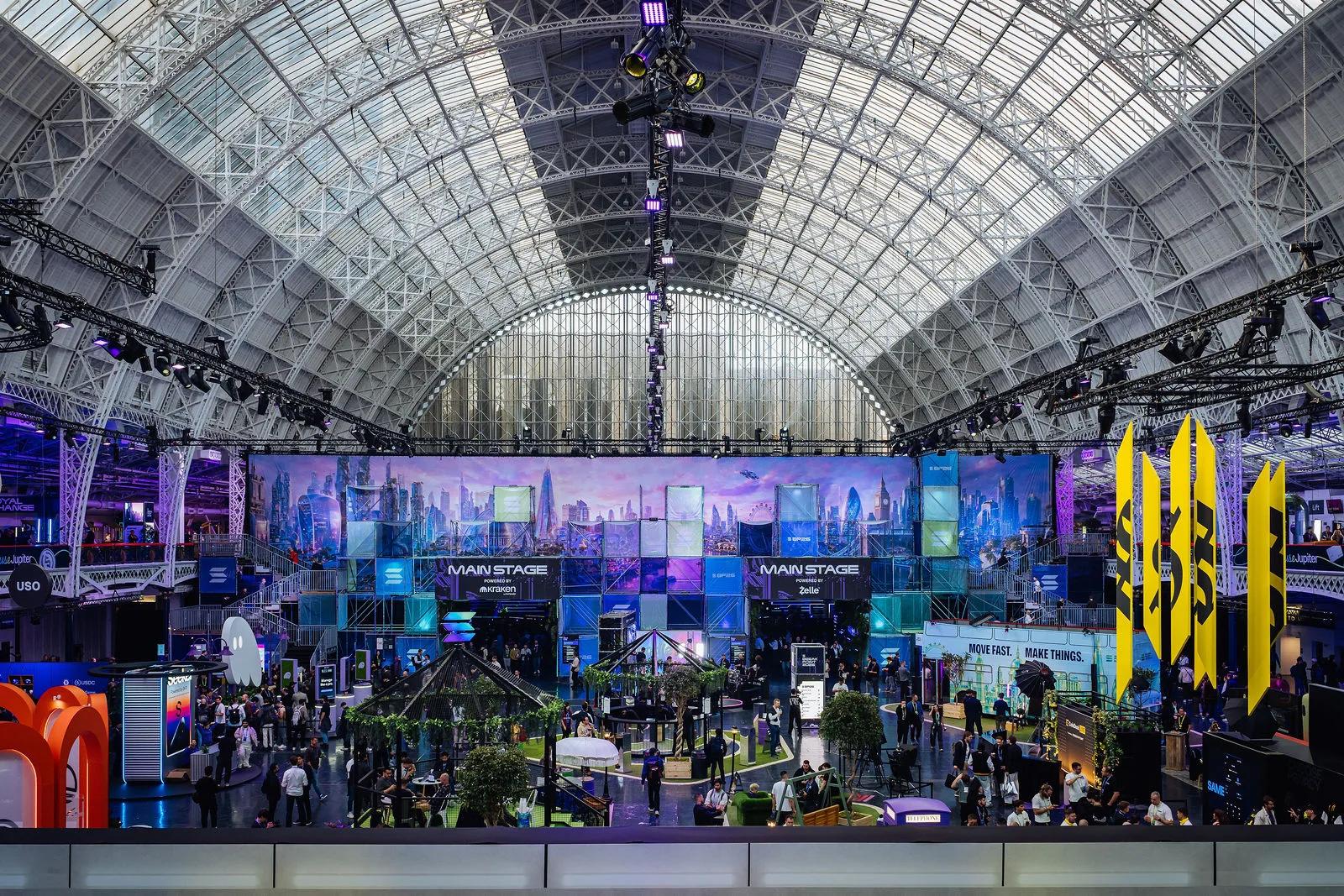
The Solana ecosystem has well and truly taken over London. Last night, pubs, bars, galleries and restaurants all over the city were filled to bursting with members of our community, and yet people were back at Olympia for more before the doors had even opened on the second day of Breakpoint 2026.
The floor picked up right where it left off. Attendees filled in their USDC booth crawl cards and hunted down the last of the Breakpoint jackets, the builder zone and Colosseum filled up around the second stage, and the Frontier Pub on the main floor was soon doing a roaring trade.
Clasping coffees and pastries from the Kast cafe, attendees made their way past the greenery, the t-rex skull and the tea-making robot towards the main stage, to hear Solana Foundation Chief Product Officer Vibhu Norby welcome the audience to the day at the financial frontier.
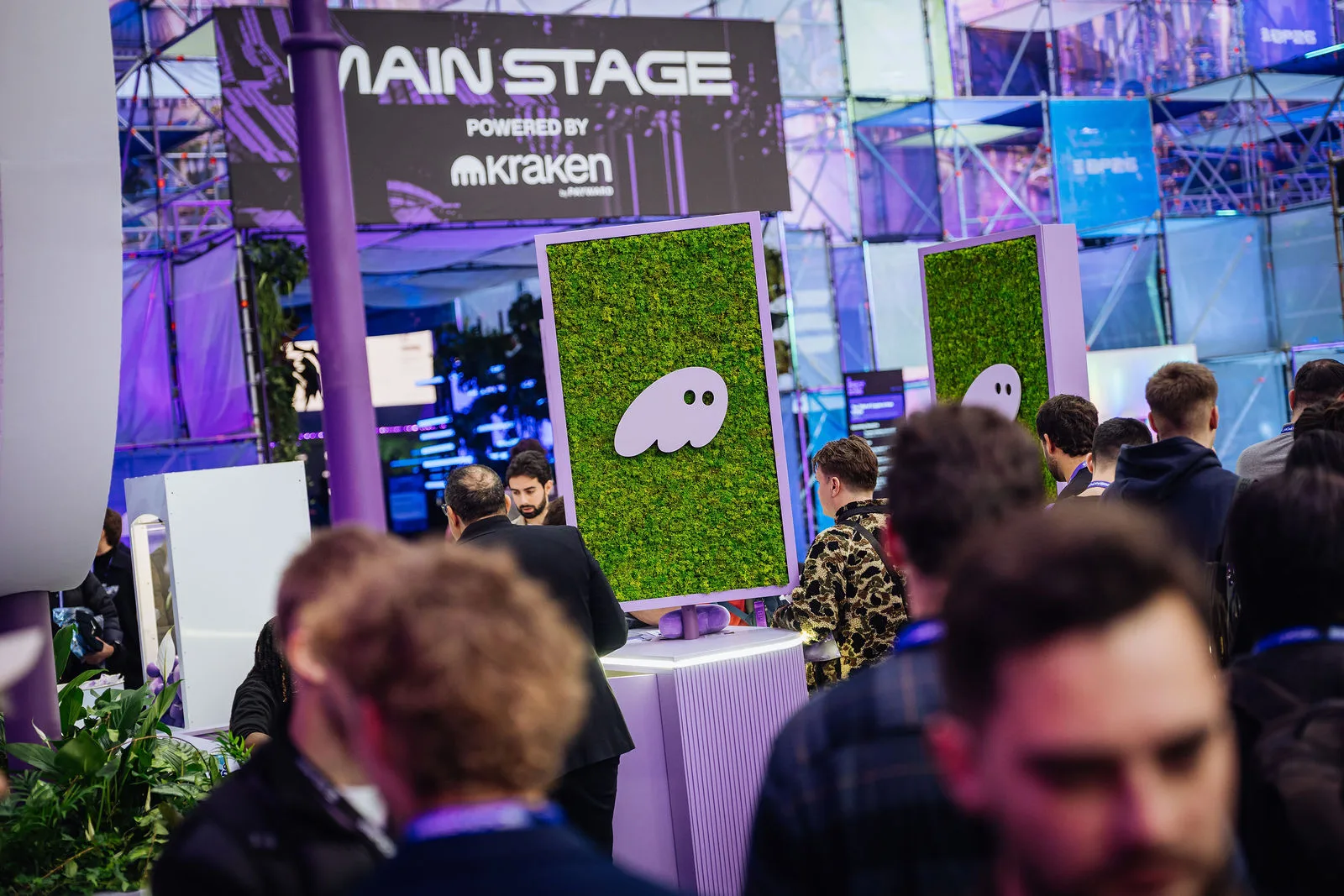 The Breakpoint floor buzzing by the main stage on Day 2
Day 2 Highlights
Here's a quick rundown of what was announced today.
-
CoinGecko announced its next phase of growth, backed by Solana Foundation, doubling down on its API and exploring adding trading to the platform.
-
Akash published the design for Akash Compute Forwards, an onchain order book for future GPU hours on Solana, with a pilot set to open in March and the first month of compute delivered in April.
-
Temporal unveiled Supermassive, which brings spot, perpetuals and options on Solana into one account margined on net risk, launching in 2027.
-
Forma announced it is moving all in on the UK, building a permanent residential campus for founders in Bath's Riverside innovation district in collaboration with the University of Bath.
-
Breakpoint 2027 is heading to San Francisco, September 8–10 at Pier 48.
Vibhu framed the programme ahead as "the other side of the token supercycle," where AI agents, compute and new forms of ownership move onchain.
"If yesterday was about traditional finance, today is all about the frontier use cases, the financial frontier," he said, pointing to assets that are either new to the world or that previously sat in markets too illiquid or too local to be robust.
As promised, the morning dove headfirst into AI and the brand-new markets forming around it, before the afternoon turned to Britain's big chance to lead in tokenisation and to where Solana goes next.
Bringing Liquidity to Illiquid Markets
The morning got off to a flying start with Revolut Chairman Martin Gilbert, who sat down with Solana Foundation's GM, Institutional, Nick Ducoff. Gilbert had clearly been enjoying the floor, singling out the robotic tea maker outside the main stage as his favourite thing at the event. He was optimistic about the direction of fintech: "Blockchain is one of the building blocks that’s going to change the world of investment, in my opinion."
Gilbert’s fireside wrapped up with a rallying cry for the founders in the audience, urging them to give their ideas a go and to "raise the money when you don't need it because you're not going to get it when you do need it." He had some love for the host city too, telling the room there is no better place in the world to run a founder-led business than London.
The Machine Economy
From there the main stage turned to AI, and to the markets that will need to form to finance and power it. Real Vision co-founder and CEO Raoul Pal set out the scale of the shift, pointing to the 53% of web traffic now driven by bots and agents. "These are a new internet population," he said. Pal argued that these agents will turn to blockchains to transact, and that over time the wider financial system will move onchain with them.
Agents run on compute, which still lacks the financial infrastructure other commodities take for granted. "What will a GPU hour cost in June? For most GPUs there is no open price," said Akash founder and CEO Greg Osuri. Farmers solved the same problem in 1851 by selling corn forward, and oil and freight have long had forward markets of their own, yet compute has none. Akash's answer is Akash Compute Forwards, an onchain order book for future GPU hours where each contract covers one node for one month at one price. A Solana program matches buyers and sellers, and validators verify each hour of delivery so buyers are paid back for any hour that is missed. The design and white paper went live today, with the first month of compute due for delivery in April.
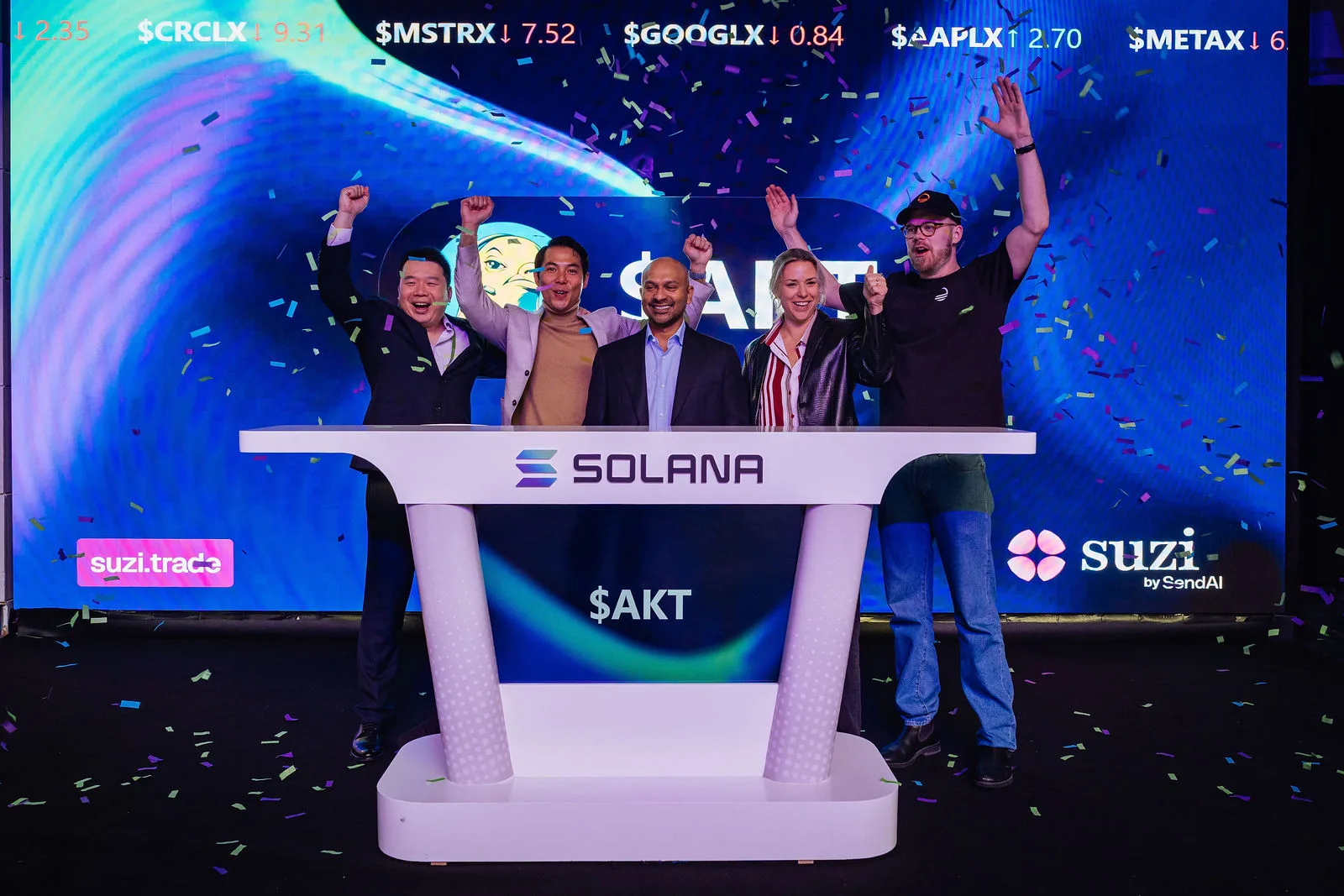 Akash’s $AKT team rings in the token on Solana with a confetti celebration at Breakpoint
Multicoin Capital General Partner Shayan Sengupta called compute markets one of the most opportunity-rich design spaces in crypto right now. In his view the so-called compute shortage is really a cash flow and duration mismatch, with teams that need GPUs for two weeks stuck choosing between multi-year contracts and the hourly spot market, and crypto rails make it far cheaper to build the markets that close that gap.
The panel that followed was just as bullish, as Foundation Capital General Partner and early Solana backer Steve Vassallo called compute "the first market in my career where demand literally equals supply," while Grayscale's Krista Lynch described it as digital oil for the next wave of crypto and AI.
Rishin Sharma, who leads AI at Solana Foundation, rounded out the morning with a look at the year ahead, starting with how far agentic activity has already come. Agents now account for 76% of token spend, up from 8%, and x402 has processed more than 400 million agentic payments totalling $100 million in volume after starting from zero just 12 months ago.
"When the interface changes, there's fundamentally an opportunity to reinvent the rails," he said, pointing to the Foundation's own work to meet it. Last week the Foundation launched Solana AI, a new home for the more than 120 teams building AI products on Solana, alongside payment channels that can handle a million payments per second.
Data, Debate and the Case for SOL as Money
Back on the main stage, Vibhu welcomed CoinGecko co-founder Bobby Ong onstage, hours after the news went out that CoinGecko is entering its next phase of growth with the backing of Solana Foundation.
The plan is to double down on CoinGecko's API, which is used by 100,000 developers across the industry, and to start exploring trading on the platform.
Ong and his co-founder TM Lee started CoinGecko in Kuala Lumpur 12 years ago, tracking 20 coins. Today it tracks more than 50 million tokens across 220 chains, and 39% of them are Solana tokens. "Anything that can be tokenized will be tokenized," Ong said, adding that he expects the count to reach a billion within a few years. "Crypto is such a level playing field," he said. "It democratizes success."
Then came the session Vibhu had said he was most looking forward to, the flagship debate of Breakpoint 2026 on whether SOL is money. With Austin Federa moderating, Helius CEO Mert Mumtaz argued for the motion while Solana co-founder Anatoly Yakovenko took the opposing side. Mert opened by telling the room his job was "to save our bags and convince the founder of the chain that we are not going to zero," before asking for a show of hands from everyone who had bought an NFT with SOL. Hands shot up across most of the audience.
Toly countered that what makes modern money powerful is its role as a unit of account for debt, backed by central banks and the power to tax, and that SOL can't compete with the dollar on those terms. In his view SOL has a bigger destiny as "the spam resistant engine for the global economy."
Mert responded that SOL functions as money for its community every day, and that being dull is part of the job. "Money is not supposed to be the sexy, exciting thing. It's supposed to be boring and reliable," he said. When the audience votes came in, Mert carried the motion: SOL is money.
Britain's Opportunity to Lead in Tokenisation
The afternoon brought the conversation back to the host country, and to whether Britain can shape the next chapter of capital markets as it shaped the last. Sir Nicholas Lyons, former Lord Mayor of London and chairman of Standard Life, which looks after the pensions and savings of 16 million policyholders, made the case for tokenisation as the next step in a proud line of British financial innovation stretching from Lloyd's in the 1660s to the Big Bang reforms of 1986.
Lyons pointed to the progress the UK has made, highlighting the pilot issuance of Britain's first digital gilt and a report for the government estimating that faster adoption of digital markets could add as much as £33 billion a year to UK output by 2035.
For him the biggest prize is the ordinary saver, with around £850 billion of UK wealth sitting in cash. Of the four priorities he set out, the one closest to his heart was making sure retail investors share in the benefits.
"We're not pursuing tokenization for the sake of technological leadership. We're pursuing better capital markets, more productive investment, greater economic prosperity and wider participation in the creation of wealth and jobs," he said. "Britain helped design the international capital markets of today. We now have the opportunity to help shape their next evolution. Let's seize it."
That optimism carried straight into the panel that followed, as former Chancellor Sir Sajid Javid and former culture minister Lord Ed Vaizey were joined by Baroness Sue Gray to discuss what it will take for the UK to win in tech. Forma co-founder Farhaj Mayan, who moderated, opened by noting that 18 unicorns had been minted in the UK by September this year. Vaizey was quick to remind the room of the country's strengths. "We lead the world in quantum computing. We're a great power in AI after America and China," he said, adding that much of the innovation in crypto and stablecoins is happening right here in the UK.
Javid made the case for opening the doors to the best talent in the world. As Chancellor he created the High Potential Individual visa, which lets graduates of the world's top 50 universities move to the UK without a job offer, and the current government has since extended it to the top 150. "People like that would just create work," he said. "They create work for others." He also called for more British money to back British companies, noting that UK shares made up 56% of British pension fund assets in 1997 and just 6% today. Gray added that the government has set regulators a clear mission for growth. "I do think the UK is a brilliant place to invest," she said.
Farhaj closed the session with news of his own, announcing that Forma is moving all in on the UK and building a residential campus for "frighteningly ambitious founders" in Bath's Riverside innovation district.
He predicted Britain is about to enter its own roaring thirties, and the panel signed off with a toast. "Here's to the roaring 30s," said Vaizey.
Looking Ahead to 2027
As the day drew to a close, the main stage turned to what comes next. Anza CEO Brennan Watt delivered the State of Solana address, looking back on 2026 and starting with last month's live migration from Tower BFT to Alpenglow on mainnet, just 18 months after the protocol was first published as a white paper.
The network has now run for more than 1,000 days without interruption across 300 billion transactions. This year token transfers also became more than 50 times more efficient, and the cost of storing data fell by 27%, with a further 7x cut due in the next two weeks.
Next year brings Alpenglow Next, which replaces Turbine with a faster protocol called Rotor, along with Constellation, a redesign of block building that makes transaction ordering more predictable and fair. "We don't do multi-year road maps, we do releases," Watt said. "As always, the real alpha exists in plain sight on GitHub."
Breakpoint itself is heading somewhere new next year, too. Solana Foundation revealed onstage that Breakpoint 2027 will take place in San Francisco, September 8–10 at Pier 48. Get your tickets today during the flash sale here!
The final session drew a packed room, as bestselling author Michael Lewis, whose books include Liar's Poker and The Big Short, joined Solana Foundation Head of Payments Growth Amira Valliani for the closing fireside.
As the lights came down on Breakpoint 2026, Amira thanked the more than 6,000 people who came through Olympia over the two days, the end of a journey that began with the hacker houses and side events of the past two weeks. "We've been imagining this for months," she said. "It means a lot, I think, to a lot of us."
Thank you to everyone who joined us in London for Breakpoint 2026. See you in San Francisco for Breakpoint 2027!