Talking Tokens

Talking Tokens

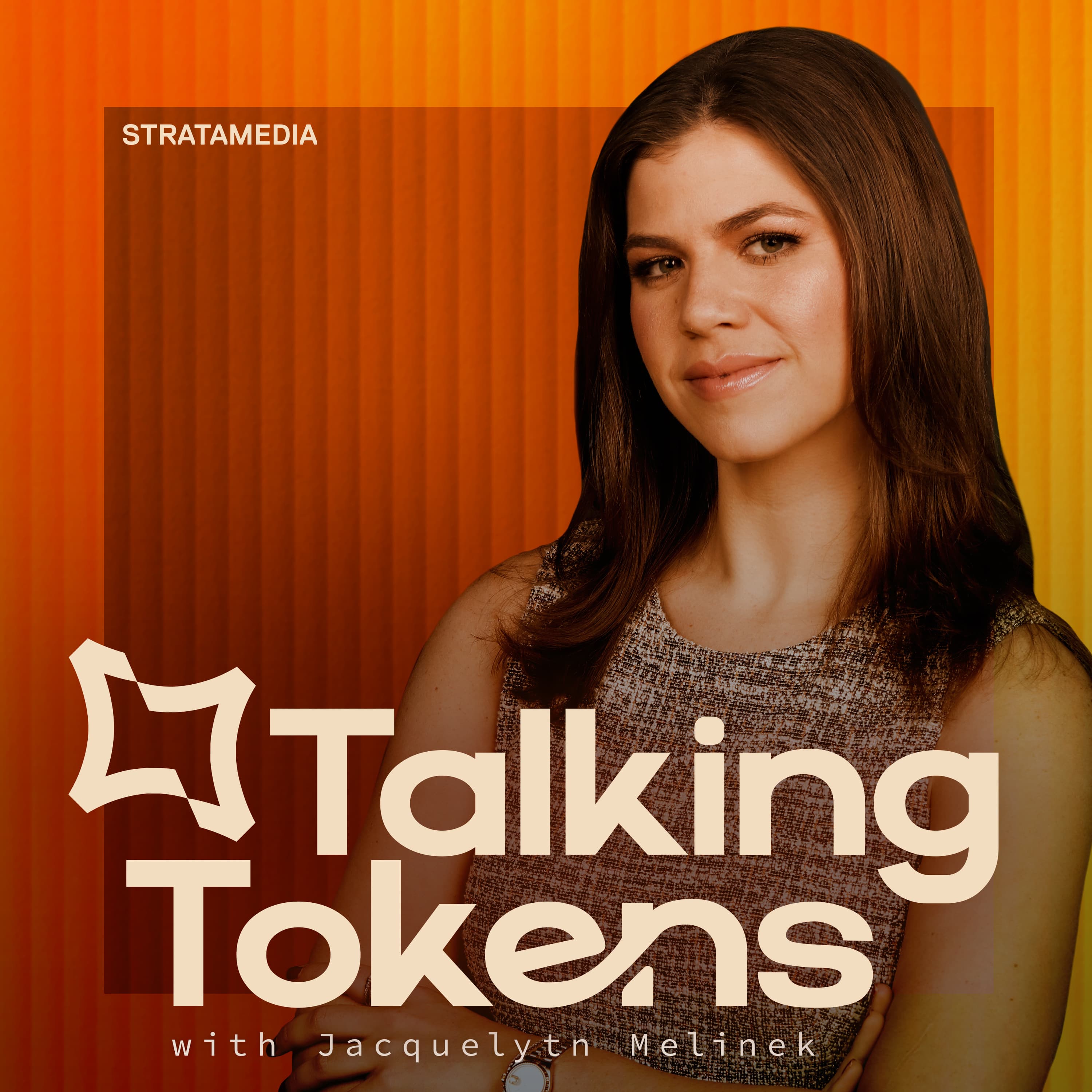
Talking Tokens is a podcast focused on interviews with crypto leaders, startups, market participants, and up-and-coming founders changing the industry. Hosted by Jacquelyn Melinek, the show publishes on Tuesdays and Thursdays across YouTube, Spotify, Apple Podcasts, X, and more.

New episodes tue & thu

Latest Episode

What's Overhyped, Underhyped, and Actually Happening in Crypto Right Now

0:000:00

All Episodes(12+)

What's Overhyped, Underhyped, and Actually Happening in Crypto Right Now
39:48
May 12, 2026

What's Overhyped, Underhyped, and Actually Happening in Crypto Right Now

In this special episode of Talking Tokens, Jacquelyn Melinek sits down with eight crypto leaders at an event in Miami hosted by StrataMedia alongside GSR and Alpaca for a rapid-fire mini interview series. Each guest is asked a similar set of questions: what their company is working on, how they describe the state of the crypto market, whether bearish sentiment is overhyped, what they would tokenize if they could tokenize anything, and what else they're paying attention to that listeners should be watching too. Guests include Asheesh Birla (CEO, Evernorth), Phil Fogel (CEO and co-founder, Cork Protocol), Neil Chopra (head of strategy and BD, Fireblocks), Scott Dykstra (co-founder and CTO, Space and Time), David Reising (founder and CEO, Lotus Protocol), Yoshi Yokokawa (co-founder and CEO, Alpaca), Tom Murphy (head of communications, Securitize), and Jakob Palmstierna (president, GSR). Answers range from wanting to tokenize chickens and avocados to entire balance sheets, and the through line is clear: institutions are here, the infrastructure is maturing, and the people still building through a tough market are the ones who will define what comes next. TIMESTAMPS (00:00) Intro (00:32) Asheesh Birla, CEO of Evernorth, on active XRP treasury management and tokenizing compute (05:48) Phil Fogel, CEO and co-founder of Cork Protocol, on risk infrastructure DeFi is still missing (12:08) Neil Chopra, head of strategy and BD at Fireblocks, on convergence of crypto native and traditional markets (18:10) Scott Dykstra, co-founder and CTO of Space and Time, on its new institutional Virtual Vvaults and decentralization after exploits (21:56) David Reising, founder and CEO of Lotus Protocol, on tranched lending and DeFi insurance (24:36) Yoshi Yokokawa, co-founder and CEO of Alpaca, on tokenization infrastructure and the paradigm shift ahead (28:11) Tom Murphy, head of communications at Securitize, on its new Jump and Jupiter partnership, Computershare announcement, and tokenized stocks (34:38) Jakob Palmstierna, president of GSR, on market structure evolution and tokenized equities trading 24/7 ESSENTIALS You can subscribe to the podcast on Spotify, Apple or YouTube. If you enjoy the show, please leave a review — it really helps. Spotify: https://open.spotify.com/show/0LOgWxIQ0NnNUD5eXsSuoZ Apple Podcasts: https://podcasts.apple.com/us/podcast/talking-tokens/id1743669141 Follow us on X Jacquelyn: https://twitter.com/jacqmelinek Talking Tokens: https://twitter.com/_TalkingTokens Follow us on Instagram https://www.instagram.com/_talkingtokens/ Note: This podcast is for informational purposes only. Views shared are opinions, not financial advice. The host or guests may have financial interests in discussed content.

How Crypto Is Slowly Taking Over Wall Street Territory | Kevin Beardsley
21:38
May 7, 2026

How Crypto Is Slowly Taking Over Wall Street Territory | Kevin Beardsley

In this episode of Talking Tokens, Jacquelyn Melinek does an exclusive interview with Kevin Beardsley, the new head of institutional growth at Jito Foundation, in his first interview since announcing the role. Kevin, who previously held senior positions at Kraken and Ctrl Wallet, explains why institutions want Solana exposure but still struggle to actually use the technology, and how the 18-month education process behind every big institutional deal is invisible from the outside. He walks through the process of liquid staking tokens solving the trade-off between earning yield and maintaining capital efficiency, why crypto-native companies are increasingly taking territory from traditional banks rather than the other way around, and what Jito's institutional integrations with Anchorage, FalconX, and others actually look like in practice. The conversation also covers why meme coins created real perception damage for institutional adoption, the branding problem crypto still hasn't fixed, and why AI-enabled wallets are the next thing worth watching. TIMESTAMPS (00:00) Intro (00:33) How Xin defines tokenization (02:46) GSR's origin story as a market maker for Ripple's XRP in 2013 (06:00) How options evolved from a backwater to a core crypto market (09:12) The crypto gap GSR is trying to fill: building a full-service investment bank (14:29) Acquisitions of Architech and Autonomous and his bear market M&A thesis (17:27) Why the infrastructure bridge between traditional finance and onchain markets still needs work (21:24) Who tokenization actually serves: the underbanked, 24/7 traders, and AI agents (24:28) Will tokenized assets steal market share from bitcoin over time? (27:57) Stablecoin proliferation post-Genius Act and the yield pass-through debate (30:13) How GSR's role evolves as more real world assets get tokenized (33:49) Tokenized equities: wrapped vs issuer-led approaches and what's winning (41:17) Standard Chartered Ventures investment and what banking rails unlock for crypto (49:46) What Xin is watching: AI and blockchain intersection (52:07) Final advice: grit, patience, and keep building through the lows ESSENTIALS You can subscribe to the podcast on Spotify, Apple or YouTube. If you enjoy the show, please leave a review — it really helps. Spotify: https://open.spotify.com/show/0LOgWxIQ0NnNUD5eXsSuoZ Apple Podcasts: https://podcasts.apple.com/us/podcast/talking-tokens/id1743669141 Follow us on X Jacquelyn: https://twitter.com/jacqmelinek Talking Tokens: https://twitter.com/_TalkingTokens Follow us on Instagram https://www.instagram.com/_talkingtokens/ Note: This podcast is for informational purposes only. Views shared are opinions, not financial advice. The host or guests may have financial interests in discussed content.

Tokenization Will Eat Capital Markets. Here's How. | Xin Song
55:34
May 5, 2026

Tokenization Will Eat Capital Markets. Here's How. | Xin Song

In this episode of Talking Tokenization, Jacquelyn Melinek speaks with Xin Song, CEO of GSR, about how the firm is evolving from a crypto market maker into a full-service digital asset investment bank. Xin, who started his career at BlackRock before later running his own crypto derivatives hedge fund and joining GSR in 2019, explains why tokenization will eat the capital markets world and why the firm acquired Architech and Autonomous to build end-to-end advisory, origination, and distribution capabilities. He walks through how GSR got its start as a market maker for Ripple, how options and prediction markets are converging to unlock new liquidity, and why the real tokenization opportunity is distributing fund products to crypto-native foundations rather than trying to bring traditional institutions onchain. The conversation covers the Standard Chartered Ventures investment and what banking rails unlock for crypto, why the wrapped equity model is winning over issuer-led approaches, and how he sees the current altcoin drawdown as worse than post-FTX - by some measures. This episode is sponsored by Securitize, the proven leader in tokenized funds, equities, and private markets. Discover more at securitize.io. TIMESTAMPS (00:00) Intro (00:33) How Xin defines tokenization (02:46) GSR's origin story as a market maker for Ripple's XRP in 2013 (06:00) How options evolved from a backwater to a core crypto market (09:12) The crypto gap GSR is trying to fill: building a full-service investment bank (14:29) Acquisitions of Architech and Autonomous and his bear market M&A thesis (17:27) Why the infrastructure bridge between traditional finance and onchain markets still needs work (21:24) Who tokenization actually serves: the underbanked, 24/7 traders, and AI agents (24:28) Will tokenized assets steal market share from bitcoin over time? (27:57) Stablecoin proliferation post-Genius Act and the yield pass-through debate (30:13) How GSR's role evolves as more real world assets get tokenized (33:49) Tokenized equities: wrapped vs issuer-led approaches and what's winning (41:17) Standard Chartered Ventures investment and what banking rails unlock for crypto (49:46) What Xin is watching: AI and blockchain intersection (52:07) Final advice: grit, patience, and keep building through the lows ESSENTIALS You can subscribe to the podcast on Spotify, Apple or YouTube. If you enjoy the show, please leave a review — it really helps. Spotify: https://open.spotify.com/show/0LOgWxIQ0NnNUD5eXsSuoZ Apple Podcasts: https://podcasts.apple.com/us/podcast/talking-tokens/id1743669141 Follow us on X Jacquelyn: https://twitter.com/jacqmelinek Talking Tokens: https://twitter.com/_TalkingTokens Follow us on Instagram https://www.instagram.com/_talkingtokens/ Note: This podcast is for informational purposes only. Views shared are opinions, not financial advice. The host or guests may have financial interests in discussed content.

Talking Tokenization EXCLUSIVE: BlackRock Digital Assets Director Shares Strategy for Tokenization, Bitcoin Stablecoins, and More | Max Stein
39:56
April 30, 2026

Talking Tokenization EXCLUSIVE: BlackRock Digital Assets Director Shares Strategy for Tokenization, Bitcoin Stablecoins, and More | Max Stein

In this episode of Talking Tokenization, Jacquelyn Melinek speaks with Max Stein, a director on the digital assets team at BlackRock, about how the firm translates crypto and tokenization ideas into actual products, and why tokenized cash still has a long way to run. Max, who previously spent four years at ConsenSys and invested at Sino Global Capital before joining BlackRock, explains how the firm's tokenization work actually accelerated after the FTX collapse, and why its BUIDL fund was designed to prove that tokenization could be commercial rather than just a proof of concept. He walks through how BlackRock chose Securitize over other tokenization platforms, why stablecoins and tokenized money market funds are complementary as the payment and savings assets of crypto, and why the real growth driver for stablecoins will be non-crypto use cases. The conversation covers why DeFi exploits shook $15 billion out of lending markets and what that means for tokenized asset design, how AI agents may prefer onchain rails over traditional ones, and why privacy solutions will eventually be necessary for institutional scale. This episode is sponsored by Securitize, the proven leader in tokenized funds, equities, and private markets. Discover more at securitize.io. TIMESTAMPS (00:00) Intro (01:18) How Max defines tokenization and his role at BlackRock (01:40) How BlackRock goes from idea to product in digital assets (03:16) Regulatory environment and how it affects the pace of product development (05:21) Stablecoins at BlackRock: reserve management and internal use (06:17) Why BlackRock chose Securitize and how BUIDL was designed (07:54) How the FTX collapse actually accelerated BlackRock's tokenization work (08:54) Why tokenized cash is still the biggest opportunity (14:09) The shift from private chains to public networks and the hybrid model (22:17) Stablecoins as utility: programmable money, flash loans, and same-rail settlement (27:36) His thoughts on DeFi exploits, contagion, and what it means for tokenized asset design (33:13) How AI agents may prefer onchain rails and accelerate crypto adoption (38:50) Final advice: small decisions shape whether a product scales or sits on a shelf ESSENTIALS You can subscribe to the podcast on Spotify, Apple or YouTube. If you enjoy the show, please leave a review — it really helps. Spotify: https://open.spotify.com/show/0LOgWxIQ0NnNUD5eXsSuoZ Apple Podcasts: https://podcasts.apple.com/us/podcast/talking-tokens/id1743669141 Follow us on X Jacquelyn: https://twitter.com/jacqmelinek Talking Tokens: https://twitter.com/_TalkingTokens Follow us on Instagram https://www.instagram.com/_talkingtokens/ Note: This podcast is for informational purposes only. Views shared are opinions, not financial advice. The host or guests may have financial interests in discussed content.

Inside PayPal’s Bet on Stablecoins | May Zabaneh
29:04
April 28, 2026

Inside PayPal’s Bet on Stablecoins | May Zabaneh

In this episode of Talking Tokens, Jacquelyn Melinek speaks with May Zabaneh, SVP and GM of Crypto at PayPal, about why today’s payment systems still suffer from hidden inefficiencies and how stablecoins are emerging as the next layer of financial infrastructure. May explains that while payments today work, they remain slow, costly, and fragmented especially across borders. She breaks down how stablecoins enable faster, cheaper, and more flexible global transactions, and why their real impact may come not from user-facing products, but backend rails powering money movement. The conversation explores what “programmable money” actually means, how agent-driven commerce could automate transactions, and why simplicity and trust are the biggest barriers to adoption. Maye also shares where stablecoins are already working at scale, from peer-to-peer payments to global payouts and how businesses benefit from faster settlement and improved capital efficiency. They also discuss generational shifts in crypto adoption, the role of stablecoins in emerging markets, and why access to stable currency is becoming increasingly important globally. The episode closes with how PayPal is approaching the space differently: focusing on PYUSD distribution, real-world usage, and integrating stablecoins into everyday financial systems. TIMESTAMPS  (00:00) Introduction (02:13) PayPal’s Hidden Advantage in Crypto (04:38) Payments Are “Easy”… But Still Messy (07:34) The Real Stablecoin Unlock: Cross-Border Efficiency (10:49) Paypal’s outlook on Stablecoins (13:21) Forgd Ad (13:46) The Inflection Point With: Programmable Money (15:54) The First Real Use Case of Agents + Payments (20:57) The Trust Barrier (And How It Breaks) (24:59) The Business Case For: Margins, Speed, and Survival (26:49) The Endgame: Invisible Financial Infrastructure (28:02) PayPal vs The Broader Stablecoin Market ESSENTIALS You can subscribe to the podcast on Spotify, Apple or YouTube. If you enjoy the show, please leave a review — it really helps.  Spotify: https://open.spotify.com/show/0LOgWxIQ0NnNUD5eXsSuoZ  Apple Podcasts: https://podcasts.apple.com/us/podcast/talking-tokens/id1743669141  Follow us on X Jacquelyn: https://twitter.com/jacqmelinek  Talking Tokens: https://twitter.com/_TalkingTokens  Follow us on Instagram https://www.instagram.com/_talkingtokens/ Note: This podcast is for informational purposes only. Views shared are opinions, not financial advice. The host or guests may have financial interests in discussed content.

Why Crypto Token Launches Are Broken and How to Fix Them | Shane Molidor
46:18
April 23, 2026

Why Crypto Token Launches Are Broken and How to Fix Them | Shane Molidor

In this episode of Talking Tokens, Jacquelyn Melinek speaks with Shane Molidor, founder and CEO of Forgd, about why token launches keep failing and what it would actually take to fix them. Shane, who previously led trading desks at Gemini, AscendEX, and FBG Capital before founding Forgd, explains why the structural gaps that bull markets used to hide are now fully exposed, and why founders, VCs, and public sale participants are all down bad as a result. He breaks down how IPOs are engineered with book building and underwriters while crypto launches rely on hope, retail speculation, and market makers that overpromise and underdeliver.He walks through how Forgd's free-to-use benchmarking tool tracks over 600 market maker engagements across 35+ desks, why data-driven RFQs are replacing voice brokerage, and how the exchange listing decision between Binance and OKEx can meaningfully change the shape of a token's chart. The conversation covers why institutional demand for new launches is near zero, why active market making is a glorified pump and dump, and what a fundamental shift to fundraising and book building would actually look like. TIMESTAMPS (00:00) Intro (01:06) State of token launches four months after crypto’s all-time highs (02:03) Structural gaps bull markets hide: who is getting hurt and how (05:23) Why IPOs are engineered and crypto launches are improvised (06:56) Should crypto adopt IPO-style book building and will it happen (08:41) Is now a good time to launch a token? The double-edged sword argument (10:27) Tools Forgd is seeing increased demand for right now (12:30) How Forgd’s benchmarking tool works: 600 engagements, 35+ market makers (15:43) How reputation plays into market maker selection and what changes it (17:46) Why data-driven RFQs are replacing legacy voice brokerage (21:39) Why Shane built Forgd after running a trading desk and seeing the gap firsthand (26:51) Top performing market makers on the leaderboard right now (29:35) How founders say the historical data has changed their decision making (30:43) Forgd’s 2026 roadmap: exchange listing tools, tokenomics simulations, and AI (33:40) Exchange listing strategy: what the data says about Binance vs OKEx vs Coinbase (39:30) How institutional demand for new launches has collapsed and what teams are doing instead (42:22) What the actual solution looks like: rethinking fundraising and book building (44:57) Final advice: use data, not gut instinct, when selecting market makersEpisodes air every Tuesday and Thursday on YouTube, Spotify, Apple Podcasts, X and more. For more updates, subscribe to the Talking Tokens newsletter here: https://talkingtokens.beehiiv.com/ And follow us on X: Jacquelyn: https://twitter.com/jacqmelinek Talking Tokens: https://twitter.com/_TalkingTokens Token Relations: https://twitter.com/Token_Relations This podcast is built by Token Relations. Please note that this podcast is for informational purposes only and any views shared by anyone on the show are opinions, not financial advice. The host or guests may have a direct or indirect financial interest in content mentioned in this episode.

Most RWAs Are Built Wrong | Ayyan Rahman
42:26
April 21, 2026

Most RWAs Are Built Wrong | Ayyan Rahman

In this episode of Talking Tokens, Jacquelyn Melinek speaks with Ayyan Rahman, co-founder and chief growth officer at OnRe, about why most real-world asset (RWA) projects in crypto are fundamentally misaligned with how DeFi actually works.Ayyan explains that tokenization alone isn’t enough and that many RWAs today function more like repackaged traditional finance than truly composable on-chain assets. He breaks down why this creates a risk of “Wall Street exit liquidity,” and what it actually takes to build an asset that integrates properly into DeFi systems.The conversation explores why reinsurance offers a unique source of uncorrelated yield, how tokenization can unlock more efficient capital scaling, and why liquidity, redemption mechanics, and risk modeling need to be rethought for on-chain markets.They also discuss the impact of Drift Protocol’s exploit on market confidence, what stress reveals about DeFi systems, why the idea of “risk-free yield” is flawed, and how institutional capital is evaluating onchain opportunities. The episode closes with a broader look at where crypto is heading from speculative markets toward more structured, resilient financial systems built around real assets.This episode is a part of the Solana Sessions campaign that Token Relations and the Talking Tokens podcast are doing, diving into founders’ journeys and startups building on Solana. Check out the accompanying newsletter on https://www.token-relations.com/investor-updates/all?network=Solana TIMESTAMPS 00:00 Introduction00:32 The Tokenization Illusion01:59 Tokenization vs Reality03:15 Why Reinsurance Actually Matters06:22 The Real Unlock: Scaling Capital09:05 Building a DeFi-Compatible Asset12:14 What Breaks DeFi Under Stress17:13 The Question That Actually Matters22:07 Redefining Risk in DeFi23:49 The Yield Trap29:06 Best Gameplan for Growth36:37 Where Adoption Actually Comes FromEpisodes air every Tuesday and Thursday on YouTube, Spotify, Apple Podcasts, X and more.For more updates, subscribe to the Talking Tokens newsletter here: https://talkingtokens.beehiiv.com/ And follow us on X: Jacquelyn: https://twitter.com/jacqmelinek Talking Tokens: https://twitter.com/_TalkingTokens Token Relations: https://twitter.com/Token_Relations This podcast is built by Token Relations.Please note that this podcast is for informational purposes only and any views shared by anyone on the show are opinions, not financial advice. The host or guests may have a direct or indirect financial interest in content mentioned in this episode.

Crypto Is Built on a Broken Internet | Tom Warner
34:49
April 16, 2026

Crypto Is Built on a Broken Internet | Tom Warner

In this episode of Talking Tokens, Jacquelyn Melinek speaks with Tom Warner, head of BD at DoubleZero, about why crypto is fundamentally limited by the public internet and how a new high-performance network layer could change everything. Tom explains how blockchains like Solana are hitting a performance ceiling not because of the chains themselves, but because of the infrastructure they run on. He breaks down how traditional finance firms rely on private, ultra-fast networks, why crypto has never had access to that level of connectivity, and how DoubleZero is building a decentralized alternative using subsea cables and high-performance routing. The conversation covers the launch of DoubleZero Edge, a real-time market data distribution platform designed to level the playing field for traders, why predictable latency matters more than raw speed, and how crypto still lags behind Wall Street in execution reliability. Tom also explains Solana “shreds” through a simple analogy, how multicast technology changes data distribution, and why inconsistent transaction timing is one of the biggest barriers to institutional capital. They also explore the future of 24/7 markets, the convergence of DeFi and traditional finance, the growing tension between banks and stablecoins, and what still needs to happen before crypto becomes the dominant financial system. 00:00 Introduction 00:33 What is Double Zero? 01:18 The Internet Is Slowing Crypto Down 02:47 The Hidden Network War You Never See 04:56 Solana’s Bottleneck Isn’t What You Think 06:35 What DoubleZero Edge Changes 10:22 This Analogy Explains Everything 19:16 Crypto Still Can’t Compete With Wall Street 23:32 What Happens When Markets Never Close 26:14 What’s Still Holding Crypto Back 31:52 Banks vs Stablecoins Is Just Getting Started 33:31 Where the Real Opportunities Are You can subscribe to the podcast on Spotify, Apple or YouTube. If you enjoy the show, please leave a review — it really helps. Spotify: https://open.spotify.com/show/0LOgWxIQ0NnNUD5eXsSuoZ Apple Podcasts: https://podcasts.apple.com/us/podcast/talking-tokens/id1743669141 Follow us on X Jacquelyn: https://twitter.com/jacqmelinek Talking Tokens: https://twitter.com/_TalkingTokens Follow us on Instagram https://www.instagram.com/_talkingtokens/ Note: This podcast is for informational purposes only. Views shared are opinions, not financial advice. The host or guests may have financial interests in discussed content.

Why Bitcoin Really Exists | Matt Luongo and Arthur Hayes
46:33
April 14, 2026

Why Bitcoin Really Exists | Matt Luongo and Arthur Hayes

In this episode of Talking Tokens, Jacquelyn Melinek speaks with Matt Luongo, co-founder of Mezo, and Arthur Hayes, CIO of Maelstrom and co-founder of BitMEX, about why they see bitcoin as the best collateral ever created and what it means to build a financial system on top of it. Matt explains how Mezo is rebuilding banking on bitcoin by letting holders borrow against their BTC rather than spend it, and why the lending market that blew up last cycle is now being rebuilt onchain with better infrastructure. Arthur shares why he treats bitcoin purely as a liquidity barometer, why governments will always choose to print rather than accept consequences, and why that makes bitcoin the only rational long-term savings asset. The two walk through what sustainable bitcoin yield actually looks like versus the token-printing schemes that failed in the last cycle and how institutions holding bitcoin on their balance sheet are deploying it. The conversation also covers Arthur's personal philosophy on leverage, Matt's experience financing his house with bitcoin, and why both guests believe people shouldn’t sell your BTC, just borrow against it.  Arthur Hayes: Instagram - https://www.instagram.com/cryptohayes/ LinkedIn - https://www.linkedin.com/in/arthur-hayes-b493b42/ Substack - https://cryptohayes.substack.com/ Web: https://www.cryptohayes.com X - https://x.com/cryptohayes Maelstrom Fund: LinkedIn: https://www.linkedin.com/company/maelstromfund Web - https://www.maelstrom.fund X - https://x.com/maelstromfund TIMESTAMPS (00:00) Intro (01:37) Why Matt built Mezo and what drew Arthur in with his big picture thesis (02:23) Arthur on Maelstrom, his family office, and why bitcoin needs to be useful (03:16) The state of bitcoin in 2026 (05:57) Bitcoin as a liquidity alarm: why it rises and falls with global money printing (08:47) Governments choosing bailouts over consequences, and how bitcoin can win (15:04) How to think about risk before going max long bitcoin (20:39) What macro patterns Arthur and Matt actually track (23:41) What sustainable bitcoin yield looks like versus token-printing schemes (25:24) Why a lot of bitcoin holders have never had access to standard DeFi (32:36) How institutions with BTC on their balance sheet are thinking about yield today (34:26) Why every DeFi exploit sets institutional adoption back and what changes that (37:03) Bitcoin as collateral: what it actually unlocks for holders (38:25) How Matt and Arthur each got into crypto (44:41) Is it too late to buy bitcoin? The conversations people are actually having now (45:55) Market outlook and price predictions ESSENTIALS You can subscribe to the podcast on Spotify, Apple or YouTube. If you enjoy the show, please leave a review — it really helps. Spotify: https://open.spotify.com/show/0LOgWxIQ0NnNUD5eXsSuoZ Apple Podcasts: https://podcasts.apple.com/us/podcast/talking-tokens/id1743669141 Follow us on X Jacquelyn: https://twitter.com/jacqmelinek Talking Tokens: https://twitter.com/_TalkingTokens Follow us on Instagram https://www.instagram.com/_talkingtokens/ Note: This podcast is for informational purposes only. Views shared are opinions, not financial advice. The host or guests may have financial interests in discussed content.

How Sky Is Building the Future of Stablecoin Yield With USDS | Rune Christensen
52:24
April 9, 2026

How Sky Is Building the Future of Stablecoin Yield With USDS | Rune Christensen

In this episode of Talking Tokens, Jacquelyn Melinek speaks with Rune Christensen, founder of Sky (formerly MakerDAO), about how the protocol is connecting hundreds of billions in idle stablecoins to institutional-grade yield through its Sky Agent Network. Rune explains why Sky evolved from MakerDAO, how USDS offers a native 3.75% savings rate with no lock-ups or fees, and why the protocol generated $338 million in annualized revenue with $158 million in net profit during recent market volatility. He walks through the Sky Agent Network enabling decentralized capital allocation across players like Spark, BlackRock, and Janus Henderson, why Sky deployed $1 billion into the first tokenized CLO, and how the protocol's seven-year track record makes it the only project institutions trust at scale. The conversation covers Sky's 74% USDS supply growth, why DeFi and TradFi will merge into one system, and how AI agents will drive the next phase of financial automation through blockchain-native stablecoins. TIMESTAMPS  00:00 – Intro 02:08 – Why Sky evolved from MakerDAO: rethinking DeFi for real-world scale 04:00 – Sky as infrastructure for global capital markets and capital formation 05:34 – How Sky Savings Rate works with 3.75% yield 07:06 – Sky Agent Network: decentralized businesses competing for best risk-adjusted returns 08:16 – Why Sky is different from Ethena and other yield-bearing stablecoins 11:49 – Spark protocol reaching $3 billion TVL as it grows in the lending market 14:03 – How real cash-flowing assets are coming onchain for the first time 18:32 – Why institutions like BlackRock and Janus Henderson work with Sky  27:18 – Sky’s Grove deploying $1 billion into first tokenized CLO by Janus Henderson and Centrifuge 30:10 – When DeFi and TradFi merge: stablecoins can act as super capital 34:13 – AI agents driving blockchain-native financial automation 37:35 – Sky's revenue: $338M annualized with $158M net profit during market volatility 39:05 – Growing stablecoin supply as the main opportunity ahead 50:18 – Rune's endgame: fully automating Sky through AI to finally step away ESSENTIALS  You can subscribe to the podcast on Spotify, Apple or YouTube. If you enjoy the show, please leave a review — it really helps. Spotify: https://open.spotify.com/show/0LOgWxIQ0NnNUD5eXsSuoZ Apple Podcasts: https://podcasts.apple.com/us/podcast/talking-tokens/id1743669141 Follow us on X Jacquelyn: https://twitter.com/jacqmelinek Talking Tokens: https://twitter.com/_TalkingTokens Follow us on Instagram https://www.instagram.com/_talkingtokens/ Note: This podcast is for informational purposes only. Views shared are opinions, not financial advice. The host or guests may have financial interests in discussed content.

Why AI Agents Will Manage Your DeFi Portfolio Before You Do | Vik Arun
41:37
April 7, 2026

Why AI Agents Will Manage Your DeFi Portfolio Before You Do | Vik Arun

In this episode of Talking Tokens, Jacquelyn Melinek speaks with Vik Arun, co-founder of Superform, about why DeFi was always heading toward automation and why AI agents not humans are the natural managers of onchain portfolios. Vik, who previously co-led a $100M DeFi and yield fund at BlockTower Capital before launching Superform in 2022, explains how the protocol evolved from a yield marketplace into a user-owned neobank, and why he believes the goal is to replace banks entirely rather than work alongside them. He walks through Superform's UP token launch, why 85% of airdrop recipients sold immediately, and what teams getting ready to TGE should learn from that experience. The conversation covers the two paths left for software companies in the age of AI, and why the only thing that can stop crypto's future is believers burning themselves out. TIMESTAMPS (00:00) Intro (01:15) How Vik is using AI across Superform and what it means for team structure (03:18) Two paths for software companies: fully embrace AI or settle for margins (07:45) Superform's evolution from yield marketplace to user-owned neobank (09:12) Why DeFi was always heading toward automation, not human management (10:51) How AI agents will manage vault strategies and what guardrails are needed (11:00) Where banks can't compete and what user-owned finance actually means (14:20) Self-custody: why some people genuinely don't want it and what that costs them (15:02) The Clarity Act and why banning stablecoin yields through banks could be great for DeFi (18:00) Will banks acquire DeFi protocols or will DeFi replace them? (19:08) Superform's end goal: replace the banks (23:27) Why Superform launched its UP token in a tough market (24:34) Core governance capabilities and the first three improvement proposals (26:09) Token launch lessons: after 85% of recipients sold immediately, distribution is everything (29:03) B2C vs B2B: mobile app for consumers, super vaults for institutions (30:52) Why this cycle may be the first where institutions lead retail into DeFi (31:38) 2026 roadmap: Android launch, credit card, and agentic vault managers (39:12) Final advice: the believers who stay will build what matters ESSENTIALS You can subscribe to the podcast on Spotify, Apple or YouTube. If you enjoy the show, please leave a review — it really helps. Spotify: https://open.spotify.com/show/0LOgWxIQ0NnNUD5eXsSuoZ Apple Podcasts: https://podcasts.apple.com/us/podcast/talking-tokens/id1743669141 Follow us on X Jacquelyn: https://twitter.com/jacqmelinek Talking Tokens: https://twitter.com/_TalkingTokens Follow us on Instagram https://www.instagram.com/_talkingtokens/ Note: This podcast is for informational purposes only. Views shared are opinions, not financial advice. The host or guests may have financial interests in discussed content.

How RockawayX Is Building the Actively Managed DeFi Vault | Samantha Bohbot
44:01
April 2, 2026

How RockawayX Is Building the Actively Managed DeFi Vault | Samantha Bohbot

In this episode of Talking Tokens, Jacquelyn Melinek speaks with Samantha Bohbot, partner and chief growth officer at RockawayX, about why DeFi vaults have evolved from simple yield products into the foundation for actively managed, institutional-grade credit strategies. Samantha, who spent nearly four years as VP of growth at DCG before joining RockawayX, explains how the firm allocates over $2 billion across venture, liquid tokens, and onchain credit, and why it launched its own vaults on Morpho and Camino after spending years as one of the largest depositors into these products itself. She walks through what separates a serious vault from a commoditized one, why credit underwriting and risk infrastructure matter more than yield numbers, and how AI agents could reshape how capital flows into DeFi. The conversation also covers the Resolve exploit, why prediction markets are overhyped relative to actual usage, how to spot confirmation bias in crypto venture, and why building real financial infrastructure takes longer than a hackathon. TIMESTAMPS (00:00) Intro (01:14) Samantha's background at DCG and path to RockawayX (01:49) What RockawayX is: venture, liquid tokens, credit fund, and infrastructure (03:11) Why vaults are the next stage of the DeFi promise (05:24) How RockawayX differentiates its vault strategy from the crowd (07:22) Why credit underwriting and risk infrastructure are what separate real vaults (08:21) Why RockawayX decided to build vaults itself rather than wait (09:03) How the first RWA mixed pool works (13:37) Generative finance and how AI agents change vault UX and product fit (16:19) Embedding vaults into fintech products to reach non-crypto users (19:45) The Resolv exploit: how the attack worked and what curators got right (22:30) RockawayX's 2026 priorities and where to allocate time and resources (26:02) Why prediction markets are getting too much attention (27:14) Running a market-neutral strategy on Polymarket and its liquidity limits (33:16) Confirmation bias in crypto venture: pitching decks instead of businesses (40:09) OCC charters and the future of crypto banking regulation (42:37) Final advice: trust your gut on people and ideas You can subscribe to the podcast on Spotify, Apple or YouTube. If you enjoy the show, please leave a review — it really helps. Spotify: https://open.spotify.com/show/0LOgWxIQ0NnNUD5eXsSuoZ Apple Podcasts: https://podcasts.apple.com/us/podcast/talking-tokens/id1743669141 Follow us on X Jacquelyn: https://twitter.com/jacqmelinek Talking Tokens: https://twitter.com/_TalkingTokens Follow us on Instagram https://www.instagram.com/_talkingtokens/ Note: This podcast is for informational purposes only. Views shared are opinions, not financial advice. The host or guests may have financial interests in discussed content.

Beheerd door

© 2026 Solana Foundation.
Alle rechten voorbehouden.
Blijf Verbonden