
Solana Ecosystem Roundup: April 2026
Three threads dominated April. Institutional commitments moved deeper into bank and card-issuer infrastructure. Tokenized asset coverage expanded beyond credit and equity into pre-IPO names, gold, and mortgages. The Solana Foundation announced a coordinated platform-level security program in early April, and weeks later provided USDT liquidity support to Aave following a separate cross-network DeFi incident.
Network-level numbers from the closing of Q1 2026 anchored these shifts.
- Solana recorded approximately 167 million monthly SPL token-holder addresses in April, an all-time high
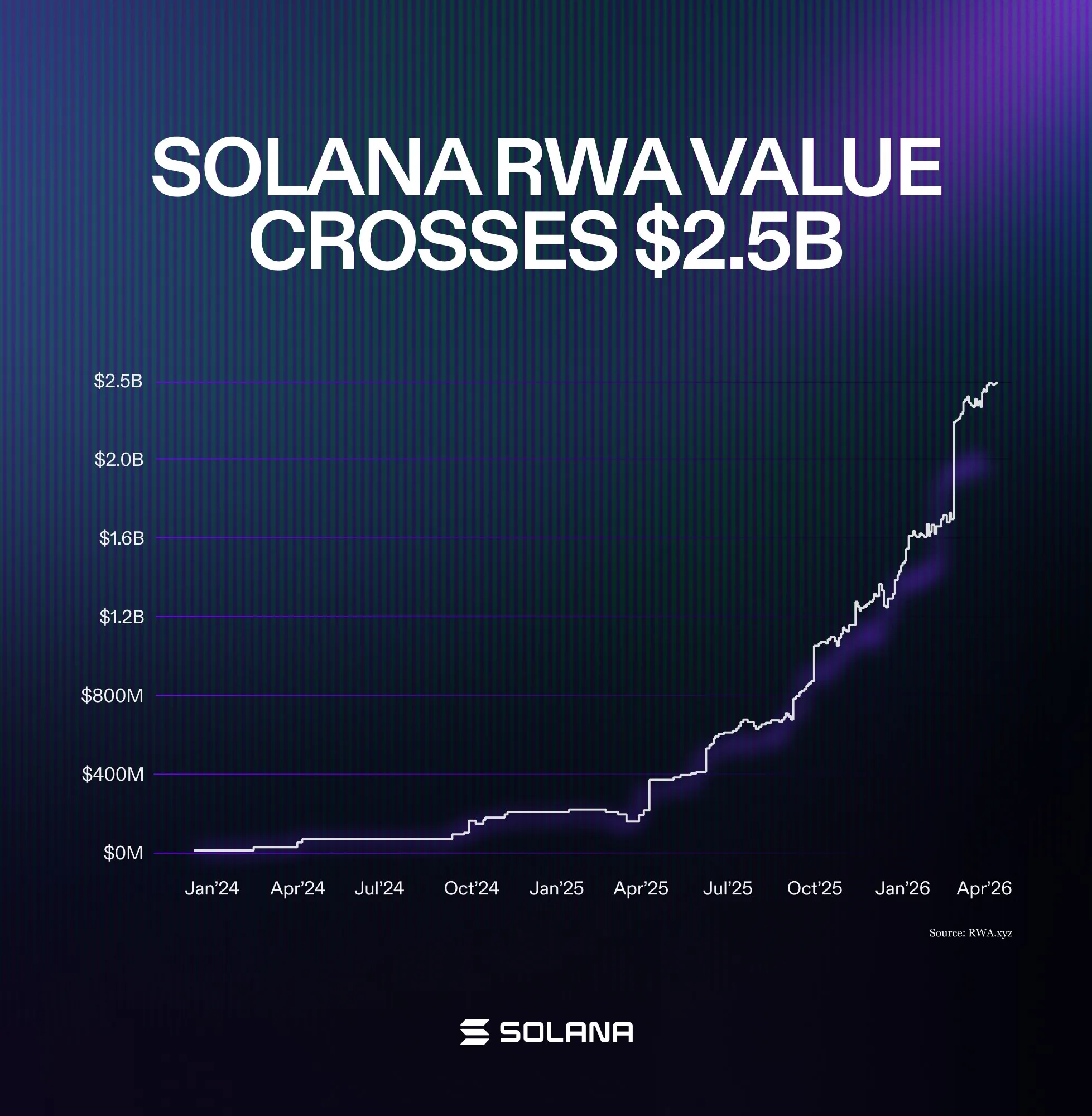
- Total RWA value on Solana reached over $2.5 billion by month's end
Institutional and Enterprise Adoption
Several institutional and enterprise commitments anchored the month.
B2C2, the SBI Holdings-backed institutional crypto trading firm, designated Solana as its primary network for institutional stablecoin settlement.
SoFi announced Big Business Banking, an enterprise fiat and stablecoin banking service expected to leverage Solana alongside other blockchain networks. SoFi is a nationally chartered bank with ~15 million members and over $50 billion in assets.
Shinhan Card, South Korea's largest card issuer with 28 million cardholders, signed an MOU with the Solana Foundation to build stablecoin payments solutions.
Other commitments included Anchorage Digital adding Marinade-powered Solana staking for regulated custody clients, Singapore Gulf Bank launching USD-to-USDC conversion with Solana as the settlement rail, OCBC partnering with Lion Global Investors and DigiFT to launch GOLDX (a tokenized gold fund with approximately $526 million in AUM), and Coinbase Asset Management launching CUSHY (a stablecoin credit fund with a tokenized share class) via Superstate.
The common thread is regulated financial institutions using Solana for settlement, custody, tokenization, or payments.
Tokenized Assets
Access to tokenized equity, pre-IPO, and leverage products is subject to jurisdiction and platform eligibility.
Solana's tokenized asset stack scaled and broadened in April. Stable issued what it described as the first blockchain-native mortgage on Solana, extending the asset class beyond credit, equity, and gold.
Tokenized equity activity expanded across pre-IPO names, leverage products, and lending collateral. Securitize and Currenc Group (Nasdaq: CURR) announced a partnership to tokenize Currenc shares on Solana.
Bitget concluded its preSPAX launch sale on IPO Prime, exclusively on Solana, with 14K participants committing $177 million, nearly 3x oversubscribed. Jupiter Lend added SPYx, QQQx, NVDAx, and TSLAx as collateral, with leverage available where eligible. PreStocks recorded over $750 million in cumulative volume across pre-IPO names. AviciMoney launched a basket of pre-IPO names including SpaceX, OpenAI, Anthropic, Neuralink, Kalshi, Anduril, and Polymarket via PreStocks, where access permits.
Loopscale shipped Loops 2.0, with a new execution engine, expanded asset coverage for RWAs and bridged assets, and async settlement support designed to make every newly tokenized asset Loopable from day one. Loopscale's Deposit-Backed Lending also went live with Jupiter Lend positions as collateral.
Cross-chain asset additions: Sunrise DeFi added SUI, MEGA (MegaETH), CHZ (Chiliz), BLEND (Fluent), and CHIP (USD.AI) to Solana in April. Ripple's wXRP went live on Solana, enabled by Hex Trust and LayerZero.
Stablecoins and Payments
Distribution at the consumer surface deepened. Meta added support for USDC payments on Solana for creators in Colombia and the Philippines. MetaMask Card added support for Solana USDC for eligible U.S. users, spendable anywhere Mastercard is accepted. USDC cross-chain forwarding to Solana went live via Circle's CCTP and Bridge Kit, removing a step from cross-chain USDC settlement. Solflare added Fast Crypto Buys via Coinbase Apple Pay onramps.
Also in April: StraitsX launched XGSD and XUSD on Solana with direct issuance and onchain SGD-USD FX; KAST launched USD Prime Vault using USDKy with custody held in a Solana wallet; KOSH launched as a global financial account for freelancers and creators; Tether support went live in Ramp.
Agentic Commerce and x402
The Solana Foundation joined the x402 Foundation at the Linux Foundation, formalizing institutional support for the agentic payment standard. The Foundation also released Solana Agent Skills, a set of pre-built capabilities that drop into AI tools so agents can interact with Solana through one-line installs.
Payment rails for agentic commerce extended. MoonPay eliminated all fees on stablecoin onramps for agents. Crossmint announced agent payments via Mastercard through lobstercash. OKX introduced APP, the Agent Payments Protocol, an open standard for agents to handle negotiation, payments, escrow, and dispute resolution. atxp.ai migrated to x402 and the Machine Payments Protocol on Solana. MoonPay Commerce reported over $40 million in single-payment volume since its October 2025 launch, with 88% on Solana.
Application surfaces also expanded, with new launches across agent-native trading (DFlow Agent CLI, PenguBot for Telegram), tokenized agent assets (Metaplex Agent Tokens), autonomous agents (Clawpump's Eternal Agents, THEA's predictive AI for risk markets), and consumer wallet AI (LanaAI, Blueprint AI's Compactor).
DeFi and Trading
The month's DeFi launches focused on lending depth, better execution, and new market formats.
Lending consolidation continued. Project 0's Prime engine now covers approximately 98% of Solana lending TVL with the integration of Jupiter Lend, spanning 8 isolated markets across Kamino, Drift, Jupiter Lend, and P0-native. Jupiter Offerbook launched in private beta, introducing fixed-term peer-to-peer lending without oracles or price-based liquidations.
Trading and matching infrastructure deepened. Titan Exchange shipped DART, a routing engine that enforces price priority by always filling with market makers offering the best price, alongside the DART API in beta. Manifest launched options markets supporting calls and puts on any token. Arkham launched Decentralized Trading on Solana with real-time tracking of recently launched tokens. Symbiosis added full Solana support for any-to-any token swaps with onchain routing powered by Raydium. Meteora released DAMM v2 Portfolio PNL with live position tracking. Humidifi launched Aquarium, a market-making system with public dashboards across pools, spreads, and metrics.
Prediction and conviction markets expanded. Ride Markets opened conviction markets where treasuries fund skilled traders, Vistadex introduced Claim Markets that translate public statements into prediction positions, and Jupiter announced a Telegram-native Prediction Bot.
Also in April: yoSOL crossed $1 million TVL three weeks from launch; Pods announced its Solana expansion to integrate Solana DeFi strategies into neobank infrastructure; Bulk released sub-accounts, native multisig, and isolated margin.
Protocol Infrastructure
Several major infrastructure components shipped in April. Anchor v1.0.0 launched as the first stable major release of the Solana program development framework. Triton One, Helius, Jupiter, Anza, and the Solana Foundation announced RPC 2.0, a multi-stage rebuild of Solana's read layer rolling out through 2026, designed to be faster, cheaper, and more expressive than the prior baseline.
DoubleZero Edge entered beta, providing dedicated shred-delivery infrastructure designed for low-latency market data delivery. DoubleZero captured 98.3% of Solana's non-European stake growth during its Phase II rollout. The Firedancer audit competition opened on Immunefi with a $1 million scaling reward pool running April 9 to May 9, targeting bugs in Firedancer V1.
Jump Crypto introduced the BAM Maker Priority plugin, the first plugin on its block-assembly framework. The plugin gives onchain market makers deterministic top-of-batch execution every 50ms, designed to compress spreads by removing the unpredictability of validator-side scheduling. Harmonic shipped streaming block delivery with configurable scheduling strategies.
Also in April: Tektonic released a high-throughput BigQuery table populated from validator exports; Nodit Datashare added Solana support; Alchemy committed a $20 million Solana infrastructure fund offering up to $25,000 in credits per team; OVHcloud joined the Solana ecosystem in partnership with Superteam Poland and Degen House.
Security and DeFi Resilience
Following the early-April Drift Protocol incident, the Solana Foundation announced a coordinated security program led by Asymmetric Research. STRIDE (Solana Trust, Resilience and Infrastructure for DeFi Enterprises) sets evaluation standards for Solana DeFi protocols and publishes a public repository of findings. Protocols above $10 million in TVL receive ongoing operational security and 24/7 threat monitoring funded by Foundation grants. Protocols above $100 million in TVL receive Foundation-funded formal verification.
Alongside STRIDE, the Solana Incident Response Network (SIRN) launched as a membership network of security firms providing real-time crisis response, available to all protocols and prioritized by TVL. Founding members include Asymmetric Research, OtterSec, Neodyme, Squads, and Zero Shadow.
Protocol-level security tools shipped. Kamino introduced Whitelisted Reserves, a smart-contract-level restriction that ensures Lending Vault funds can only allocate into verified reserves. Squads released three open-source multisig tools for Squads Protocol v4 covering review, verification, and monitoring workflows.
The Foundation also extended support beyond Solana. Following the April 18 KelpDAO and LayerZero rsETH bridge exploit, which enabled approximately $190 million in withdrawals from Aave markets using unbacked collateral, the Solana Foundation provided USDT liquidity to Aave as part of broader DeFi recovery efforts. Solana Foundation President Lily Liu framed the move as an effort to support the move towards open finance and open systems. The AAVE governance token also launched natively on Solana that same weekend.
Consumer Apps and Collectibles
Collectibles were a major consumer growth story in April, while wallets, mobile, and commerce products continued to broaden access.
April delivered $165 million in volume and $85 million in revenue for Collector Crypt, a single-month record for the platform.
Phygitals crossed $180 million in cumulative volume on Solana and executed an onchain buyback of a PSA 10 2004 Japanese Rocket Gang Strikes Back 1st Edition Torchic Gold Star card valued at approximately $50,000. Candy Digital announced its migration to Solana, beginning in May 2026.
The Helium Mobile Network reported over 3.5 million daily users. Solana Name Service opened public access to {yourname}.sol.site websites for any .sol domain owner. Phantom launched P&L tracking for Solana tokens. X launched its Cashtags feature with Solana token coverage powered by Dialect, Helius, Jupiter, and Birdeye.
Also in April: Solana Mobile concluded its hackathon with over 400 app submissions from builders in 66 countries; Jupiter Mobile recorded $890 million traded in March; Risedotrich crossed $100 million in volume across 200,000 transactions on its launchpad; Nomu launched Stores, an e-commerce platform built for wallets; IkonShop integrated with Shopify.
Looking Ahead
May opens with two immediate ecosystem milestones.
The Solana Frontier Hackathon closes submissions on May 11, 2026, with $2.5 million in venture funding from Colosseum and up to 10 startups expected to enter the next accelerator batch.
Candy Digital is also expected to begin migrating collectibles to Solana in May, adding another major consumer collectibles platform to the network. Meanwhile, applications are open for Solana Incubator Cohort 5, a three-month New York City program beginning in September 2026.
Closing Takeaway
April was less about one breakout narrative and more about Solana’s infrastructure becoming harder to separate from the products built on top of it.
Banks, card issuers, custodians, fintechs, and asset managers moved closer to using Solana for settlement, tokenization, staking, and payments. DeFi protocols deepened their lending and trading surfaces. Consumer apps pushed further into collectibles, wallets, mobile, and commerce. At the same time, the Foundation’s security work signaled that institutional growth now requires stronger shared standards, not just faster rails.