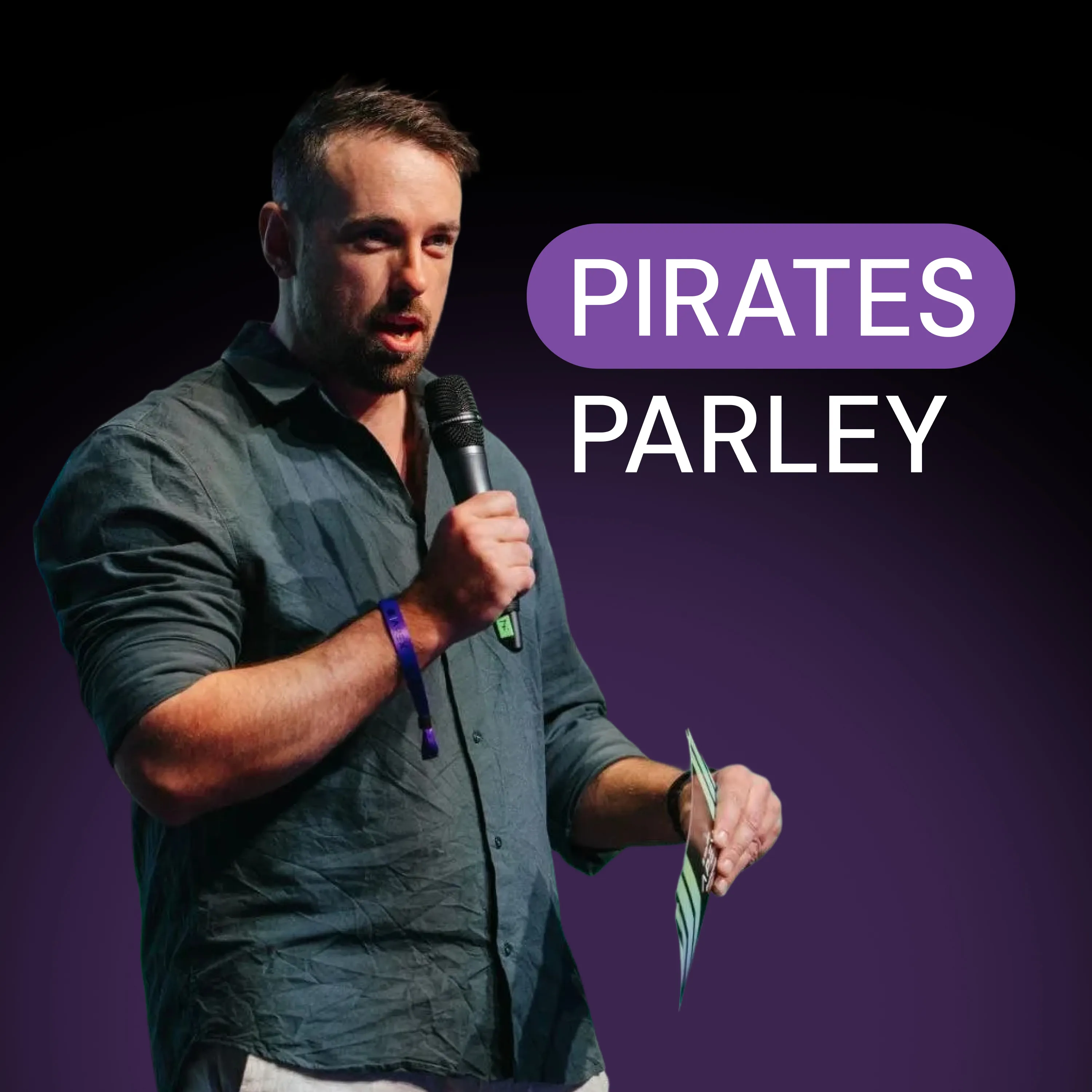
0% Interest Loans on Tokenized Stocks: The Two Pauls Behind Spout Finance
Two Pauls from Spout Finance join Pirates Parley — Dutch co-founders and childhood friends going on 24 years, building a lending protocol where you borrow at 0% interest against your tokenized equities. The trick: sell covered calls on the collateral to generate the yield lenders want, so borrowers get stock-backed liquidity without paying rate.We get into how the covered-call mechanic actually works, why they abandoned EVM's global fee market after building on Starknet and Aptos, what three months in the Solana Foundation Incubator was actually like (weekly sessions with Eman, a one-on-one with Nigel Eccles who exited FanDuel for $440M, Nick Ducoff as a repeat helper), and the multi-jurisdiction setup — US corp, BVI for RWA issuance, Panama for the lending piece — that's currently the price of doing this legally. We also cover DTCC-land vs on-chain market structure, transfer agent licenses, which kinds of MEV are actually load-bearing, DoubleZero and validator geography for a real global order book, and why building a company with your kindergarten friend works if you can fight and go get tacos afterwards.Also: why Rust is better than Solidity, and where NYSE-on-chain actually lands.Mainnet in ~1 month, larger go-to-market push ~2 months out. Test net access by pinging them on X or Telegram. Hiring BDs when go-to-market kicks off.
0:00 Welcome — Two Pauls from Spout Finance, 24 years of friendship1:22 Paul on Starknet privacy, Aptos in NYC, and finding co-founder Mark4:16 Why EVM's global fee market was a dealbreaker6:53 Paul's Bitcoin origin: a Call of Duty payout, then a smart-contract thesis8:50 Pivoting from corporate bonds to tokenized equities12:14 The pitch: 0% loans against tokenized stocks, funded by covered calls16:01 How lenders still earn when nobody's borrowing (T-bill backstop)19:11 Three months at the Solana Incubator: Iman weekly, Nigel Eccles from FanDuel24:24 Coming from Ethereum: how much hands-on help Solana gives DeFi teams27:22 Building with your kindergarten friend: fights, trust, and tacos after31:55 Chicken-and-egg: launching a lending protocol that needs both sides34:49 US corp, BVI, Panama — one protocol, three jurisdictions39:44 Transfer agents, NYSE-on-chain, and direct ownership vs the DTCC43:04 MEV on-chain vs Nasdaq, DoubleZero, and a global order book49:12 Audits, mainnet in a month, biggest fumbles, and why Rust beats Solidity
0% Interest Loans on Tokenized Stocks: The Two Pauls Behind Spout Finance
Velocity: Inside the Drift Rebuild, North Korea's Hack, and What "Good OPSEC" Actually Means
Inder Preet Singh, Doma: 1,600 New TLDs, $70M AI.com Deals, and What Happens to Your .sol
More from Pirates Parley
$250K in Hidden Fees: How Imperial Built a 1bp Perp DEX on Solana
Imperial started as a Jupiter Perps wrapper that just told you what you were actually paying. Jordan Prince built it after finding he'd paid a quarter of a million dollars in fees, part of it in swap charges the front end never reported. Now he and Hunter run Armada: a prop-AMM perp venue native to Solana with 1 basis point taker fees and books up to 20x deeper than the competition. We get into Jordan and Bartosz's early Solana Labs days (Metaplex, Candy Machine, the first hacker house in a Lisbon horse stable), Hunter's road from a DC lobbyist family to Teleport, the four perp ideas that flopped first, and why a failed MagicBlock L2 experiment pushed them to hedged, delta-neutral liquidity. Plus why traders stay loyal to more expensive venues: perp DEXs behave more like NFT collections than markets. Also: closing a $1.5M round from Foundation Capital a week before bankruptcy, and the no-paperwork $25K wire from Brian Long that bought them two more weeks. Trade at imperial.space. Armada needs an access code, so start in their Discord. Follow-ups and codes: t.me/piratesparley 0:00 Welcome — Imperial isn't just an aggregator anymore 2:11 Citadel hell to Solana Labs: Jordan, Bartosz and the first DeFi commits 4:00 The first hacker house, built overnight in a billionaire's horse stable 9:41 Hunter: lobbyist's kid, Ritz-Carlton basement, $15M for Teleport 17:13 Four failed perp ideas: BTC volatility perps and memes too dangerous to trade 20:14 $330K in trading profits and "Jupiter lies about fees" 24:54 People don't want choice, they want the perception of choice: routing explained 29:24 The MagicBlock L2 experiment that got their pool farmed 31:02 Armada: 1 basis point fees, and why 10x leverage turns 5 bps into 1% 34:06 Perp DEXs are NFT collections: why traders don't switch to cheaper venues 41:18 20x deeper books, hedged and delta neutral: how the prop AMM works 46:12 $1.5M from Foundation Capital, a week from bankruptcy, and Brian's $25K wire 54:25 "We are a premium RPC company": Helius vs Triton 57:39 How to get an Armada code, pre-IPO Anthropic perps, and gacha perp packs 1:02:01 Closers — Breakpoint, Telegram codes, and the Circular tease
"Go Hack That Bank": Asymmetric Research's CEO on Wormhole, Drift, and Bad OPSEC
Jonathan Claudius, CEO and co-founder of Asymmetric Research, started his first real pen-test after guys in suits picked him up at the airport, dropped him at a bank, and told him to go hack it. Twenty years later he's the person Solana calls when something blows up. We get into his path from breaking into banks to running offensive security at Mozilla, and why his second day at Jump Crypto was the day Wormhole got hacked. He explains why AR doesn't call itself an audit firm, and why AI knocked out the bottom of the audit market without touching the top: "when execution is free, you end up with a huge human attention bottleneck." He also walks through STRIDE and SIRN, the proactive and reactive programs AR runs with the Solana Foundation. By his count, about 60% of Solana TVL has gone through STRIDE, and SIRN has saved north of $5M so far. Also: wrench attacks and why AR now runs protective services with an ex-Secret Service agent, Lazarus versus the 14-year-old with $200M, and the boring afternoon of policy work that would have prevented this year's biggest hacks. 0:00 Welcome — Jonathan from Asymmetric Research ("we're not an audit company") 1:34 From breaking into banks to Mozilla: what offensive security actually is 5:05 Day two at Jump Crypto: Wormhole gets hacked, and the 2.5-year recovery 8:37 Founding AR at Block Zero Amsterdam: "the first rule of BD is we don't sell anything" 13:18 Audit firm vs. security firm: being the inside guys, and "Be Boring" 16:53 AI ate the bottom of the audit market, and judgment is the new bottleneck 21:24 Can AI replace your auditor? Agreeable models and waves of AI psychosis 25:21 Re-audit every commit? Threat models, Mozilla's RRA, and where to start 32:10 STRIDE and SIRN: the Solana Foundation's proactive and reactive security programs 37:05 Is it always North Korea? Attribution, AI-enabled attackers, the 14-year-old with $200M 40:56 From leaky code to bad OPSEC: why 2026's big hacks were human failures 47:07 Wrench attacks, Tom's mustache, and AR's protective services 51:50 Eden's question: the bank bathroom trick and the "running man" 57:45 The question you should've asked: boring policy wins, hardware keys, branch protection 1:01:02 Pirates Parley Telegram + see you in London
Percolator: Toly's Risk Engine, Two Vibe-Coders, and the "Pump.fun for Perps
Squid and Dark are the two-person team behind Percolator — Solana's permissionless perps DEX built on Anatoly Yakovenko's open-sourced risk engine. Any token with a DEX pool gets a perp market, no gatekeeping. We get into how they CTO'd a rugged pump.fun token into an 8,500-person waitlist, why they've spent eight months and roughly $1,000 in Claude subscriptions instead of hiring, and what "formal verification" actually buys you when every market is isolated and no one steps in during a flash crash. Squid and Dark walk through the creator-stake model that filters out imbalanced markets, why they're deliberately targeting the pump.fun crowd first, and how OPSEC changes when your entire codebase is public in the AI era. Also: the name comes from a bad house track called "It's Time for the Percolator" — Toly picked it while listening to it — and apparently Squid drinks half as much coffee as I do. DevNet V2 lands end of September, then a raise, then an audit. Percolator is quoted at $300k+ to audit properly. Waitlist: percolator.trade/waitlist. Next week I'm off; the week after, Asymmetric Research on why audits cost what they cost. 0:00 Welcome — meet Squid and Dark from Percolator 1:00 Castle DAO recap and how tall Dark actually is (spoiler: not 6'7") 2:35 How Percolator came to be: CTOing a rugged pump.fun token 5:00 What Percolator is: permissionless perps for any DEX pool 8:20 Toly's role — he'll do the risk engine, nothing else 10:00 "Is Toly really that much of a dev?" — the AI-assisted question 11:10 Vibe-coding with 11 OpenClaw agents, then slowing back down 12:35 DevNet V2 end of month, then audit, then mainnet 19:25 Why the risk engine is different: formal verification and isolated markets 24:00 OPSEC in the AI era, spoofed emails, and never merging PRs 32:05 The case for open source: copiers fail, contributors help 38:30 Devil's advocate — is Percolator "pump.fun for perps"? 42:20 Closed beta, VCs, and the road to permissionless by end of 2027 50:00 Agentic trading and adopting Toly's risk engine changes 54:20 Where the name came from, 20 cups of coffee, and next week's tease